Part One
The creed of Ahl al-Sunnah wa-l-Jamāʿah in summary
First Issue: The Word Tafwīḍ in the Language and in the Sharīʿah
Tafwīḍ is the verbal noun of fawwaḍah: to hand over a matter to someone and leave the decision to him. The believer of Pharaoh’s family said: “And I entrust my affair (ufawwiḍu amrī) to Allah.” In creed the word is used in two senses, and the whole question turns on telling them apart.
The first is tafwīḍ of the modality (kayf): to affirm the attribute with its meaning, and to leave the knowledge of how it is to Allah. The Salaf went this way, and it is the meaning of Mālik’s saying that the istiwāʾ is known and its modality is unknown. The second is tafwīḍ of the meaning: to say that the words of the attributes have no meaning that we know, that they are like letters recited without understanding, and that their meaning is left entirely to Allah. The later Ashʿarīs attributed that position to the Salaf, and it is false in its attribution and false in itself.
Part Two
The explanation of the mufassirūn and the Salaf
Second Issue: The Verse of Āl ʿImrān, and What al-Ṭabarī Said of It
The whole of the mufawwiḍ’s case is hung on one verse. He says that the verses of the Attributes are the mutashābih, that the mutashābih is what none knows but Allah, and that therefore the Salaf consigned their meaning. So the verse itself is taken first, with what the imam of the mufassirūn said of it, in order.
Allah, the Exalted, said at the opening of Sūrat Āl ʿImrān:
It is He who sent down to you the Book; in it are verses that are decisive (muḥkamāt) — they are the foundation of the Book — and others that are ambiguous (mutashābihāt). As for those in whose hearts is deviation, they follow what is ambiguous in it, seeking discord and seeking its taʾwīl. And none knows its taʾwīl except Allah. And those firmly grounded in knowledge say: 'We believe in it; all of it is from our Lord.' And none take heed except people of understanding.
Sūrat Āl ʿImrān, 3:7 Read the verse (opens in a new tab)
The verse names the two kinds of verses and it blames those who follow what is ambiguous, seeking discord. It does not name the Attributes, and neither does anyone from the Companions in explaining it.
Al-Ṭabarī opened his discussion in Jāmiʿ al-Bayān as follows:
The people of interpretation differed over the interpretation of His saying: 'in it are verses muḥkamāt, they are the foundation of the Book, and others mutashābihāt' — over what the muḥkam of the verses of the Book is, and what the mutashābih is.
al-Ṭabarī, Jāmiʿ al-Bayān (ed. Shākir, Dār al-Tarbiyah wa-l-Turāth) 6/174
Source, chain and authenticity
Read the page in the source edition (opens in a new tab)
The whole page in Arabic
* * *
وقد اختلف أهل التأويل في تأويل قوله:"منه آيات محكمات هنّ أم الكتاب وأخَر متشابهات"، وما المحكم من آي الكتاب، وما المتشابه منه؟
فقال بعضهم:"المحكمات" من آي القرآن، المعمول بهن، وهنّ الناسخات أو المثبتاتُ الأحكامَ ="والمتشابهات" من آية، المتروك العملُ بهنّ، المنسوخاتُ.
ذكر من قال ذلك:
٦٥٧٣ - حدثني يعقوب بن إبراهيم قال، حدثنا هشيم قال، أخبرنا العوّام، عمن حدثه، عن ابن عباس في قوله:"منه آيات محكمات"، قال: هي الثلاث الآيات من ههنا: (قُلْ تَعَالَوْا أَتْلُ مَا حَرَّمَ رَبُّكُمْ عَلَيْكُمْ) [سورة الأنعام: ١٥١، ١٥٢] ، إلى ثلاث آيات، (١) والتي في"بني إسرائيل": (وَقَضَى رَبُّكَ أَلا تَعْبُدُوا إِلا إِيَّاهُ) [سورة الإسراء: ٢٣ - ٣٩] ، إلى آخر الآيات. (٢)
Al-Ṭabarī then gives the positions one by one, each with its reports from the Companions and the Followers, and the reader can count for himself how many of them name an attribute.
He said:
ذكر من قال ذلك
Some said: the muḥkamāt of the verses of the Qurʾān are those acted upon — the abrogating verses or those that establish rulings; and the mutashābihāt of its verses are those whose ruling has been abandoned — the abrogated ones. Those who said this: …
al-Ṭabarī, Jāmiʿ al-Bayān (ed. Shākir, Dār al-Tarbiyah wa-l-Turāth) 6/174
Source, chain and authenticity
Read the page in the source edition (opens in a new tab)
The whole page in Arabic
* * *
وقد اختلف أهل التأويل في تأويل قوله:"منه آيات محكمات هنّ أم الكتاب وأخَر متشابهات"، وما المحكم من آي الكتاب، وما المتشابه منه؟
فقال بعضهم:"المحكمات" من آي القرآن، المعمول بهن، وهنّ الناسخات أو المثبتاتُ الأحكامَ ="والمتشابهات" من آية، المتروك العملُ بهنّ، المنسوخاتُ.
ذكر من قال ذلك:
٦٥٧٣ - حدثني يعقوب بن إبراهيم قال، حدثنا هشيم قال، أخبرنا العوّام، عمن حدثه، عن ابن عباس في قوله:"منه آيات محكمات"، قال: هي الثلاث الآيات من ههنا: (قُلْ تَعَالَوْا أَتْلُ مَا حَرَّمَ رَبُّكُمْ عَلَيْكُمْ) [سورة الأنعام: ١٥١، ١٥٢] ، إلى ثلاث آيات، (١) والتي في"بني إسرائيل": (وَقَضَى رَبُّكَ أَلا تَعْبُدُوا إِلا إِيَّاهُ) [سورة الإسراء: ٢٣ - ٣٩] ، إلى آخر الآيات. (٢)
On this first view, which al-Ṭabarī reports from Ibn ʿAbbās among others, the mutashābih is what has been abrogated, and so it is a matter of rulings.
And he said:
ذكر من قال ذلك
Others said: the muḥkamāt of the verses of the Book are those in which Allah made firm the explanation of His lawful and His unlawful; and the mutashābih among them are those resembling one another in meaning even if their wording differs. Those who said this: …
al-Ṭabarī, Jāmiʿ al-Bayān (ed. Shākir, Dār al-Tarbiyah wa-l-Turāth) 6/176
Source, chain and authenticity
Read the page in the source edition (opens in a new tab)
The whole page in Arabic
٦٥٨٠ - حدثني المثنى قال، حدثنا عمرو قال، حدثنا هشيم، عن جويبر، عن الضحاك في قوله:"آيات محكمات هن أم الكتاب"، قال: الناسخات ="وأخر متشابهات"، قال: ما نُسخ وتُرك يُتلى.
٦٥٨١ - حدثني ابن وكيع قال، حدثنا أبي، عن سلمة بن نبيط، عن الضحاك بن مزاحم قال: المحكم، ما لم ينسخ = وما تشابه منه: ما نسخ.
٦٥٨٢ - حدثني يحيى بن أبي طالب قال، أخبرنا يزيد قال، أخبرنا جويبر، عن الضحاك في قوله:"آيات محكمات هن أم الكتاب"، قال: الناسخ ="وأخر متشابهات"، قال: المنسوخ.
٦٥٨٣ - حدثت عن الحسين بن الفرج قال، سمعت أبا معاذ يحدث قال، أخبرنا عبيد بن سليمان قال، سمعت الضحاك يقول في قوله:"منه آيات محكمات"، يعني الناسخ الذي يعمل به ="وأخر متشابهات"، يعنى المنسوح، يؤمن به ولا يعمل به.
٦٥٨٤- حدثني أحمد بن حازم قال، حدثنا أبو نعيم قال، حدثنا سلمة، عن الضحاك:"منه آيات محكمات"، قال: ما لم ينسخ ="وأخر متشابهات"، قال: ما قد نسخ.
* * *
وقال آخرون:"المحكمات" من آي الكتاب: ما أحكم الله فيه بيانَ حلاله وحرامه ="والمتشابه" منها: ما أشبه بعضُه بعضًا في المعاني، وإن اختلفت ألفاظه.
ذكر من قال ذلك:
On the second it is what resembles other verses in meaning while differing in wording, which makes it a matter of expression and leaves its meaning known.
And he said, with the report of Muḥammad ibn Jaʿfar ibn al-Zubayr:
ذكر من قال ذلك:
٦٥٨٧ - حدثنا ابن حميد قال، حدثنا سلمة، عن محمد بن إسحاق قال، حدثني محمد بن جعفر بن الزبير:"هو الذي أنزل عليك الكتاب منه آيات محكمات"، فيهن حجة الربّ، وعصمةُ العباد، ودفع الخصُوم والباطل، ليس لها تصريف ولا تحريف عما وضعت عليه = (١) "وأخَرُ متشابهات"، في الصدق، لهن تصريف وتحريف وتأويل، ابتلى الله فيهن العبادَ، كما ابتلاهم في الحلال والحرام، لا يُصرفن إلى الباطل ولا يحرّفن عن الحق.
Others said: the muḥkamāt of the verses of the Book are those that bear only one interpretation, and the mutashābih among them those that bear several interpretations. Those who said this: 6587 — Ibn Ḥumayd narrated to us: Salama narrated to us, from Muḥammad ibn Isḥāq, who said: Muḥammad ibn Jaʿfar ibn al-Zubayr narrated to me: '… and others mutashābihāt' — they are true, [but] they admit variation, turning and interpretation; Allah tested His servants by them as He tested them by the lawful and the unlawful; they are not to be diverted to falsehood, nor turned away from the truth.
al-Ṭabarī, Jāmiʿ al-Bayān (ed. Shākir, Dār al-Tarbiyah wa-l-Turāth) 6/177–178
Source, chain and authenticity
Read the page in the source edition (opens in a new tab)
The whole page in Arabic
٦٥٨٦ - حدثني المثنى قال، حدثنا أبو حذيفة قال، حدثنا شبل، عن ابن أبي نجيح، عن مجاهد مثله.
* * *
وقال آخرون:"المحكمات" من آي الكتاب: ما لم يحتمل من التأويل غير وجه واحد ="والمتشابه" منها: ما احتمل من التأويل أوجهًا.
ذكر من قال ذلك:
٦٥٨٧ - حدثنا ابن حميد قال، حدثنا سلمة، عن محمد بن إسحاق قال، حدثني محمد بن جعفر بن الزبير:"هو الذي أنزل عليك الكتاب منه آيات محكمات"، فيهن حجة الربّ، وعصمةُ العباد، ودفع الخصُوم والباطل، ليس لها تصريف ولا تحريف عما وضعت عليه = (١) "وأخَرُ متشابهات"، في الصدق، (٢) لهن تصريف وتحريف وتأويل، (٣) ابتلى الله فيهن العبادَ، كما ابتلاهم في الحلال والحرام، لا يُصرفن إلى الباطل ولا يحرّفن عن الحق. (٤)
* * *
وقال آخرون: معنى"المحكم": ما أحكم الله فيه من آي القرآن، وقَصَص الأمم ورُسلهم الذين أرسلوا إليهم، ففصّله ببيان ذلك لمحمد وأمته ="والمتشابه"، هو ما اشتبهت الألفاظ به من قصصهم عند التكرير في السور، بقَصّه باتفاق الألفاظ واختلاف المعاني، وبقصّه باختلاف الألفاظ واتفاق المعانى. (١)
ذكر من قال ذلك:
٦٥٨٨ - حدثني يونس قال، أخبرنا ابن وهب قال، قال ابن زيد وقرأ: (ألر كِتَابٌ أُحْكِمَتْ آيَاتُهُ ثُمَّ فُصِّلَتْ مِنْ لَدُنْ حَكِيمٍ خَبِيرٍ) [سورة هود: ١] ، قال: وذكر حديثَ رسول الله ﷺ في أربع وعشرين آية منها: (٢) وحديثَ نوح في أربع وعشرين آية منها. ثم قال: (تِلْكَ مِنْ أَنْبَاءِ الْغَيْبِ) [سورة هود: ٤٩] ، ثم ذكر (وَإِلَى عَادٍ) ، فقرأ حتى بلغ (وَاسْتَغْفِرُوا رَبَّكُمْ) (٣) ثم مضى. ثم ذكر صالحًا وإبراهيم ولوطًا وشعيبًا وفرغ من ذلك. وهذا تبيين ذلك، تبيين"أحكمت آياته ثم فصلت" = (٤) قال: والمتشابهُ ذكر موسى في أمكنة
On the third it is what bears several interpretations. Ibn al-Zubayr adds that such verses are true, and are not to be diverted to falsehood.
And he said:
ذكر من قال ذلك
Others said: the meaning of 'muḥkam' is what Allah made firm among the verses of the Qurʾān and the stories of the nations and their messengers sent to them, detailing them with explanation for Muḥammad and his community; and the mutashābih is where the wording resembles other wording when the stories are repeated in the sūras — sometimes agreeing in wording and differing in meaning, sometimes differing in wording and agreeing in meaning. Those who said this: …
al-Ṭabarī, Jāmiʿ al-Bayān (ed. Shākir, Dār al-Tarbiyah wa-l-Turāth) 6/178
Source, chain and authenticity
Read the page in the source edition (opens in a new tab)
The whole page in Arabic
ذكر من قال ذلك:
٦٥٨٨ - حدثني يونس قال، أخبرنا ابن وهب قال، قال ابن زيد وقرأ: (ألر كِتَابٌ أُحْكِمَتْ آيَاتُهُ ثُمَّ فُصِّلَتْ مِنْ لَدُنْ حَكِيمٍ خَبِيرٍ) [سورة هود: ١] ، قال: وذكر حديثَ رسول الله ﷺ في أربع وعشرين آية منها: (٢) وحديثَ نوح في أربع وعشرين آية منها. ثم قال: (تِلْكَ مِنْ أَنْبَاءِ الْغَيْبِ) [سورة هود: ٤٩] ، ثم ذكر (وَإِلَى عَادٍ) ، فقرأ حتى بلغ (وَاسْتَغْفِرُوا رَبَّكُمْ) (٣) ثم مضى. ثم ذكر صالحًا وإبراهيم ولوطًا وشعيبًا وفرغ من ذلك. وهذا تبيين ذلك، تبيين"أحكمت آياته ثم فصلت" = (٤) قال: والمتشابهُ ذكر موسى في أمكنة
On the fourth it is the repeated wording of the stories of the nations, and those stories are understood by every reader of them.
Then he came to the view that concerns us:
محمد وأمته، فأكذب الله أحدوثتهم بذلك، وأعلمهم أنّ ما ابتغوا علمه من ذلك من قِبَل هذه الحروف المتشابهة لا يدركونه ولا من قبل غيرها، وأن ذلك لا يعلمه إلا الله.
* * *
قال أبو جعفر: وهذا قولٌ ذُكر عن جابر بن عبد الله بن رئاب: (٢) أن هذه الآية نزلت فيه، وقد ذكرنا الرواية بذلك عنه وعن غيره ممن قال نحو مقالته، في تأويل ذلك في تفسير قوله: (الم ذَلِكَ الْكِتَابُ لا رَيْبَ فِيهِ) [سورة البقرة: ٢]
* * *
قال أبو جعفر: وهذا القول الذي ذكرناه عن جابر بن عبد الله أشبه بتأويل الآية.
Others said: rather, the muḥkam of the verses of the Qurʾān is that whose interpretation the scholars know, whose meaning and explanation they understand; and the mutashābih is that to whose knowledge no one has any way, being among what Allah has kept to Himself in its knowledge to the exclusion of His creation — such as the time of ʿĪsā son of Maryam's coming forth, the time of the sun's rising from its setting-place, the Hour, the passing of this world, and the like; none knows that. They said: Allah called certain verses of the Book mutashābih — the disjointed letters at the openings of some sūras (Alif Lām Mīm, Alif Lām Mīm Ṣād, Alif Lām Mīm Rā, Alif Lām Rā, and the like) — because they resemble one another in wording and coincide with the letters of the reckoning of al-jummal. A group of Jews in the time of the Messenger of Allah ﷺ hoped to learn from them the duration of Islam and its people, and the end of the term of Muḥammad and his community; Allah declared their claim false, and informed them that what they sought to know by these mutashābih letters is not attained through them nor anything else, and none knows it but Allah. Abū Jaʿfar said: This is a view reported from Jābir ibn ʿAbdullāh ibn Riʾāb, that this verse was revealed concerning him … Abū Jaʿfar said: This view we have mentioned from Jābir ibn ʿAbdullāh most resembles the interpretation of the verse.
al-Ṭabarī, Jāmiʿ al-Bayān (ed. Shākir, Dār al-Tarbiyah wa-l-Turāth) 6/179–180
Source, chain and authenticity
Read the page in the source edition (opens in a new tab)
The whole page in Arabic
* * *
وقال آخرون: بل"المحكم" من آي القرآن: ما عرف العلماءُ تأويله، وفهموا معناه وتفسيره = و"المتشابه": ما لم يكن لأحد إلى علمه سبيل، مما استأثر الله بعلمه دون خلقه، وذلك نحو الخبر عن وقت مَخْرج عيسى ابن مريم، ووقت طُلوع الشمس من مغربها، وقيام الساعة، وفناءِ الدنيا، وما أشبه ذلك، فإن ذلك لا يعلمه أحدٌ. وقالوا: إنما سمى الله من آي الكتاب"المتشابه"، الحروف المقطّعة التي في أوائل بعض سور القرآن، من نحو"ألم" و"ألمص"، و"ألمر"، و"ألر"، وما أشبه ذلك، لأنهن متشابهات في الألفاظ، وموافقات حروف حساب الجمَّل. وكان قومٌ من اليهود على عهد رسول الله ﷺ طَمِعوا أن يدركوا من قِبَلها معرفة مدّة الإسلام وأهله، ويعلموا نهايةَ أُكْلِ
محمد وأمته، (١) فأكذب الله أحدوثتهم بذلك، وأعلمهم أنّ ما ابتغوا علمه من ذلك من قِبَل هذه الحروف المتشابهة لا يدركونه ولا من قبل غيرها، وأن ذلك لا يعلمه إلا الله.
* * *
قال أبو جعفر: وهذا قولٌ ذُكر عن جابر بن عبد الله بن رئاب: (٢) أن هذه الآية نزلت فيه، (٣) وقد ذكرنا الرواية بذلك عنه وعن غيره ممن قال نحو مقالته، في تأويل ذلك في تفسير قوله: (الم ذَلِكَ الْكِتَابُ لا رَيْبَ فِيهِ) (٤) [سورة البقرة: ٢]
* * *
قال أبو جعفر: وهذا القول الذي ذكرناه عن جابر بن عبد الله أشبه بتأويل الآية. وذلك أن جميع ما أنزل الله ﷿ من آي القرآن على رسوله ﷺ، فإنما أنزله عليه بيانًا له ولأمته وهدًى للعالمين، وغيرُ جائز أن يكون فيه ما لا حاجة بهم إليه، ولا أن يكون فيه ما بهم إليه الحاجةُ، ثم لا يكون لهم إلى علم تأويله سبيل. فإذْ كان ذلك كذلك، فكل ما فيه بخلقه إليه الحاجة، (٥) وإن كان في بعضه ما بهم عن بعض معانيه الغنى= [وإن اضطرته الحاجة إليه في معان كثيرة] (٦) = وذلكَ
Those who said that the mutashābih cannot be known by anyone gave examples of what they meant: the coming forth of ʿĪsā, the rising of the sun from its setting-place, the Hour, the passing of this world, and the disjointed letters. Five positions are recorded here in the largest tafsīr of the Salaf, and not one of them gives the Face, the Hand or the Istiwāʾ as an example of the mutashābih.
Al-Ṭabarī said, giving his own explanation:
As for the muḥkamāt: they are those made firm by explanation and detail, whose proofs and evidences have been established for that for which they were made proofs — the lawful and the unlawful, promise and threat, reward and punishment, command and prohibition, report and parable, admonition and lesson, and the like.
al-Ṭabarī, Jāmiʿ al-Bayān (ed. Shākir, Dār al-Tarbiyah wa-l-Turāth) 6/170
Source, chain and authenticity
Read the page in the source edition (opens in a new tab)
The whole page in Arabic
* * *
وأما قوله:"منه آيات محكمات" فإنه يعني: من الكتاب آيات. يعني ب"الآيات" آيات القرآن.
وأما"المحكمات"، فإنهن اللواتي قد أحكمن بالبيان والتفصيل، وأثبتت حججهن وأدلتهن على ما جُعلن أدلة عليه من حلال وحرام، ووعد ووعيد، وثواب وعقاب، وأمر وزجر، وخبر ومثل، وعظة وعِبر، وما أشبه ذلك.
* * *
ثم وصف جل ثناؤه: هؤلاء"الآيات المحكمات"، بأنهن:"هُنّ أمّ الكتاب" (٢) . يعني بذلك: أنهن أصل الكتاب الذي فيه عماد الدين والفرائض والحدود، وسائر ما بالخلق إليه الحاجة من أمر دينهم، وما كلفوا من الفرائض في عاجلهم وآجلهم.
* * *
وإنما سماهن"أمّ الكتاب"، لأنهن معظم الكتاب، وموضع مَفزَع أهله عند الحاجة إليه، وكذلك تفعل العرب، تسمي الجامعَ معظم الشيء"أمًّا" له. فتسمى راية القوم التي تجمعهم في العساكر:"أمّهم"، والمدبر معظم أمر القرية والبلدة:"أمها".
وقد بينا ذلك فيما مضى بما أغنى عن إعادته. (٣)
* * *
ووحَّد"أمّ الكتاب"، ولم يجمع فيقول: هن أمَّهات الكتاب، وقد قال:"هُنّ" = لأنه أراد جميع الآيات المحكمات"أم الكتاب"، لا أن كل آية منهن"أم الكتاب". ولو كان معنى ذلك أن كل آية منهن"أم الكتاب"،
“Report and parable” are among what he counts as made firm by explanation, and the verses that describe Allah are reports. By al-Ṭabarī’s own definition they belong to the muḥkam.
And he said of the word mutashābihāt:
* * *
فتأويل الكلام إذًا: إن الذي لا يخفى عليه شيء في الأرض ولا في السماء، هو الذي أنزل عليك يا محمد القرآن، منه آيات محكمات بالبيان، هن أصل الكتاب الذي عليه عمادُك وعماد أمتك في الدّين، وإليه مفزعُك ومفزعهم فيما افترضت عليك وعليهم من شرائع الإسلام = وآيات أخر، هنّ متشابهاتٌ في التلاوة، مختلفات في المعاني.
As for His saying 'mutashābihāt': its meaning is: resembling one another in recitation, differing in meaning — as He, exalted is His praise, said: 'and it is given to them in likeness (mutashābihan)' [2:25], meaning in appearance, while differing in taste; and as He said, reporting the words of those of the Children of Israel: 'cows look alike to us (tashābahah ʿalaynā)' [2:70], meaning: they resemble one another to us in description, though their kinds differ. [Then, after discussing the grammar:] So the interpretation of the passage is: the One from whom nothing in the earth or the heaven is hidden is He who sent down to you, O Muḥammad, the Qurʾān; among it are verses made muḥkam by explanation — they are the foundation of the Book, upon which your religion and your community's rest and to which you resort in the laws of Islam obligated upon you — and others resembling one another in recitation, differing in meanings.
al-Ṭabarī, Jāmiʿ al-Bayān (ed. Shākir, Dār al-Tarbiyah wa-l-Turāth) 6/173–174
Source, chain and authenticity
Read the page in the source edition (opens in a new tab)
The whole page in Arabic
فقال بعضهم: لم يصرف"أخر" من أجل أنها نعتٌ، واحدتها"أخرى"، كما لم تصرف"جُمَع" و"كُتَع"، لأنهن نعوتٌ.
* * *
وقال آخرون: إنما لم تصرف"الأخر"، لزيادة الياء التي في واحدتها، وأنّ جمعها مبنيّ على واحدها في ترك الصرف. قالوا: وإنما ترك صرف"أخرى"، كما ترك صرف"حمراء" و"بيضاء"، في النكرة والمعرفة، لزيادة المدة فيها والهمزة بالواو. (١) ثم افترق جمع"حمراء" و"أخرى"، فبنى جمع"أخرى" على واحدته فقيل:"فُعَلٌ" و"أخر"، (٢) فترك صرفها كما ترك صرف"أخرى" = وبنى جمع"حمراء" و"بيضاء" على خلاف واحدته فصرف، فقيل:"حمر" و"بيض"، فلاختلاف حالتهما في الجمع، اختلفَ إعرابهما عندهم في الصرف. ولاتفاق حالتيهما في الواحدة، اتفقت حالتاهما فيها.
* * *
وأما قوله:"متشابهات"، فإن معناه: متشابهات في التلاوة، مختلفات في المعنى، كما قال جل ثناؤه: (وَأُتُوا بِهِ مُتَشَابِهًا) [سورة البقرة: ٢٥] ، يعني في المنظر، مختلفًا في المطعم (٣) وكما قال مخبرًا عمن أخبر عنه من بني إسرائيل أنه قال: (إِنَّ الْبَقَرَ تَشَابَهَ عَلَيْنَا) [سورة البقرة: ٧٠] ، يعنون بذلك: تشابه علينا في الصفة، وإن اختلفت أنواعه. (٤)
* * *
فتأويل الكلام إذًا: إن الذي لا يخفى عليه شيء في الأرض ولا في السماء، هو الذي أنزل عليك يا محمد القرآن، منه آيات محكمات بالبيان، هن أصل الكتاب الذي عليه عمادُك وعماد أمتك في الدّين، وإليه مفزعُك ومفزعهم فيما افترضت عليك وعليهم من شرائع الإسلام = وآيات أخر، هنّ متشابهاتٌ في التلاوة، مختلفات في المعاني.
* * *
وقد اختلف أهل التأويل في تأويل قوله:"منه آيات محكمات هنّ أم الكتاب وأخَر متشابهات"، وما المحكم من آي الكتاب، وما المتشابه منه؟
فقال بعضهم:"المحكمات" من آي القرآن، المعمول بهن، وهنّ الناسخات أو المثبتاتُ الأحكامَ ="والمتشابهات" من آية، المتروك العملُ بهنّ، المنسوخاتُ.
ذكر من قال ذلك:
٦٥٧٣ - حدثني يعقوب بن إبراهيم قال، حدثنا هشيم قال، أخبرنا العوّام، عمن حدثه، عن ابن عباس في قوله:"منه آيات محكمات"، قال: هي الثلاث الآيات من ههنا: (قُلْ تَعَالَوْا أَتْلُ مَا حَرَّمَ رَبُّكُمْ عَلَيْكُمْ) [سورة الأنعام: ١٥١، ١٥٢] ، إلى ثلاث آيات، (١) والتي في"بني إسرائيل": (وَقَضَى رَبُّكَ أَلا تَعْبُدُوا إِلا إِيَّاهُ) [سورة الإسراء: ٢٣ - ٣٩] ، إلى آخر الآيات. (٢)
Resembling in recitation, differing in meaning. His examples are the fruits of Paradise and the cows of Banū Isrāʾīl, and in neither case is the meaning unknown.
Then he came to “those firmly grounded in knowledge”, and whether a new sentence begins with them:
فقال بعضهم: معنى ذلك: وما يعلم تأويل ذلك إلا الله وحده منفردًا بعلمه. وأما الراسخون في العلم، فإنهم ابتُدئ الخبر عنهم بأنهم يقولون: آمنا بالمتشابه والمحكم، وأنّ جَميع ذلك من عند الله.
The people of interpretation differed over this: whether 'those firm in knowledge' is joined to the name 'Allah' — meaning that knowledge of the taʾwīl of the mutashābih is affirmed for them — or whether a new sentence begins with them, meaning a report about them that they say: 'We believe in the mutashābih and affirm that its knowledge none knows but Allah.' Some said: the meaning is: none knows its taʾwīl except Allah alone, uniquely; as for those firm in knowledge, a new report about them begins: that they say, 'We believe in the mutashābih and the muḥkam, and that all of it is from Allah.'
al-Ṭabarī, Jāmiʿ al-Bayān (ed. Shākir, Dār al-Tarbiyah wa-l-Turāth) 6/201
Source, chain and authenticity
Read the page in the source edition (opens in a new tab)
The whole page in Arabic
* * *
القول في تأويل قوله: ﴿وَمَا يَعْلَمُ تَأْوِيلَهُ إِلا اللَّهُ وَالرَّاسِخُونَ فِي الْعِلْمِ يَقُولُونَ آمَنَّا بِهِ كُلٌّ مِنْ عِنْدِ رَبِّنَا﴾
قال أبو جعفر: يعني جل ثناؤه بذلك: وما يعلم وقتَ قيام الساعة، وانقضاء مدة أكل محمد وأمته، (١) وما هو كائن، إلا الله، دونَ منْ سواه من البشر الذين أمَّلوا إدراك علم ذلك من قبل الحساب والتنجيم والكهانة. وأما الراسخون في العلم فيقولون:"آمنا به، كل من عند ربنا" - لا يعلمون ذلك، ولكن فَضْل عِلمهم في ذلك على غيرهم، العلمُ بأن الله هو العالم بذلك دونَ منْ سواه من خلقه.
* * *
واختلف أهل التأويل في تأويل ذلك، وهل"الراسخون" معطوف على اسم"الله"، بمعنى إيجاب العلم لهم بتأويل المتشابه، أمْ هم مستأنَفٌ ذكرهم، (٢) بمعنى الخبر عنهم أنهم يقولون: آمنا بالمتشابه وصدّقنا أنّ علم ذلك لا يعلمه إلا الله؟
فقال بعضهم: معنى ذلك: وما يعلم تأويل ذلك إلا الله وحده منفردًا بعلمه. وأما الراسخون في العلم، فإنهم ابتُدئ الخبر عنهم بأنهم يقولون: آمنا بالمتشابه والمحكم، وأنّ جَميع ذلك من عند الله.
ذكر من قال ذلك:
This is the difference over where one stops in the recitation, and the mufawwiḍ builds on it.
Abū Jaʿfar al-Ṭabarī gave his own reading:
Abū Jaʿfar said: By this, exalted is His praise, He means: none knows the time of the Hour's arrival, the end of the term of Muḥammad and his community, and what is to come, except Allah — not any other human being who hoped to attain knowledge of that through calculation, astrology and soothsaying. As for those firm in knowledge, they say: 'We believe in it; all of it is from our Lord' — they do not know that; rather, the superiority of their knowledge over others in this is their knowing that Allah alone knows it, to the exclusion of His creation.
al-Ṭabarī, Jāmiʿ al-Bayān (ed. Shākir, Dār al-Tarbiyah wa-l-Turāth) 6/201
Source, chain and authenticity
Read the page in the source edition (opens in a new tab)
The whole page in Arabic
* * *
القول في تأويل قوله: ﴿وَمَا يَعْلَمُ تَأْوِيلَهُ إِلا اللَّهُ وَالرَّاسِخُونَ فِي الْعِلْمِ يَقُولُونَ آمَنَّا بِهِ كُلٌّ مِنْ عِنْدِ رَبِّنَا﴾
قال أبو جعفر: يعني جل ثناؤه بذلك: وما يعلم وقتَ قيام الساعة، وانقضاء مدة أكل محمد وأمته، (١) وما هو كائن، إلا الله، دونَ منْ سواه من البشر الذين أمَّلوا إدراك علم ذلك من قبل الحساب والتنجيم والكهانة. وأما الراسخون في العلم فيقولون:"آمنا به، كل من عند ربنا" - لا يعلمون ذلك، ولكن فَضْل عِلمهم في ذلك على غيرهم، العلمُ بأن الله هو العالم بذلك دونَ منْ سواه من خلقه.
* * *
واختلف أهل التأويل في تأويل ذلك، وهل"الراسخون" معطوف على اسم"الله"، بمعنى إيجاب العلم لهم بتأويل المتشابه، أمْ هم مستأنَفٌ ذكرهم، (٢) بمعنى الخبر عنهم أنهم يقولون: آمنا بالمتشابه وصدّقنا أنّ علم ذلك لا يعلمه إلا الله؟
فقال بعضهم: معنى ذلك: وما يعلم تأويل ذلك إلا الله وحده منفردًا بعلمه. وأما الراسخون في العلم، فإنهم ابتُدئ الخبر عنهم بأنهم يقولون: آمنا بالمتشابه والمحكم، وأنّ جَميع ذلك من عند الله.
ذكر من قال ذلك:
What he says none but Allah knows is the time of the Hour, the end of the term of Muḥammad’s community, and what is to come. People tried to reach it by calculation, astrology and soothsaying. That is what the verse removes from the reach of creatures, and it is a knowledge of when, and it has nothing to do with what the words of a verse mean.
And he stated what he held to be correct:
What is correct in our view is that they ['those firm in knowledge'] are in the nominative as the subject of the clause that follows them, namely 'they say', for the reason we have explained before: [that they do not know the taʾwīl of the mutashābih…].
al-Ṭabarī, Jāmiʿ al-Bayān (ed. Shākir, Dār al-Tarbiyah wa-l-Turāth) 6/204
Source, chain and authenticity
Read the page in the source edition (opens in a new tab)
The whole page in Arabic
* * *
قال أبو جعفر: فمن قال القول الأول في ذلك، وقال: إن الراسخين لا يعلمون تأويل ذلك، وإنما أخبر الله عنهم بإيمانهم وتصديقهم بأنه من عند الله، فإنه يرفع"الراسخين في العلم" بالابتداء في قول البصريون، ويجعل خبره:"يقولون آمنا به". وأما في قول بعض الكوفيين، فبالعائد من ذكرهم في"يقولون". وفي قول بعضهم: بجملة الخبر عنهم، وهي:"يقولون".
* * *
ومن قال القول الثاني، وزعم أنّ الراسخين يعلمون تأويله، عطف بـ"الراسخين" على اسم"الله"، فرفعهم بالعطف عليه.
* * *
قال أبو جعفر: والصواب عندنا في ذلك أنهم مرفوعون بجملة خبرهم بعدهم وهو:"يقولون"، لما قد بينا قبل من أنهم لا يعلمون تأويل المتشابه الذي ذكره الله ﷿ في هذه الآية، وهو فيما بلغني مع ذلك في قراءة أبيّ: (وَيَقُولُ الرَّاسِخُونَ فِي الْعِلْمِ) كما ذكرناه عن ابن عباس أنه كان يقرأه. (٤) وفي قراءة عبد الله: (إِنْ تَأْوِيلُهُ إِلا عِنْدَ اللَّهِ وَالرَّاسِخُونَ فِي الْعِلْمِ يَقُولُونَ) .
* * *
قال أبو جعفر: وأما معنى"التأويل" في كلام العرب، فإنه التفسير والمرجع والمصير. وقد أنشد بعضُ الرواة بيتَ الأعشى:
So al-Ṭabarī is among those who stop at “except Allah”, and the mufawwiḍ quotes him for that reason. He has quoted the stop and left out what al-Ṭabarī says is stopped at.
And he defined the word itself:
As for the meaning of 'taʾwīl' in the speech of the Arabs: it is explanation (al-tafsīr), the return (al-marjiʿ) and the outcome (al-maṣīr).
al-Ṭabarī, Jāmiʿ al-Bayān (ed. Shākir, Dār al-Tarbiyah wa-l-Turāth) 6/204
Source, chain and authenticity
Read the page in the source edition (opens in a new tab)
The whole page in Arabic
* * *
قال أبو جعفر: فمن قال القول الأول في ذلك، وقال: إن الراسخين لا يعلمون تأويل ذلك، وإنما أخبر الله عنهم بإيمانهم وتصديقهم بأنه من عند الله، فإنه يرفع"الراسخين في العلم" بالابتداء في قول البصريون، ويجعل خبره:"يقولون آمنا به". وأما في قول بعض الكوفيين، فبالعائد من ذكرهم في"يقولون". وفي قول بعضهم: بجملة الخبر عنهم، وهي:"يقولون".
* * *
ومن قال القول الثاني، وزعم أنّ الراسخين يعلمون تأويله، عطف بـ"الراسخين" على اسم"الله"، فرفعهم بالعطف عليه.
* * *
قال أبو جعفر: والصواب عندنا في ذلك أنهم مرفوعون بجملة خبرهم بعدهم وهو:"يقولون"، لما قد بينا قبل من أنهم لا يعلمون تأويل المتشابه الذي ذكره الله ﷿ في هذه الآية، وهو فيما بلغني مع ذلك في قراءة أبيّ: (وَيَقُولُ الرَّاسِخُونَ فِي الْعِلْمِ) كما ذكرناه عن ابن عباس أنه كان يقرأه. (٤) وفي قراءة عبد الله: (إِنْ تَأْوِيلُهُ إِلا عِنْدَ اللَّهِ وَالرَّاسِخُونَ فِي الْعِلْمِ يَقُولُونَ) .
* * *
قال أبو جعفر: وأما معنى"التأويل" في كلام العرب، فإنه التفسير والمرجع والمصير. وقد أنشد بعضُ الرواة بيتَ الأعشى:
Explanation, return and outcome. The later meaning, which is to divert a word from its apparent sense because of an evidence, is not among them, so the verse cannot be used in either direction for what the mutakallimūn call taʾwīl.
And Allah, the Exalted, said at the opening of Sūrat Yūsuf:
Indeed, We have sent it down as an Arabic Qurʾān so that you may understand.
Sūrat Yūsuf, 12:2 Read the verse (opens in a new tab)
He gave the reason for its being Arabic: so that you understand. Tafwīḍ of the meaning says that the verses on the Lord Himself, which are the noblest in the Book, were sent down so that no one would understand them.
Part Three
The statements of the Salaf
Third Issue: Mālik: The Istiwāʾ Is Known, the How Is Unknown
Qiwām al-Sunnah al-Aṣbahānī said in al-Ḥujjah fī Bayān al-Maḥajjah:
And for this reason Mālik ibn Anas, may Allah's mercy be upon him, said when he was asked about His word 'The Most Merciful rose over the Throne': The istiwāʾ is known, the how is unknown, belief in it is obligatory, and asking about it is an innovation.
Qiwām al-Sunnah al-Aṣbahānī, al-Ḥujjah fī Bayān al-Maḥajjah 2/274. the attribution to Mālik is from this and the other sources listed in the note
Source, chain and authenticity
Read the page in the source edition (opens in a new tab)
The whole page in Arabic
تَقول الْعَرَب: اسْتَوَى الشَّيْء إِذا كَانَ معوجا فَذهب عوجه، تَقول: سويته أَي: قومته فاستقام، وَهَذَا الْمَعْنى لَا يجوز عَلَى الله تَعَالَى.
وَمِنْه الاسْتوَاء بِمَعْنى الْمُمَاثلَة والمشابهة. يُقَال اسْتَوَى فلَان وَفُلَان فِي هَذَا الْأَمر أَي: تماثلا وتساويا قَالَ الله تَعَالَى: ﴿لَا يَسْتَوِي أَصْحَاب النَّار وَأَصْحَاب الْجنَّة﴾ أَي لَا يتساوى هَذَانِ الْفَرِيقَانِ، وَهَذَا أَيْضا لَا يجوز فِي حق الله تَعَالَى.
وَمِنْه الاسْتوَاء بِمَعْنى الْقَصْد، وَيسْتَعْمل مَعَ إِلَى، يُقَال: استويت إِلَى هَذَا الْأَمر، أَي قصدته. قَالَ الله تَعَالَى: ﴿ثُمَّ اسْتَوَى إِلَى السَّمَاءِ وَهِيَ دُخان﴾ أَي قَصدهَا، وَلَا يُقَال: اسْتَوَى عَلَيْهِ بِمَعْنى قَصده، فَمن خَالف
Mālik declared the meaning known and consigned only the modality, and so the tafwīḍ of the Salaf is stated in the first answer ever given on the question. The mufawwiḍ has to reverse the first clause in order to keep the second.
Fourth Issue: Aḥmad: “Allah laughs, and we do not know how that is”
Abū Yaʿlā said in Ibṭāl al-Taʾwīlāt:
٢١١ - قال في رواية حنبل: يضحك الله، ولا نعلم كيف ذلك إلا بتصديقها الرسول ﷺ ...... القرآن.
Know that it is not impossible to take these hadiths according to their apparent sense without taʾwīl, and Aḥmad stated that explicitly in the report of the group. 211 — He said in the report of Ḥanbal: Allah laughs, and we do not know how that is, except by affirming the Messenger ﷺ as truthful … [lacuna in the edition] … the Qurʾān.
Abū Yaʿlā, Ibṭāl al-Taʾwīlāt (Ghirās) p. 260 no. 211
Source, chain and authenticity
Read the page in the source edition (opens in a new tab)
The whole page in Arabic
٢١١ - قال في رواية حنبل: يضحك الله، ولا نعلم كيف ذلك إلا بتصديقها الرسول ﷺ ...... (¬١) القرآن.
٢١٢ - وقال المروذي: سألت أبا عبد الله عن عبد الله التيمي فقال صدوقٌ، وقد كتبت عنه من الرقايق ولكن حُكي عنه أنه ذكر حديث الضحك فقال: مثل الزرع الضحك، وهذا كلام الجهمية (¬٢)، قلت: ما تقول في حديث ابن جريج عن أبي الزبير عن جابر "فضحك حتى بدت" قال: هذا يشنَّع به، قلت فقد حدَّثت به قال: ما أعلم أني حدثت له إلا محمد بن داود يعني المصيصي وذلك أنَّه طلب إليَّ فيه، قلت: أفليس العلماء تلقته بالقبول؟ قال: بلى.
٢١٣ - قال أبو بكر الخلال رأيت في كتاب لهرون المستملي أنه قال لأبي عبد الله حديث جابر بن عبد الله "ضحك ربنا حتى بدت لهواته أو قال أضراسه ممن سمعته" قال نا روح قال رسول الله ﷺ "يضحك حتى بدت لهواته أو قال أضراسه".
فقد نصَّ على صحة هذه الأحاديث والأخذ بظاهرها والإنكار على فسرَّها، ولك أنه ليس في حمله على ظاهره ما يُحيل صفاته ولا يخرجها
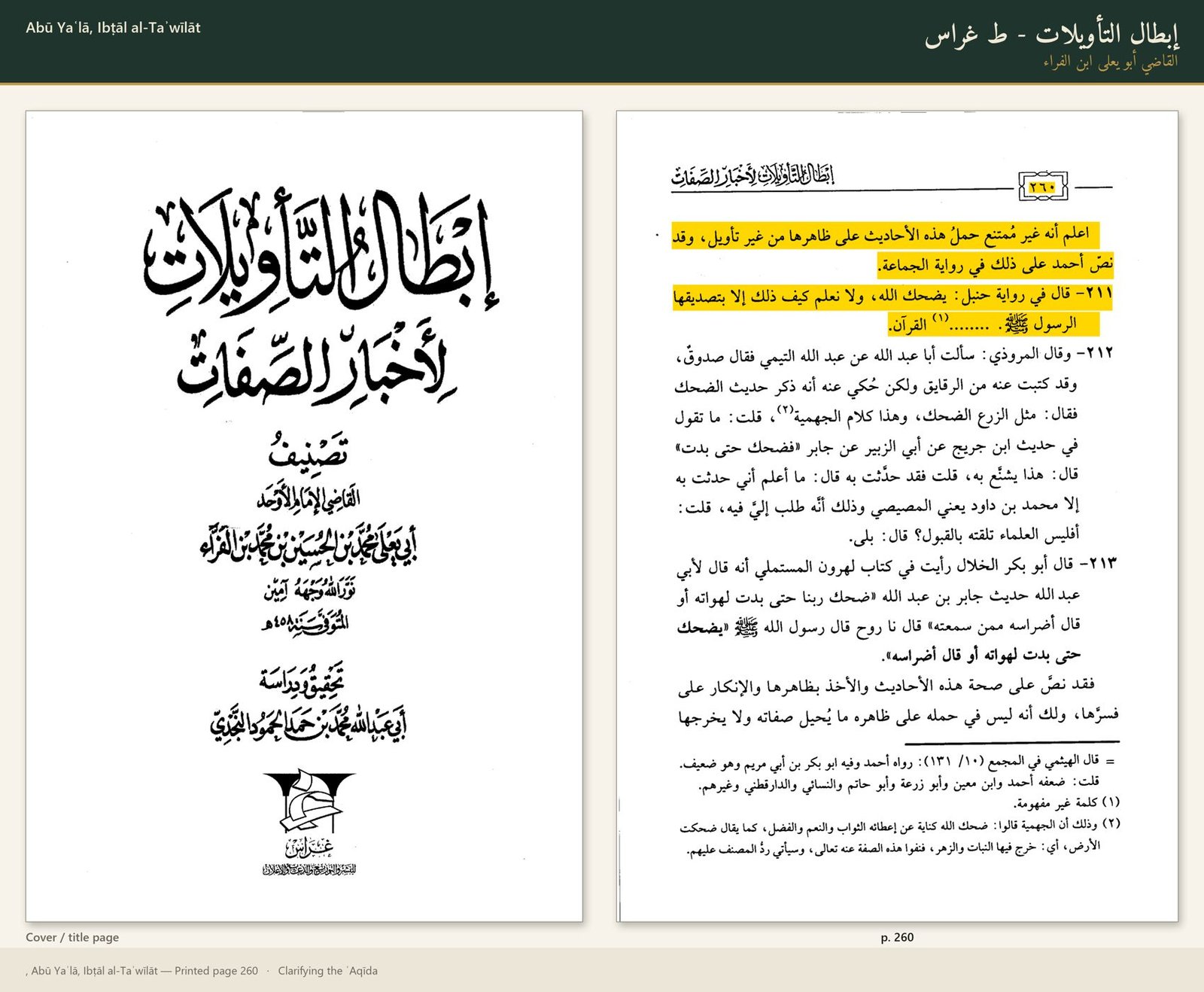
The lacuna in that edition can be filled, for Ibn Taymiyyah preserves the same words.
Ibn Taymiyyah said in Bayān Talbīs al-Jahmiyyah:
Allah laughs, and it is not known how that is, except by affirming the Messenger ﷺ and establishing the Qurʾān. The describers do not describe Him and no one delimits Him; exalted is Allah above what the Jahmiyyah and the Mushabbihah say.
Ibn Taymiyyah, Bayān Talbīs al-Jahmiyyah 2/625, quoting Ḥanbal's report
Source, chain and authenticity
Read the page in the source edition (opens in a new tab)
The whole page in Arabic
Aḥmad’s rejection of the second party comes in another report from Ḥanbal, which states what likening is. In it he says: “Above what the Jahmiyyah and the Mushabbihah say.”
Abū Yaʿlā said in Ibṭāl al-Taʾwīlāt:
Aḥmad rejected tashbīh; he said in the report of Ḥanbal: The mushabbihah say: a sight like my sight, a hand like my hand, a foot like my foot; whoever says that has likened Allah to His creation.
Abū Yaʿlā, Ibṭāl al-Taʾwīlāt p. 47 no. 3
Source, chain and authenticity
Read the page in the source edition (opens in a new tab)
The whole page in Arabic
٣ - وقد أنكر أحمد التشبيه، فقال في رواية حنبل: المشبهة تقول: بصرٌ كبصري، ويدٌ كيدي، وقَدَمٌ كقدمي، ومن قال ذلك فقد شبَّه الله بخلقه.
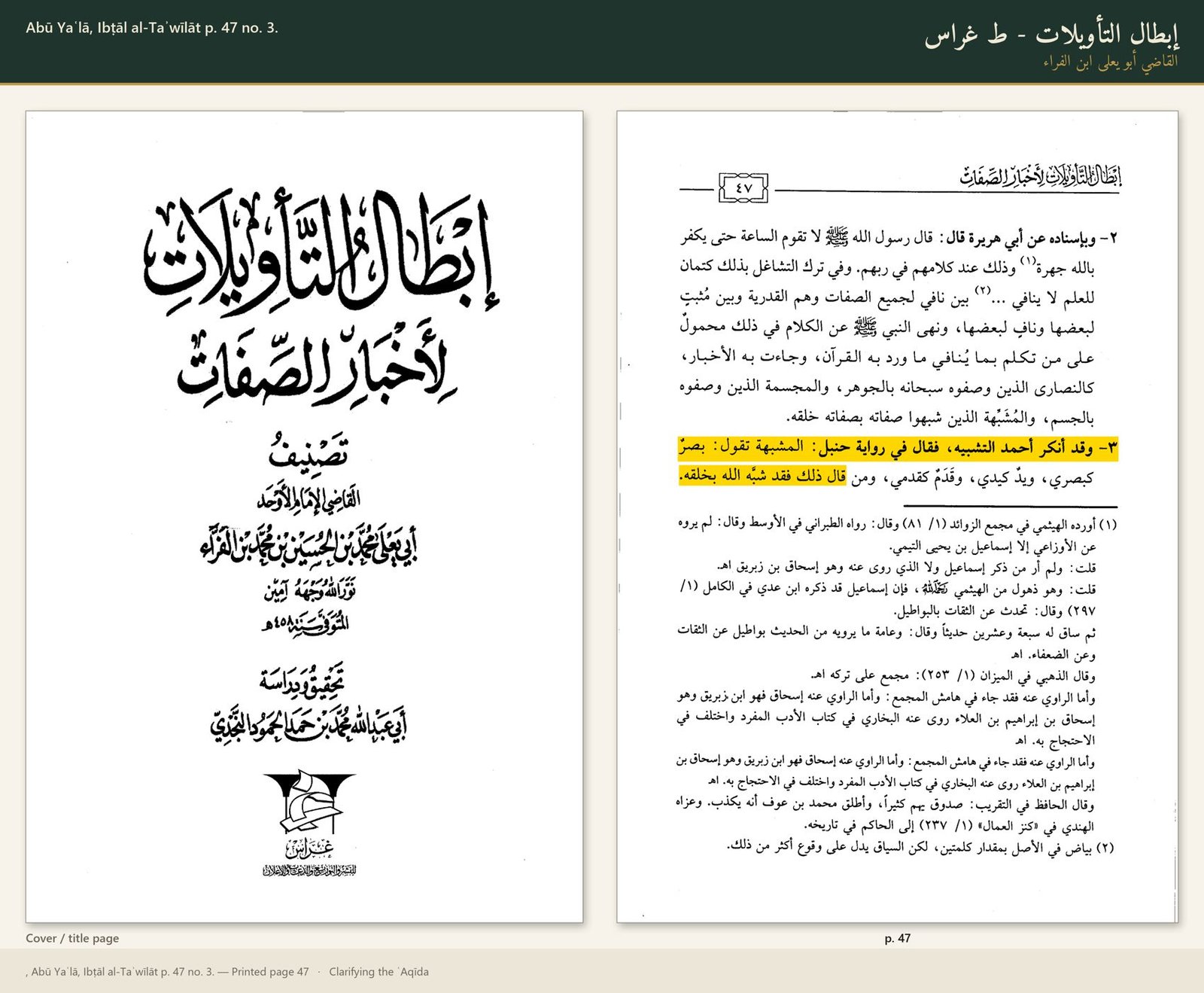
Aḥmad set himself against two parties in this report: the Jahmiyyah, who deny the laughter, and the mushabbihah, who say “a hand like my hand”. Abū Yaʿlā, transmitting it, drew the rule that these ḥadīths are taken on their apparent sense without taʾwīl, as Aḥmad stated in the report of the group.
The words of Aḥmad are transmitted from Ḥanbal by a chain whose men are known, and it is set out here, since this report is quoted as proof of tafwīḍ.
Ghulām al-Khallāl reported in the surviving part of his Kitāb al-Sunnah:
48 — ʿAbdullāh narrated to us: Ḥanbal narrated to us, saying: I heard Abū ʿAbdullāh say: Allah laughs, and we do not know how that is, except by affirming the Messenger as truthful and affirming the Qurʾān.
Ghulām al-Khallāl, juzʾ from Kitāb al-Sunnah p. 522, no. 48; also Abū Yaʿlā, Ibṭāl al-Taʾwīlāt p. 260, no. 211
Source, chain and authenticity
We do not know how. The phrase has no sense unless there is a reality whose modality is unknown. Had Aḥmad held that the word has no known meaning, “how” would never have arisen. He makes no room for those who say that there is no how at all.
Al-Dhahabī said of Ghulām al-Khallāl in the Siyar:
Whoever looks into his book al-Shāfī knows his place in knowledge — were it not for what disfigured him: the hatred of some of the imams — although he is reliable (thiqa) in what he transmits.
Ghulām al-Khallāl, juzʾ from Kitāb al-Sunnah p. 522, no. 48; also Abū Yaʿlā, Ibṭāl al-Taʾwīlāt p. 260, no. 211
Source, chain and authenticity
Read the page in the source edition (opens in a new tab)
The whole page in Arabic
وَمَنْ نَظَرَ فِي كِتَابِهِ (الشَّافِي) عرفَ محلَّهُ مِنَ العِلْمِ لَوْلاَ مَا بشَّعَهُ بغض بَعْضِ الأَئِمَّةِ، مَعَ أَنَّهُ ثِقَةٌ فِيمَا ينقُلُهُ.
قَالَ أَبُو حَفْصٍ البَرْمكِيُّ: سَمِعْتُهُ يَقُوْلُ: سَمِعَ مِنِّي شيخُنَا أَبُو بَكْرٍ الخَلاَّلُ نَحْواً مِنْ عِشْرِيْنَ مسأَلةٍ، وَأَثبتَهَا فِي كُتُبِهِ.
قَالَ القَاضِي أَبُو يَعْلَى: كَانَ لأَبِي بكرٍ عَبْدِ العَزِيْزِ مصنَّفَاتٌ حسَنَةٌ مِنْهَا: كِتَابُ (المقنعِ) وَهُوَ نَحْوُ مائَةِ جزءٍ، وَكِتَابُ (الشَّافِي) نَحْوَ ثَمَانِيْنَ جزءاً، وَكِتَابُ (زَادِ المُسَافِرِ) ، وَكتَابُ (الخلاَفِ مَعَ الشَّافِعِيِّ) ، وَكِتَابُ (مختصرِ السُّنَّةِ) ، وَرُوِيَ عَنْهُ أَنَّهُ قَالَ فِي مرضِهِ: أَنَا عِنْدَكُم إِلَى يَوْمِ الجُمُعَةِ، فَمَاتَ يَوْمَ الجُمُعَةِ، وَيُذكَرُ عَنْهُ عبَادَةٌ، وَتَأَلُّهٌ، وَزُهدٌ، وَقُنوعٌ.
وَذَكَرَ أَبُو يَعْلَى أَنَّهُ كَانَ معظَّماً فِي النُّفُوْسِ، متقدِّماً عِنْدَ الدَّوْلَةِ، بارعاً فِي مَذْهَب الإِمَامِ أَحْمَدَ.
قُلْتُ: مَا جَاءَ بَعْدَ أَصْحَابِ أَحْمَدَ مِثْلُ الخَلاَّلِ، وَلاَ جَاءَ بَعْدَ الخَلاَّلِ مِثْلُ عَبْدِ العَزِيْزِ إِلاَّ أَنْ يَكُونَ أَبا القَاسِمِ الخِرَقِيِّ.
قَالَ ابْنُ الفَرَّاءِ: تُوُفِّيَ فِي شَوَّالٍ سَنَةَ ثَلاَثٍ وَسِتِّيْنَ وَثَلاَثِ مائَةٍ، وَلَهُ ثَمَانٍ وَسَبْعُوْنَ سَنَةً، فِي سنِّ شَيْخِهِ الخَلاَّلِ، وَسنِّ شَيْخِ شَيْخِهِ أَبِي بَكْرٍ المَرْوَذِيِّ، وَسنِّ شَيْخِ المَرْوَذِيِّ الإِمَامِ أَحْمَدَ.
وَفِيْهَا مَاتَ: جُمَحُ بنُ القَاسِمِ المُؤَذِّنُ بِدِمَشْقَ، وَأَبُو بَكْرٍ مُحَمَّدُ بنُ أَحْمَدَ الرَّمْلِيِّ ابْنِ النَّابلسِيِّ الشَّهِيْدِ، وَأَبُو الحَسَنِ مُحَمَّدُ بنُ الحُسَيْنِ بنِ إِبْرَاهِيْمَ الآبرِيُّ، وَالحَافِظُ أَبُو العَبَّاسِ مُحَمَّدُ بنُ مُوْسَى السِّمْسَارُ، وَمظفّرُ
Al-Dhahabī, who found fault with him on another matter, nevertheless calls him reliable in what he transmits.
The ʿAbdullāh in the chain is Ibn ʿAttāb. Al-Khaṭīb said of him in Tārīkh Madīnat al-Salām:
حَدَّثَ عَن محمد بن عمرو بن حنان، والحسن بن عبد العزيز الجروي، وأحمد بن منصور الرمادي.
رَوَى عنه عبد الله بن الحسن ابن النخاس المقرئ، وأبو عمر بن حيويه، وأبو حفص بن شاهين، وغيرهم. وكان ثقة.
4917 — ʿAbdullāh ibn Aḥmad ibn ʿAttāb ibn Muḥammad ibn Fāyid ibn ʿAbd al-Raḥmān, Abū Muḥammad al-ʿAbdī; Fāʾid is Abū al-Warqāʾ, the companion of ʿAbdullāh ibn Abī Awfā. He narrated from Muḥammad ibn ʿAmr ibn Ḥannān, al-Ḥasan ibn ʿAbd al-ʿAzīz al-Jarawī and Aḥmad ibn Manṣūr al-Ramādī. From him narrated ʿAbdullāh ibn al-Ḥasan Ibn al-Nakhkhās al-Muqriʾ, Abū ʿUmar ibn Ḥayyawayh, Abū Ḥafṣ ibn Shāhīn and others. And he was reliable (thiqa).
al-Khaṭīb al-Baghdādī, Tārīkh Madīnat al-Salām (ed. Bashshār ʿAwwād) 11/23 no. 4917; = ʿIlmiyyah ed. 9/390 no. 4964
Source, chain and authenticity
Read the page in the source edition (opens in a new tab)
The whole page in Arabic
٤٩١٧ - عبد الله بن أحمد بن عتاب بن محمد بن فايد بن عبد الرحمن، أبو محمد العبدي، وفائد هو أبو الورقاء صاحب عبد الله بن أبي أوفى.
حَدَّثَ عَن محمد بن عمرو بن حنان، والحسن بن عبد العزيز الجروي، وأحمد بن منصور الرمادي.
رَوَى عنه عبد الله بن الحسن ابن النخاس المقرئ، وأبو عمر بن حيويه، وأبو حفص بن شاهين، وغيرهم. وكان ثقة.
أخبرنا محمد بن عبد الملك القرشي، قال: أخبرنا عمر بن أحمد الواعظ، قال: حدثنا عبد الله بن أحمد بن عتاب بن محمد بن فايد بن عبد الرحمن أبي الورقاء صاحب عبد الله بن أبي أوفى قال: حدثنا محمد بن عمرو بن حنان، قال: حدثنا بقية بن الوليد، قال: حدثني شعبة، قال: حدثني هشام بن زيد بن أنس بن مالك، قال: سمعت أنس بن مالك يقول: كان رسول الله ﷺ يطوف على نسائه ثم يغتسل.
Al-Khaṭīb closes his entry on ʿAbdullāh ibn ʿAttāb with “and he was reliable”, and so the next link of the chain is established as well.
And Ḥanbal is the cousin of Imām Aḥmad. Ibn Abī Yaʿlā said of him in Ṭabaqāt al-Ḥanābilah:
أبو على الشيبانى. ابن عم إمامنا أحمد.
سمع أبا نعيم الفضل بن دكين، وأبا غسان مالك بن اسماعيل، وعفان بن مسلم، وسعيد بن سليمان، وعارم بن الفضل بن دكين، وسليمان بن حرب، وإمامنا أحمد فى آخرين. حدث عنه ابنه - وقد اختلف فى اسم ابنه، فقوم قالوا:
عبيد الله. وقوم قالوا: عبد الله - وعبد الله بن محمد البغوى، ويحيى بن صاعد، وأبو بكر الخلال وغيرهم. وذكره الخطيب أحمد بن ثابت، فقال: كان ثقة ثبتا.
قال: وأخبرنا الأزهرى قال: سئل الدارقطنى عن حنبل؟ فقال: كان صدوقا
188 — Ḥanbal ibn Isḥāq ibn Ḥanbal, Abū ʿAlī al-Shaybānī, the paternal cousin of our Imām Aḥmad. He heard Abū Nuʿaym al-Faḍl ibn Dukayn, Abū Ghassān Mālik ibn Ismāʿīl, ʿAffān ibn Muslim, Saʿīd ibn Sulaymān, ʿĀrim ibn al-Faḍl ibn Dukayn, Sulaymān ibn Ḥarb and our Imām Aḥmad, among others. From him narrated his son — there is disagreement over his son's name: some said ʿUbayd Allāh, others ʿAbdullāh — and ʿAbdullāh ibn Muḥammad al-Baghawī, Yaḥyā ibn Ṣāʿid, Abū Bakr al-Khallāl and others. Al-Khaṭīb Aḥmad ibn Thābit mentioned him and said: He was reliable and precise (thiqa thabt). He said: al-Azharī informed us: al-Dāraquṭnī was asked about Ḥanbal and said: He was truthful (ṣadūq).
Ibn Abī Yaʿlā, Ṭabaqāt al-Ḥanābilah (ed. al-Fiqī) 1/143 no. 188
Source, chain and authenticity
Read the page in the source edition (opens in a new tab)
The whole page in Arabic
ذكره أبو محمد الخلال فيمن روى عن أحمد
ذكر مفاريد حرف الحاء ومثانيها
١٨٨ - حنبل بن إسحاق بن حنبل.
أبو على الشيبانى. ابن عم إمامنا أحمد.
سمع أبا نعيم الفضل بن دكين، وأبا غسان مالك بن اسماعيل، وعفان بن مسلم، وسعيد بن سليمان، وعارم بن الفضل بن دكين، وسليمان بن حرب، وإمامنا أحمد فى آخرين. حدث عنه ابنه - وقد اختلف فى اسم ابنه، فقوم قالوا:
عبيد الله. وقوم قالوا: عبد الله - وعبد الله بن محمد البغوى، ويحيى بن صاعد، وأبو بكر الخلال وغيرهم. وذكره الخطيب أحمد بن ثابت، فقال: كان ثقة ثبتا.
قال: وأخبرنا الأزهرى قال: سئل الدارقطنى عن حنبل؟ فقال: كان صدوقا
وذكره أبو بكر الخلال فقال: قد جاء حنبل عن أحمد بمسائل أجاد فيها الرواية. وأغرب بغير شئ. وإذا نظرت فى مسائله شبهتها فى حسنها وإشباعها وجودتها بمسائل الأثرم. وكان حنبل رجلا فقيرا. خرج إلى عكبرا. فقرأ مسائله عليهم. وخرج أيضا إلى واسط، فلقيته بواسط. فسمعت منه مسائل يسيرة. ثم سمعت مسائله بعكبرا من أصحابنا العكبريين عنه.
أنبانا أبو القاسم بن البسرى عن أبى عبد الله بن بطة حدثنا أبو حفص بن رجاء حدثنا موسى بن حمدان البزاز قال قال حنبل بن اسحاق: جمعنا عمى لى ولصالح ولعبد الله، وقرأ علينا المسند. وما سمعه منه - يعنى ثانيا - غيرنا. وقال لنا: إن هذا الكتاب قد جمعته وانتقيته من أكثر من سبعمائة وخمسين ألفا. فما اختلف المسلمون فيه من حديث رسول الله ﷺ فارجعوا إليه. فان وجدتموه فيه وإلا فليس بحجة.
وقال الحسن بن على بن مليح: سمعت بعض الشيوخ بعكبرا يقول: حضرنا عند حنبل بن إسحاق - حين قدم إلى عكبرا - فنزل فى غرفة. فلما اجتمع
Reliable and precise, according to al-Khaṭīb, and truthful, according to al-Dāraquṭnī. So the report stands on its chain, and it is given here in Abū Yaʿlā’s wording.
Abū Yaʿlā said in Ibṭāl al-Taʾwīlāt:
١٠ - وقال في رواية حنبل: يضحك الله، ولا نعلم كيف ذلك إلا بتصديق الرسول. وقال: المشبهة تقول بصرٌ كبصري، ويدٌ كيدي، وقدم كقدمي
9 — And he said, in the report of Ḥanbal, about the ḥadīths that are narrated — 'Allah, Blessed and Exalted, descends to the lowest heaven', 'Allah is seen', 'He places His Foot', and the like: “We believe in them and affirm them as true, without 'how' and without 'meaning' (wa-lā kayf wa-lā maʿnā)! We reject nothing of them, and we know that what the Messenger ﷺ said is true, when [it comes] with authentic chains.” 10 — And he said, in the report of Ḥanbal: “Allah laughs, and we do not know how that is, except by affirming the Messenger as truthful.” And he said: “The mushabbihah say: a sight like my sight, a hand like my hand, a foot like my foot…”
Abū Yaʿlā, Ibṭāl al-Taʾwīlāt p. 50 nos. 9–10, from Ḥanbal ibn Isḥāq's reports from Aḥmad
Source, chain and authenticity
Read the page in the source edition (opens in a new tab)
The whole page in Arabic
٩ - وقال في رواية حنبل في الأحاديث التي تروي "إن الله ﵎ ينزل إلى سماء الدنيا" والله يُرى "وأنه يضع قدمه" وما أشبه بذلك نُؤمن بها ونصدق بها ولا كيف ولا معنى! ولا نرد شيئًا منها، ونعلم أن ما قاله الرسول ﷺ حقٌّ إذا كانت بأسانيد صحاح.
١٠ - وقال في رواية حنبل: يضحك الله، ولا نعلم كيف ذلك إلا بتصديق الرسول. وقال: المشبهة تقول بصرٌ كبصري، ويدٌ كيدي، وقدم كقدمي، ومن قال ذلك فقد شبَّه الله بخلقه.
فقد نصَّ أحمد على القول بظاهر الأخبار من غير تشبيهٍ ولا تأويل.
١١ - وذكر عبد الرحمن بن منده في كتاب الإسلام (¬١) فقال أنا يوسف بن محمد السلمي بأصبهان أنا علي بن محمد بن إبراهيم الدمشقي نا عبد الله بن محمد بن جعفر النهاوندي نا أبو بكر محمد بن إبراهيم بن عبد الله نا أحمد بن جعفر بن يعقوب الفارسي قال: قال أبو عبد الله أحمد بن محمد بن حنبل: وقد رأيت لأهل
This contains the phrase on which the whole argument is built: without how and without maʿnā. The explanation of that word is given in the chapter that follows, and the sentences around it already show the direction. We believe in them, affirm them as true, and reject nothing of them.
Fifth Issue: “Without a meaning except according to what He described Himself with”
Ibn Baṭṭah said in al-Ibānah al-Kubrā:
50 — Abū ʿAbd Allāh said: And we believe in the hadiths about this and affirm them, and pass them on as they came, without 'how', and without a meaning except according to what He described Himself with, Exalted is He. We ask Allah for safety in this world and the next, and seek refuge in Allah from slipping, uncertainty and doubt; He is able to do all things.
Ibn Baṭṭah, al-Ibānah al-Kubrā 7/58 no. 50; also collected in al-Jāmiʿ li-ʿUlūm Aḥmad 3/380
Source, chain and authenticity
Read the page in the source edition (opens in a new tab)
The whole page in Arabic
٥١ - قَالَ الْأَثْرَمُ: وَسَمِعْتُ أَبَا عَبْدِ اللَّهِ، يَقُولُ: مَنْ قَالَ: إِنَّ اللَّهَ لَا يُرَى فِي الْآخِرَةِ فَهُوَ جَهْمِيٌّ، قَالَ: وَإِنَّمَا تَكَلَّمَ مَنْ تَكَلَّمَ فِي رُؤْيَةِ الدُّنْيَا
٥٢ - وَقَالَ أَبُو عَبْدِ اللَّهِ: أَدْرَكْتُ النَّاسَ وَمَا يُنْكِرُونَ مِنْ هَذِهِ الْأَحَادِيثِ أَحَادِيثَ الرُّؤْيَةِ وَكَانُوا يُحَدِّثُونَ بِهَا عَلَى الْجُمْلَةِ يُمِرُّونَهَا عَلَى حَالِهَا غَيْرَ مُنْكِرِينَ لِذَلِكَ وَلَا مُرْتَابِينَ
٥٣ - قَالَ أَبُو عَبْدِ اللَّهِ: إِذَا لَمْ نُقِرَّ بِمَا جَاءَ عَنِ النَّبِيِّ ﷺ رَدَدْنَا عَلَى اللَّهِ أَمْرَهُ، قَالَ اللَّهُ ﷿: ﴿وَمَا آتَاكُمُ الرَّسُولُ فَخُذُوهُ وَمَا نَهَاكُمْ عَنْهُ فَانْتَهُوا﴾ [الحشر: ٧]
Ibn Baṭṭah has recorded the attitude, and Ḥanbal’s question to Aḥmad gives the wording that is in dispute in this chapter.
Ibn Qudāmah said in Taḥrīm al-Naẓar fī Kutub Ahl al-Kalām:
فَقَالَ أَبُو عبد الله رَضِي الله
عَنهُ نؤمن بهَا ونصدق بهَا وَلَا نرد مِنْهَا شَيْئا إِذا كَانَت بأسانيد صِحَاح
وَلَا نرد على الرَّسُول ﷺ قَوْله
ونعلم أَن مَا جَاءَ بِهِ الرَّسُول ﷺ حق وَلَا يُوصف الله تَعَالَى بِأَكْثَرَ مِمَّا وصف بِهِ نَفسه بِلَا حد وَلَا غَايَة ﴿لَيْسَ كمثله شَيْء وَهُوَ السَّمِيع الْبَصِير﴾
فَنَقُول كَمَا قَالَ وَنصفه كَمَا وصف نَفسه لَا نتعدى ذَلِك وَلَا نزيل عَنهُ صفة من صِفَاته لشناعة شنعت
نؤمن بِهَذِهِ الْأَحَادِيث ونقرها ونمرها كَمَا جَاءَت بِلَا كَيفَ وَلَا معنى إِلَى على مَا وصف بِهِ نَفسه ﵎ وَهُوَ كَمَا وصف نَفسه سميع بَصِير بِلَا حد وَلَا تَقْدِير
صِفَاته مِنْهُ وَله
لَا نتعدى الْقُرْآن والْحَدِيث وَالْخَبَر وَلَا نعلم كَيفَ ذَاك إِلَّا بِتَصْدِيق الرَّسُول ﷺ وتثبيت الْقُرْآن
Ḥanbal said: I asked Abū ʿAbd Allāh Aḥmad ibn Muḥammad ibn Ḥanbal about these hadiths narrated that Allah, Blessed and Exalted, is seen, that He descends to the lowest heaven, that He places His foot, and the like. Abū ʿAbd Allāh (may Allah be pleased with him) said: We believe in them and affirm them as true, and reject nothing of them when they come with authentic chains, and we do not reject the Messenger's ﷺ word; we know that what the Messenger ﷺ brought is true; and Allah, Exalted is He, is not described with more than He described Himself with, without ḥadd or extremity — 'There is nothing like Him, and He is the All-Hearing, the All-Seeing'. So we say as He said and describe Him as He described Himself; we do not go beyond that, and do not remove from Him an attribute of His because of a slander that is spread. We believe in these hadiths, affirm them and pass them on as they came, without 'how' and without a meaning except according to what He described Himself with, Blessed and Exalted; He is as He described Himself, All-Hearing, All-Seeing, without ḥadd and without measure. His attributes are from Him and belong to Him; we do not go beyond the Qurʾān, the hadith and the report, and we do not know how that is except by affirming the Messenger ﷺ and establishing the Qurʾān.
Ibn Qudāmah, Taḥrīm al-Naẓar fī Kutub Ahl al-Kalām pp. 38–39
Source, chain and authenticity
Read the page in the source edition (opens in a new tab)
The whole page in Arabic
فَروِيَ عَن مَالك بن أنس وَالْأَوْزَاعِيّ وسُفْيَان الثَّوْريّ وسُفْيَان بن عُيَيْنَة وَمعمر بن رَاشد فِي الْأَحَادِيث فِي الصِّفَات أمروها كَمَا جَاءَت
وَقَالَ أَبُو عمر بن عبد الْبر فِي كتاب الْعلم مَا جَاءَ عَن النَّبِي ﷺ من نقل الثِّقَات وَصَحَّ عَن الصَّحَابَة ﵃ فَهُوَ علم يدان بِهِ
وَمَا أحدث بعدهمْ وَلم يكن لَهُ أصل فِي مَا جَاءَ عَنْهُم فَهُوَ بِدعَة وضلالة
وَمَا جَاءَ فِي أَسمَاء الله وَصِفَاته عَنْهُم نسلم لَهُ وَلم نناظر كَمَا لم يناظروا
وَرَوَاهَا السّلف وسكتوا عَنْهَا وَكَانُوا أعمق النَّاس علما وأوسعهم فهما وَأَقلهمْ تكلفا وَلم يكن سكوتهم عَن عي
فَمن لم يَسعهُ مَا وسعهم فقد خَابَ وخسر
وروى مُحَمَّد بن الْحسن صَاحب أبي حنيفَة أَنه أجمع أهل الْعلم فِي الْمشرق وَالْمغْرب على أَن هَذِه الْأَحَادِيث الَّتِي جَاءَت فِي الصِّفَات لَا تفسر أَو كَمَا قَالَ
وَقَالَ حنبلي سَأَلت أَبَا عبد الله أَحْمد بن مُحَمَّد بن حَنْبَل ﵁ عَن هَذِه الْأَحَادِيث الَّتِي تروي أَن الله ﵎ يرى وَأَنه ينزل إِلَى سَمَاء الدُّنْيَا وَأَنه يضع قدمه وَمَا أشبه ذَلِك
فَقَالَ أَبُو عبد الله رَضِي الله
عَنهُ نؤمن بهَا ونصدق بهَا وَلَا نرد مِنْهَا شَيْئا إِذا كَانَت بأسانيد صِحَاح
وَلَا نرد على الرَّسُول ﷺ قَوْله
ونعلم أَن مَا جَاءَ بِهِ الرَّسُول ﷺ حق وَلَا يُوصف الله تَعَالَى بِأَكْثَرَ مِمَّا وصف بِهِ نَفسه بِلَا حد وَلَا غَايَة ﴿لَيْسَ كمثله شَيْء وَهُوَ السَّمِيع الْبَصِير﴾
فَنَقُول كَمَا قَالَ وَنصفه كَمَا وصف نَفسه لَا نتعدى ذَلِك وَلَا نزيل عَنهُ صفة من صِفَاته لشناعة شنعت
نؤمن بِهَذِهِ الْأَحَادِيث ونقرها ونمرها كَمَا جَاءَت بِلَا كَيفَ وَلَا معنى إِلَى على مَا وصف بِهِ نَفسه ﵎ وَهُوَ كَمَا وصف نَفسه سميع بَصِير بِلَا حد وَلَا تَقْدِير
صِفَاته مِنْهُ وَله
لَا نتعدى الْقُرْآن والْحَدِيث وَالْخَبَر وَلَا نعلم كَيفَ ذَاك إِلَّا بِتَصْدِيق الرَّسُول ﷺ وتثبيت الْقُرْآن
وَقَالَ أَبُو عبد الله حَدثنَا وَكِيع يَوْمًا بِحَدِيث من هَذِه الْأَحَادِيث فاقشعر زَكَرِيَّاء بن عدي فَقَالَ وَكِيع وَغَضب أدركنا الْأَعْمَش وسُفْيَان يحدثُونَ بِهَذِهِ الْأَحَادِيث وَلَا يُنْكِرُونَهَا
وَهَذَا مِمَّا لَا نعلم فِيهِ بَين سلفنا ﵏ اخْتِلَافا وَالْمُنكر لَهُ إِمَّا جَاهِل أَو متجاهل قَلِيل الدّين وَالْحيَاء لَا يخَاف من الله تَعَالَى إِذا كذب وَلَا يستحيي من النَّاس إِذا كذب
وَنحن على طَريقَة سلفنا وجادة أَئِمَّتنَا وَسنة نَبينَا ﷺ مَا أحدثنا قولا وَلَا زِدْنَا زِيَادَة بل آمنا بِمَا جَاءَ وأمررناه كَمَا جَاءَ وَقُلْنَا بِمَا قَالُوا وسكتنا عَمَّا سكتوا عَنهُ وسلكنا حَيْثُ سلكوا فَلَا وَجه لنسبة الْخلاف والبدعة إِلَيْنَا
وَإِنَّمَا تكلم ابْن عقيل على حَال نَفسه فِي حَال بدعته
حِين أحدث فِي دين الله ﷿ وَخَالف سلفه وأئمته وسَادَة أهل مذْهبه وَاتبع أهل الْكَلَام والبدع وَفَارق السّنة وَأخذ فِي الْبِدْعَة أهْدر دَمه وأخيف سربه وَقصد بالأذى والتشريد والإخافة والتطريد وَصَارَ ذليلا حَقِيرًا فنسب حَاله إِلَى من سواهُ وَجعل الْحَدث مِنْهُ حَادِثا مِمَّن عداهُ وكسى وَصفه لغيره وعير أهل السّنة بِمثل ذَنبه
كَمَا قيل رمتني بدائها وانسلت
The meaning that Aḥmad negates is a meaning other than the one Allah stated, which is the meaning of taʾwīl, and his exception, “except according to what He described Himself with”, affirms the meaning that Allah stated. The same report says that His attributes are from Him and belong to Him, and that we do not go beyond the Qurʾān and the ḥadīth.
Sixth Issue: Abū ʿUbayd: “this is not explained”
Al-Dāraquṭnī reported in al-Ṣifāt:
فَقَالَ: هَذِهِ الْأَحَادِيثُ صِحَاحٌ حَمَلَهَا أَصْحَابُ الْحَدِيثِ والفقهاء بعضهم على بَعْضٍ، وهِيَ عِنْدَنَا حَقٌّ لَا نَشُكُّ فِيهَا، وَلَكِنْ إِذَا قِيلَ: كَيْفَ وَضَعَ قَدَمَهُ؟ وَكَيْفَ ضَحِكَ؟ قُلْنَا: لَا يُفَسَّر هَذَا وَلَا سَمِعْنَا أَحَدًا يُفَسِّرُهُ
57. Muḥammad ibn Makhlad narrated to us: al-ʿAbbās ibn Muḥammad al-Dūrī narrated to us, saying: I heard Abū ʿUbayd al-Qāsim ibn Sallām, when he mentioned the chapter narrated about the vision, the Kursī and the place of the two feet, our Lord's laughing at the despair of His servants while His change [for them] is near, where our Lord was before He created the heaven, and that Hell will not be filled until your Lord, Mighty and Majestic, places His foot in it and it says 'Enough, enough', and reports like these. He said: These ḥadīths are authentic; the people of ḥadīth and the jurists have carried them one from another, and they are true according to us; we do not doubt them. But if it is said: How did He place His foot? How did He laugh? we say: This is not explained, and we have not heard anyone explain it.
al-Dāraquṭnī, al-Ṣifāt (ed. al-Faqīhī) pp. 68–69 no. 57; ed. al-Ghunaymān p. 39; Abū Yaʿlā, Ibṭāl al-Taʾwīlāt p. 53; al-Aṣbahānī, al-Ḥujjah 1/475
Source, chain and authenticity
Read the page in the source edition (opens in a new tab)
The whole page in Arabic
٥٧ حدَّثنا مُحَمَّدُ بْنُ مَخْلَدٍ٢، ثنا الْعَبَّاسُ بْنُ مُحَمَّدٍ الدُّورِيُّ٣ قَالَ: سَمِعْتُ أَبَا عُبَيْدٍ الْقَاسِمَ بْنَ سَلَّامٍ٤، وَذَكَرَ الْبَابَ الَّذِي يروى في الرُّؤْيَةَ وَالْكُرْسِيَّ وَمَوْضِعَ الْقَدَمَيْنِ، وَضَحِكِ رَبِّنَا مِنْ قُنُوطِ عِبَادِهِ، وَقُرْبِ غِيَرِهِ، وَأَيْنَ كَانَ رَبُّنَا قَبْلَ أَنْ يَخْلُقَ السَّمَاءَ وَأَنَّ جَهَنَّمَ لَا تَمْتَلِئُ حَتَّى يَضَعَ رَبُّكَ ﷿ قَدَمَهُ فِيهَا فَتَقُولُ: قَطْ قَطْ، وَأَشْبَاهَ هَذِهِ الْأَحَادِيثِ.
فَقَالَ: هَذِهِ الْأَحَادِيثُ صِحَاحٌ حَمَلَهَا أَصْحَابُ الْحَدِيثِ والفقهاء بعضهم على بَعْضٍ، وهِيَ عِنْدَنَا حَقٌّ لَا نَشُكُّ فِيهَا، وَلَكِنْ إِذَا قِيلَ: كَيْفَ وَضَعَ قَدَمَهُ؟ وَكَيْفَ ضَحِكَ؟ قُلْنَا: لَا يُفَسَّر هَذَا وَلَا سَمِعْنَا أَحَدًا يُفَسِّرُهُ١.
٥٨ حدَّثنا مُحَمَّدُ بْنُ مَخْلَدٍ، ثنا الْعَبَّاسُ بْنُ مُحَمَّدٍ الدُّورِيُّ، قَالَ: سَمِعْتُ يَحْيَى بن معين يقول: شهدت زكرياء بن عدي يسأل، وكيف؟ فَقَالَ: يَا أَبَا سُفْيَانَ إِنَّ هَذِهِ الْأَحَادِيثُ يَعْنِي مِثْلَ الْكُرْسِيِّ مَوْضِعِ الْقَدَمَيْنِ، وَنَحْوَ هَذَا. فَقَالَ وَكِيعٌ: أَدْرَكْنَا إِسْمَاعِيلَ بْنَ أَبِي خَالِدٍ، وَسُفْيَانَ وَمَسْعُودًا٢ يُحَدِّثُونَ بَهَذِهِ الْأَحَادِيثِ وَلَا يُفَسِّرُونَ شَيْئًا.
٥٩ حدَّثنا مُحَمَّدُ بْنُ مَخْلَدٍ، ثنا مُحَمَّدُ بْنُ إِسْحَاقَ الصَّاغَانِيُّ، ثنا مُحَمَّدُ بْنُ سُلَيْمَانَ لُوَيْنٌ٣ قَالَ: قِيلَ لِابْنِ عُيَيْنَةَ: هَذِهِ الْأَحَادِيثُ التي
Abū ʿUbayd was the imam of the language in his generation and the author of Gharīb al-Ḥadīth, a book written to explain the rare words of the ḥadīths. When such a man says of the placing of the Foot and of the laughter that “this is not explained”, he is refusing the question that he names, the question of how. He knew the meaning of every word in these ḥadīths better than anyone who quotes him.
Seventh Issue: “pass them on as they came, without how”
The phrase that the later schools quote for tafwīḍ of the meaning is itself the proof against it.
Al-Lālakāʾī reported, through al-Haytham ibn Khārijah, that al-Walīd ibn Muslim said:
Al-Walīd ibn Muslim narrated to us, saying: I asked al-Awzāʿī, Sufyān al-Thawrī and Mālik ibn Anas about these ḥadīths in which the seeing is mentioned, and they said: “Pass them on as they came, without how.”
al-Lālakāʾī, Sharḥ Uṣūl Iʿtiqād Ahl al-Sunnah 3/582, no. 930
Source, chain and authenticity
Its chain: al-Haytham ibn Khārijah, a trustworthy Baghdādī, from al-Walīd ibn Muslim, the imam of Shām, who asked the three imams himself. The same answer is reported through al-Walīd with “the ḥadīths of the attributes” in other books of the Sunnah.
Read the page in the source edition (opens in a new tab)
The whole page in Arabic
Al-Awzāʿī, al-Thawrī and Mālik, the imams of Shām, ʿIrāq and the Ḥijāz, said: pass them on as they came, without how. “As they came” means with the meaning they came with, in the language they came in; had the words no meaning, there would be nothing that came. And “without how” denies the modality; one does not deny the modality of something that has no meaning to begin with. The sentence affirms the meaning and denies the how in a single sentence, and that is the creed of Ahl al-Sunnah and exactly the opposite of tafwīḍ of the meaning.
Al-Tirmidhī reported in his Jāmiʿ what the people of knowledge said of these reports, and who said the opposite.
Al-Tirmidhī said, after the ḥadīth of the charity that Allah takes with His right hand:
هكذا رُوِي عن مالكٍ، وسُفيانَ بن عُيينةَ، وعَبد الله بن المُبَارَكِ أنهم قالوا في هذه الأحاديثِ: أمِرُّوها بِلا كَيفٍ. وهكذا قولُ أهلِ العلمِ من أهلِ السُّنَّةِ والجَماعَةِ، وأمَّا الجَهميّةُ فأنْكَرَتْ هذِهِ الرِّوايات، وقالُوا: هذا تَشْبِيهٌ.
وقد ذكَرَ اللهُ ﵎ في غيرِ مَوْضِعٍ مِن كِتابِه: اليَدَ والسَّمْعَ والبَصَرَ، فتأوَّلت الجَهْميّةُ هذِهِ الآياتِ ففَسَّرُوها على غيرِ ما فَسَّرَ أهلُ العلم، وقالوا: إنّ اللهَ لم يَخْلُقْ آدَمَ بِيَدِه، وقالُوا: إنَّ مَعنى اليَدِ هَا هنا القُوَّةُ.
More than one of the people of knowledge said about this ḥadīth and similar reports concerning the attributes, and the descent of the Lord, Blessed and Exalted, every night to the lowest heaven: The reports on this are established; they are believed in, not imagined, and it is not said 'how?'. Thus it is reported from Mālik, Sufyān ibn ʿUyaynah and ʿAbdullāh ibn al-Mubārak that they said about these ḥadīths: 'Pass them on without how.' This is the position of the people of knowledge of Ahl al-Sunnah wa-l-Jamāʿah. As for the Jahmiyyah, they rejected these reports and said: this is tashbīh. Allah has mentioned in more than one place in His Book the hand, hearing and seeing; the Jahmiyyah interpreted these verses and explained them (fassarūhā) other than as the people of knowledge explained them, and said: Allah did not create Ādam with His hand, and said: the meaning of 'hand' here is power.
al-Tirmidhī, al-Jāmiʿ (al-Risālah ed.) 2/202, after no. 662
Source, chain and authenticity
Read the page in the source edition (opens in a new tab)
The whole page in Arabic
هكذا رُوِي عن مالكٍ، وسُفيانَ بن عُيينةَ، وعَبد الله بن المُبَارَكِ أنهم قالوا في هذه الأحاديثِ: أمِرُّوها بِلا كَيفٍ. وهكذا قولُ أهلِ العلمِ من أهلِ السُّنَّةِ والجَماعَةِ، وأمَّا الجَهميّةُ فأنْكَرَتْ هذِهِ الرِّوايات، وقالُوا: هذا تَشْبِيهٌ.
وقد ذكَرَ اللهُ ﵎ في غيرِ مَوْضِعٍ مِن كِتابِه: اليَدَ والسَّمْعَ والبَصَرَ، فتأوَّلت الجَهْميّةُ هذِهِ الآياتِ ففَسَّرُوها على غيرِ ما فَسَّرَ أهلُ العلم، وقالوا: إنّ اللهَ لم يَخْلُقْ آدَمَ بِيَدِه، وقالُوا: إنَّ مَعنى اليَدِ هَا هنا القُوَّةُ.
وقال إسحاقُ بن إبراهيمَ: إنّما يكُونُ التَّشْبيهُ إذا قال: يَدٌ كَيَدٍ أو مِثْلُ يَدٍ، أو سَمْعٌ كَسَمْعٍ أو مِثْلُ سَمْعٍ، فإذا قال: سَمْعٌ كَسَمْعٍ أو مِثْلُ سَمْعٍ، فَهذا التّشْبِيهُ.
وأمَّا إذا قال كَما قال اللهُ تَعالى: يَدٌ وسَمْعٌ وبَصَرٌ، ولا يقولُ كَيفَ ولا يقولُ مِثلُ سَمْع ولا كَسَمْعٍ، فهذا لا يكون تَشْبِيهًا، وهو كما قال اللهُ تَعالى في كِتابِه: ﴿لَيْسَ كَمِثْلِهِ شَيْءٌ وَهُوَ السَّمِيعُ الْبَصِيرُ﴾ [الشورى: ١١].
“Believed in, not imagined, and it is not said how.” He attributes that to Mālik, Ibn ʿUyaynah and Ibn al-Mubārak and to the people of knowledge of Ahl al-Sunnah, and he then says that the Jahmiyyah rejected these reports and called them likening. He explains the matter in the opposite way to the mufawwiḍah, who are the ones claiming to follow those three.
Al-Tirmidhī went on to report the definition given by Isḥāq:
وأمَّا إذا قال كَما قال اللهُ تَعالى: يَدٌ وسَمْعٌ وبَصَرٌ، ولا يقولُ كَيفَ ولا يقولُ مِثلُ سَمْع ولا كَسَمْعٍ، فهذا لا يكون تَشْبِيهًا، وهو كما قال اللهُ تَعالى في كِتابِه: ﴿لَيْسَ كَمِثْلِهِ شَيْءٌ وَهُوَ السَّمِيعُ الْبَصِيرُ﴾
Isḥāq ibn Ibrāhīm said: Tashbīh is only when one says 'a hand like a hand' or 'similar to a hand', or 'hearing like hearing' or 'similar to hearing'; if he says 'hearing like hearing' or 'similar to hearing', that is tashbīh. But if he says as Allah, Exalted is He, said — hand, hearing, seeing — and does not say 'how', nor 'similar to hearing' or 'like hearing', then this is not tashbīh; it is as Allah, Exalted is He, said in His Book: 'There is nothing like Him, and He is the All-Hearing, the All-Seeing.'
al-Tirmidhī, al-Jāmiʿ (al-Risālah ed.) 2/202, after hadith no. 662
Source, chain and authenticity
Read the page in the source edition (opens in a new tab)
The whole page in Arabic
هكذا رُوِي عن مالكٍ، وسُفيانَ بن عُيينةَ، وعَبد الله بن المُبَارَكِ أنهم قالوا في هذه الأحاديثِ: أمِرُّوها بِلا كَيفٍ. وهكذا قولُ أهلِ العلمِ من أهلِ السُّنَّةِ والجَماعَةِ، وأمَّا الجَهميّةُ فأنْكَرَتْ هذِهِ الرِّوايات، وقالُوا: هذا تَشْبِيهٌ.
وقد ذكَرَ اللهُ ﵎ في غيرِ مَوْضِعٍ مِن كِتابِه: اليَدَ والسَّمْعَ والبَصَرَ، فتأوَّلت الجَهْميّةُ هذِهِ الآياتِ ففَسَّرُوها على غيرِ ما فَسَّرَ أهلُ العلم، وقالوا: إنّ اللهَ لم يَخْلُقْ آدَمَ بِيَدِه، وقالُوا: إنَّ مَعنى اليَدِ هَا هنا القُوَّةُ.
وقال إسحاقُ بن إبراهيمَ: إنّما يكُونُ التَّشْبيهُ إذا قال: يَدٌ كَيَدٍ أو مِثْلُ يَدٍ، أو سَمْعٌ كَسَمْعٍ أو مِثْلُ سَمْعٍ، فإذا قال: سَمْعٌ كَسَمْعٍ أو مِثْلُ سَمْعٍ، فَهذا التّشْبِيهُ.
وأمَّا إذا قال كَما قال اللهُ تَعالى: يَدٌ وسَمْعٌ وبَصَرٌ، ولا يقولُ كَيفَ ولا يقولُ مِثلُ سَمْع ولا كَسَمْعٍ، فهذا لا يكون تَشْبِيهًا، وهو كما قال اللهُ تَعالى في كِتابِه: ﴿لَيْسَ كَمِثْلِهِ شَيْءٌ وَهُوَ السَّمِيعُ الْبَصِيرُ﴾ [الشورى: ١١].
Isḥāq defines what is forbidden with exactness. It is the addition of “like” and “similar to”. A hand, hearing and seeing, said as Allah said them and without how, are not tashbīh. He cites the verse that the mufawwiḍ uses against him, and it says both things: nothing is like Him, and He is the All-Hearing, the All-Seeing.
Al-Bukhārī reported in Khalq Afʿāl al-ʿIbād:
And Abū Jaʿfar narrated to me, saying: I heard al-Ḥasan ibn Mūsā al-Ashyab mention the Jahmiyyah and speak against them; then he said: “One of the heads of the heretics (zanādiqah), called Shamghala, was brought before al-Mahdī. He said: Point me to your companions. He said: My companions are more than that. He said: Point me to them. He said: Two kinds among those who profess the qiblah, [the Jahmiyyah] and the Qadariyyah. The Jahmī, when he goes to extremes, says: There is nothing there” — and al-Ashyab pointed to the heaven — “and the Qadarī, when he goes to extremes, says: They are two, a creator of good and a creator of evil. So he struck his neck and crucified him.”
al-Bukhārī, Khalq Afʿāl al-ʿIbād pp. 37–38; quoted by Ibn Taymiyyah, Bayān Talbīs al-Jahmiyyah 3/530 and Ibn al-Qayyim, al-Ṣawāʿiq al-Mursalah
Source, chain and authenticity
Part Four
The imams after them
Eighth Issue: Ibn Rajab on Those Who Empty the Texts of Their Meanings
Ibn Rajab said in Fatḥ al-Bārī:
وهذا هو الصحيح عن أحمد، ومن قبله من السلف، وهو قول إسحاق وغيره من الأئمة.
وكان السلف ينسبون تأويل هذه الآيات والأحاديث الصحيحة إلى الجهمية؛ لأن جهماً وأصحابه أول من أشتهر عنهم أن الله تعالى منزه عما دلت عليه هذه النصوص بأدلة العقول التي سموها أدلة قطعية هي المحكمات، وجعلوا ألفاظ الكتاب والسنة هي المتشابهات فعرضوا ما فيها على تلك الخيالات، فقبلوا ما دلت على ثبوته بزعمهم، وردوا مادلت على نفيه بزعمهم، ووافقهم على ذلك سائر طوائف أهل الكلام من المعتزلة وغيرهم.
وزعموا أن ظاهر ما يدل عليه الكتاب والسنة تشبيه وتجسيم وضلال، واشتقوا من ذلك لمن آمن بما أنزل الله على رسوله اسماء ما أنزل الله بها من سلطان، بل هي افتراء على الله، ينفرون بها عن الإيمان بالله ورسوله.
وزعموا أن ما ورد في الكتاب والسنة من ذلك – مع كثرته وأنتشاره – من باب التوسع والتجوز، وأنه يحمل على مجازات اللغة المستبعدة، وهذا من أعظم أبواب القدح في الشريعة المحكمة المطهرة، وهو من جنس حمل الباطنية نصوص الإخبار عن الغيوب كالمعاد والجنةوالنار على التوسع والمجاز دون الحقيقة، وحملهم نصوص الامروالنهي على مثل ذلك
And among them are those who affirm it and pass it on as it came, without explaining it (lā yufassiruhu), and say: it is a coming and an arrival befitting the majesty and greatness of Allah, Glorified is He. This is what is authentic from Aḥmad and those before him of the Salaf, and it is the position of Isḥāq and other imams. The Salaf used to attribute the interpretation (taʾwīl) of these authentic verses and hadiths to the Jahmiyyah, because Jahm and his followers were the first from whom it became widely known that Allah, Exalted is He, is exalted above what these texts indicate, by rational proofs which they called decisive proofs, which [they claimed] are the clear (muḥkam) [proofs], and they made the words of the Book and Sunnah the ambiguous (mutashābih); they presented what is in them to those fancies, accepting what [the texts] indicated in affirmation according to their claim, and rejecting what [the texts] indicated in negation according to their claim; and all the factions of the people of kalām, the Muʿtazilah and others, agreed with them in that. They claimed that the apparent sense of what the Book and Sunnah indicate is tashbīh, tajsīm and misguidance, and from that they derived, for whoever believes in what Allah revealed to His Messenger, names for which Allah sent down no authority — rather they are a fabrication against Allah — by which they drive people away from faith in Allah and His Messenger. And they claimed that what has come in the Book and Sunnah of that — despite its abundance and spread — is by way of extension and figurative usage, and is to be taken according to far-fetched metaphors of the language. This is among the greatest doors of attack upon the perfect, pure Sharīʿah, and it is of the same kind as the Bāṭiniyyah taking the texts that inform about the unseen — such as the Return, Paradise and the Fire — as extension and metaphor rather than reality, and their taking the texts of command and prohibition likewise.
Ibn Rajab, Fatḥ al-Bārī 7/230
Source, chain and authenticity
Ibn Rajab has described those who take the texts as extension and metaphor. His judgement follows immediately.
Ibn Rajab said in Fatḥ al-Bārī:
ولم ينه علماء السلف الصالح وأئمة الإسلام كالشافعي وأحمد وغيرهما عن الكلام وحذروا عنه، إلا خوفاً من الوقوع في مثل ذلك، ولو علم هؤلاء الأئمة أن حمل النصوص على ظاهرها كفر لوجب عليهم تبيين ذلك وتحذير الأمة منه؛ فإن ذلك من تمام نصيحة المسلمين، فكيف كان ينصحون الأمة فيما يتعلق بالاحكام العملية ويدعون نصيحتمهم فيما يتعلق بأصول الاعتقادات، هذا من أبطل الباطل.
All of this is a departure from the religion of Islam. The scholars of the righteous Salaf and the imams of Islam, such as al-Shāfiʿī, Aḥmad and others, did not forbid kalām and warn against it except out of fear of falling into the like of this. Had these imams known that taking the texts upon their apparent sense was disbelief, it would have been obligatory upon them to make that clear and warn the Ummah of it, for that is part of complete sincere counsel to the Muslims. How could they counsel the Ummah in what pertains to practical rulings and abandon their counsel in what pertains to the foundations of belief? This is among the most false of falsehoods.
Ibn Rajab, Fatḥ al-Bārī 7/231
Source, chain and authenticity
Read the page in the source edition (opens in a new tab)
The whole page in Arabic
ولم ينه علماء السلف الصالح وأئمة الإسلام كالشافعي وأحمد وغيرهما عن الكلام وحذروا عنه، إلا خوفاً من الوقوع في مثل ذلك، ولو علم هؤلاء الأئمة أن حمل النصوص على ظاهرها كفر لوجب عليهم تبيين ذلك وتحذير الأمة منه؛ فإن ذلك من تمام نصيحة المسلمين، فكيف كان ينصحون الأمة فيما يتعلق بالاحكام العملية ويدعون نصيحتمهم فيما يتعلق بأصول الاعتقادات، هذا من أبطل الباطل.
قال أبو عبد الرحمن السلمي الصوفي: سمعت عبد الرحمن بن محمد بن جابر السلمي يقول: سمعت محمد بن عقيل بن الأزهر الفقيه يقول: جاء رجل إلى المزني يسأله عن شيء من الكلام، فقال: أني أكره هذا، بل أنهي عنه، كما نهى عنه الشافعي؛ فإني سمعت الشافعي يقول: سئل مالك عن الكلام والتوحيد، فقالَ مالك: محال أن يظن بالنبي ﷺ أنه علم أمته الإستنجاء ولم يعلمهم التوحيد، فالتوحيد ما قاله النَّبيّ ﷺ:
((أمرت أن أقاتل الناس حتى يقولوا:
Ibn Rajab compares turning the reports of the attributes into metaphor with the Bāṭiniyyah’s treatment of the reports of the Return, Paradise and the Fire, and calls all of it a departure from the religion of Islam. He then argues from the conduct of the imams: had al-Shāfiʿī, Aḥmad and their peers known that taking the texts on their apparent sense was unbelief, sincere counsel to the Ummah would have obliged them to say so, and they never did.
Ninth Issue: Did al-Dhahabī Become an Ashʿarī or a Mufawwiḍ?
Some claim that al-Dhahabī, who wrote al-ʿUluww, later repented and wrote otherwise in the Siyar. On this question there is a hostile witness. Tāj al-Dīn al-Subkī (d. 771) was al-Dhahabī’s Ashʿarī student, who outlived him by twenty-three years and wrote of him after his death in 748. A repentance from Ḥanbalism would have been the first thing such a man reported.
Tāj al-Dīn al-Subkī said in Ṭabaqāt al-Shāfiʿiyyah al-Kubrā:
وَأَنا أخْشَى عَلَيْهِ يَوْم الْقِيَامَة من غَالب عُلَمَاء الْمُسلمين وأئمتهم الَّذين حملُوا لنا الشَّرِيعَة النَّبَوِيَّة فَإِن غالبهم أشاعرة وَهُوَ إِذا وَقع بأشعري لَا يبقي وَلَا يذر
وَالَّذِي أعتقده أَنهم خصماؤه يَوْم الْقِيَامَة عِنْد
The situation regarding our shaykh al-Dhahabī is even greater than what was described. He is our shaykh and our teacher; but the truth is more deserving to be followed. He reached in excessive partisanship a point at which he is laughed at, and I fear for him on the Day of Resurrection from most of the scholars of the Muslims and their imams who carried the Prophetic Sharīʿah to us — for most of them are Ashʿarīs — and he, when he falls upon an Ashʿarī, leaves nothing standing. What I believe is that they will be his adversaries on the Day of Resurrection before [One before whom the least of them may be of greater standing than he] …
Tāj al-Dīn al-Subkī, Ṭabaqāt al-Shāfiʿiyyah al-Kubrā 2/13; the same in al-Subkī's Qāʿidah fī al-Jarḥ wa-l-Taʿdīl p. 44 and quoted by al-Sakhāwī, al-Iʿlān bi-l-Tawbīkh p. 243
Source, chain and authenticity
Read the page in the source edition (opens in a new tab)
The whole page in Arabic
وَمن ذَلِك قَول بعض المجسمة فِي أَبِي حَاتِم ابْن حبَان لم يكن لَهُ كَبِير دين نَحن أخرجناه من سجستان لِأَنَّهُ أنكر الْحَد لله فياليت شعري من أَحَق بِالْإِخْرَاجِ من يَجْعَل ربه محدودا أَو من ينزهه عَن الجسمية
وأمثلة هَذَا تكْثر وَهَذَا شَيخنَا الذَّهَبِيّ ﵀ من هَذَا الْقَبِيل لَهُ علم وديانة وَعِنْده عَلَى أهل السّنة تحمل مفرط فَلَا يجوز أَن يعْتَمد عَلَيْهِ
ونقلت من خطّ الْحَافِظ صَلَاح الدّين خَلِيل بن كيكلدى العلائي ﵀ مَا نَصه الشَّيْخ الْحَافِظ شمس الدّين الذَّهَبِيّ لَا أَشك فِي دينه وورعه وتحريه فِيمَا يَقُوله النَّاس وَلكنه غلب عَلَيْهِ مَذْهَب الْإِثْبَات ومنافرة التَّأْوِيل والغفلة عَن التَّنْزِيه حَتَّى أثر ذَلِك فِي طبعه انحرافا شَدِيدا عَن أهل التَّنْزِيه وميلا قَوِيا إِلَى أهل الْإِثْبَات فَإِذا ترْجم وَاحِدًا مِنْهُم يطنب فِي وَصفه بِجَمِيعِ مَا قِيلَ فِيهِ من المحاسن ويبالغ فِي وَصفه ويتغافل عَن غلطاته ويتأول لَهُ مَا أمكن وَإِذا ذكر أحدا من الطّرف الآخر كإمام الْحَرَمَيْنِ وَالْغَزالِيّ وَنَحْوهمَا لَا يُبَالغ فِي وَصفه وَيكثر من قَول من طعن فِيهِ وَيُعِيد ذَلِك ويبديه ويعتقده دينا وَهُوَ لَا يشْعر ويعرض عَن محاسنهم الطافحة فَلَا يستوعبها وَإِذا ظفر لأحد مِنْهُم بغلطة ذكرهَا وَكَذَلِكَ فعله فِي أهل عصرنا إِذا لم يقدر عَلَى أحد مِنْهُم بتصريح يَقُول فِي تَرْجَمته وَالله يصلحه وَنَحْو ذَلِك وَسَببه الْمُخَالفَة فِي العقائد
انْتهى
وَالْحَال فِي حق شَيخنَا الذَّهَبِيّ أَزِيد مِمَّا وصف وَهُوَ شَيخنَا ومعلمنا غير أَن الْحق أَحَق أَن يتبع وَقد وصل من التعصب المفرط إِلَى حد يسخر مِنْهُ
وَأَنا أخْشَى عَلَيْهِ يَوْم الْقِيَامَة من غَالب عُلَمَاء الْمُسلمين وأئمتهم الَّذين حملُوا لنا الشَّرِيعَة النَّبَوِيَّة فَإِن غالبهم أشاعرة وَهُوَ إِذا وَقع بأشعري لَا يبقي وَلَا يذر
وَالَّذِي أعتقده أَنهم خصماؤه يَوْم الْقِيَامَة عِنْد
He says this of a teacher, and he fears for him on the Day of Resurrection because of what he said about the Ashʿarīs. No one writes this about a man who had joined them.
He said in the biography of al-Ashʿarī:
أما حوالتك على تَبْيِين كذب المفترى وتقصيرك فى مدح الشَّيْخ فَكيف يسعك ذَلِك مَعَ كونك لم تترجم مجسما يشبه الله بخلقه إِلَّا واستوفيت تَرْجَمته حَتَّى إِن كتابك مُشْتَمل على ذكر جمَاعَة من أصاغر الْمُتَأَخِّرين من الْحَنَابِلَة الَّذين لَا يؤبه إِلَيْهِم قد ترجمت كل وَاحِد مِنْهُم بأوراق عديدة فَهَل عجزت أَن تُعْطى تَرْجَمَة هَذَا الشَّيْخ حَقّهَا
I have said more than once that al-Dhahabī is my teacher and that I graduated under him in the science of ḥadīth; but the truth is more deserving to be followed, and it is my duty to make the truth clear. So I say: As for your referring [the reader] to Tabyīn Kadhib al-Muftarī, and your falling short in praising the Shaykh [al-Ashʿarī] — how can you allow yourself that, when you never wrote the biography of an anthropomorphist (mujassim) who likens Allah to His creation without giving his biography in full, so that your book contains a group of minor later Ḥanbalīs of no consequence, each of whom you gave several pages? Were you unable to give this Shaykh's biography its due …?
Tāj al-Dīn al-Subkī, Ṭabaqāt al-Shāfiʿiyyah al-Kubrā 3/353, in the biography of al-Ashʿarī
Source, chain and authenticity
Read the page in the source edition (opens in a new tab)
The whole page in Arabic
أما حوالتك على تَبْيِين كذب المفترى وتقصيرك فى مدح الشَّيْخ فَكيف يسعك ذَلِك مَعَ كونك لم تترجم مجسما يشبه الله بخلقه إِلَّا واستوفيت تَرْجَمته حَتَّى إِن كتابك مُشْتَمل على ذكر جمَاعَة من أصاغر الْمُتَأَخِّرين من الْحَنَابِلَة الَّذين لَا يؤبه إِلَيْهِم قد ترجمت كل وَاحِد مِنْهُم بأوراق عديدة فَهَل عجزت أَن تُعْطى تَرْجَمَة هَذَا الشَّيْخ حَقّهَا وتترجمه كَمَا ترجمت من هُوَ دونه بِأَلف ألف طبقَة فأى غَرَض وَهوى نفس أبلغ من هَذَا وَأقسم بِاللَّه يَمِينا برة مَا بك إِلَّا أَنَّك لَا تحب شياع اسْمه بِالْخَيرِ وَلَا تقدر فى بِلَاد الْمُسلمين على أَن تفصح فِيهِ بِمَا عنْدك من أمره وَمَا تضمره من الغض مِنْهُ فَإنَّك لَو أظهرت ذَلِك لتناولتك سيوف الله وَأما دعاؤك بِمَا دَعَوْت بِهِ فَهَل هَذَا مَكَانَهُ يامسكين وَأما إشارتك بِقَوْلِك ونبغض أعداءك إِلَى أَن الشَّيْخ من أَعدَاء الله وَأَنَّك تبْغضهُ فَسَوف تقف مَعَه بَين يدى الله تَعَالَى يَوْم يأتى وَبَين يَدَيْهِ طوائف الْعلمَاء من الْمذَاهب الْأَرْبَعَة وَالصَّالِحِينَ من الصُّوفِيَّة والجهابذة الْحفاظ من الْمُحدثين وتأتى أَنْت تتكسع فى ظلم التجسيم الذى تدعى أَنَّك برِئ مِنْهُ وَأَنت من أعظم الدعاة إِلَيْهِ وتزعم أَنَّك تعرف هَذَا الْفَنّ وَأَنت لَا تفهم فِيهِ نقيرا وَلَا قطميرا وليت شعرى من الذى يصف الله بِمَا وصف بِهِ نَفسه من شبهه بخلقه أم من قَالَ ﴿لَيْسَ كمثله شَيْء وَهُوَ السَّمِيع الْبَصِير﴾ وَالْأولَى بى على الْخُصُوص إمْسَاك عنان الْكَلَام فى هَذَا الْمقَام فقد أبلغت ثمَّ أحفظ لشَيْخِنَا حَقه وَأمْسك
Al-Subkī’s complaint is that al-Dhahabī gave pages to the people he calls mujassimah and gave al-Ashʿarī short measure, and he says it of the Tārīkh and the Siyar, the very works from which the repentance is claimed.
He said in the biography of al-Dhahabī himself:
He was our shaykh — and the truth is the most deserving thing said, and honesty the best course for one on the path — strongly inclined to the views of the Ḥanbalīs, much given to disparaging the people of the Sunnah, among whom, when they are present, Abū al-Ḥasan al-Ashʿarī is at the head of the caravan; therefore he does not treat them fairly in the biographies, nor describe them with good except against his will.
Tāj al-Dīn al-Subkī, Ṭabaqāt al-Shāfiʿiyyah al-Kubrā 9/103, biography of al-Dhahabī
Source, chain and authenticity
Read the page in the source edition (opens in a new tab)
The whole page in Arabic
وَأقَام بِدِمَشْق يرحل إِلَيْهِ من سَائِر الْبِلَاد وتناديه السؤالات من كل نَاد وَهُوَ بَين أكنافها كنف لأهليها وَشرف تفتخر وتزهى بِهِ الدُّنْيَا وَمَا فِيهَا طورا ترَاهَا ضاحكة عَن تَبَسم أزهارها وقهقهة عذرانها وَتارَة تلبس ثوب الْوَقار والفخار بِمَا اشْتَمَلت عَلَيْهِ من إمامها الْمَعْدُود فِي سكانها
وَكَانَ شَيخنَا وَالْحق أَحَق مَا قيل والصدق أولى مَا آثره ذُو السَّبِيل شَدِيد الْميل إِلَى آراء الْحَنَابِلَة كثير الإزراء بِأَهْل السّنة الَّذين إِذا حظروا كَانَ أَبُو الْحسن الْأَشْعَرِيّ فيهم مقدم الْقَافِلَة فَلذَلِك لَا ينصفهم فِي التراجم وَلَا يصفهم بِخَير إِلَّا وَقد رغم مِنْهُ أنف الراغم
This is his summary of the man, in the entry on him: strongly inclined to the Ḥanbalīs. He says nothing of any return.
And he said of al-Dhahabī's Tārīkh:
As for the history of our shaykh al-Dhahabī — may Allah forgive him — despite its excellence and comprehensiveness, it is laden with excessive partisanship, may Allah not hold him to account: he spoke much against the people of religion — I mean the fuqarāʾ [Sufis], who are the elite of creation — and let his tongue run against many imams of the Shāfiʿīs and Ḥanafīs; he leaned excessively against the Ashʿarīs, and praised to excess the mujassimah.
Tāj al-Dīn al-Subkī, Ṭabaqāt al-Shāfiʿiyyah al-Kubrā 2/22
Source, chain and authenticity
Read the page in the source edition (opens in a new tab)
The whole page in Arabic
فَنحْن نقبل قَول ابْن معِين فِي إِبْرَاهِيم بن شُعَيْب المدنى شيخ روى عَنهُ ابْن وهب إِنَّه لَيْسَ بشئ وَفِي إِبْرَاهِيم بْن يزِيد الْمدنِي إِنَّه ضَعِيف وَفِي الْحُسَيْن بْن الْفرج الْخياط إِنَّه كَذَّاب يسرق الحَدِيث وعَلى هَذَا وَإِن لم يبين الْجرْح لِأَنَّهُ إِمَام مقدم فِي هَذِهِ الصِّنَاعَة جرح طَائِفَة غير ثابتي الْعَدَالَة والثبت وَلَا نقبل قَوْله فِي الشَّافِعِي وَلَو فسر وأتى بِأَلف إِيضَاح لقِيَام الْقَاطِع عَلَى أَنه غير محق بِالنِّسْبَةِ إِلَيْهِ
فَاعْتبر مَا أَشَرنَا إِلَيْهِ فِي ابْن معِين وَغَيره واحتفظ بِمَا ذَكرْنَاهُ تنْتَفع بِهِ
وَيقرب من هَذِهِ الْقَاعِدَة الَّتِي ذَكرنَاهَا فِي الْجرْح وَالتَّعْدِيل
قَاعِدَة فِي المؤرخين
نافعة جدا فَإِن أهل التَّارِيخ رُبمَا وضعُوا من أنَاس وَرفعُوا أُنَاسًا إِمَّا لتعصب أَو لجهل أَو لمُجَرّد اعْتِمَاد عَلَى نقل من لَا يوثق بِهِ أَو غير ذَلِك من الْأَسْبَاب
وَالْجهل فِي المؤرخين أَكثر مِنْهُ فِي أهل الْجرْح وَالتَّعْدِيل وَكَذَلِكَ التعصب قل أَن رَأَيْت تَارِيخا خَالِيا من ذَلِك
وَأما تَارِيخ شَيخنَا الذَّهَبِيّ غفر اللَّه لَهُ فَإِنَّهُ عَلَى حسنه وَجمعه مشحون بالتعصب المفرط لَا واخذه اللَّه فَلَقَد أَكثر الوقيعة فِي أهل الدّين أَعنِي الْفُقَرَاء الَّذين هم صفوة الْخلق واستطال بِلِسَانِهِ عَلَى كثير من أَئِمَّة الشافعيين والحنفيين وَمَال فأفرط عَلَى الأشاعرة ومدح فَزَاد فِي المجسمة هَذَا وَهُوَ الْحَافِظ المدره وَالْإِمَام المبجل فَمَا ظَنك بعوام المؤرخين فَالرَّأْي عندنَا أَلا يقبل مدح وَلَا ذمّ من المؤرخين إِلَّا بِمَا اشْتَرَطَهُ إِمَام الْأَئِمَّة وَحبر الْأمة وَهُوَ الشَّيْخ الإِمَام الْوَالِد ﵀ حَيْثُ قَالَ ونقلته من خطه فِي مجاميعه
Al-Subkī’s four statements agree, and the word mujassimah is his own. So the witness for the claim of a repentance has given evidence against it. What al-Dhahabī says in the Siyar is that the apparent sense has become two, a true one and a false one, and this is quoted in full in the chapter on the two senses of the apparent meaning. It is the opposite of tafwīḍ, since he says that we understand from the texts what the speech indicates.
And al-Dhahabī quoted Abū Yaʿlā with approval in al-ʿUluww, the book they say he abandoned:
قال: "ويدل على إبطال التأويل أن الصحابة ومن بعدهم حملوها على ظاهرها، ولم يتعرضوا لتأويلها، ولا صرفها عن ظاهرها، فلو كان التأويل سائغاً لكانوا إليه أسبق، لما فيه من إزالة التشبيه". يعني على زعم من قال: إن ظاهرها تشبيه.
قلت: المتأخرون من أهل النظر قالوا مقالة مولدة، ما علمت أحداً سبقهم بها. قالوا: هذه الصفات تمر كما جاءت ولا تؤول، مع اعتقاد أن ظاهرها غير مراد، فتفرع من هذا أن الظاهر يعني به أمران:
أحدهما: أنه لا تأويل لها غير دلالة الخطاب كما قال السلف: الاستواء معلوم. وكما قال سفيان وغيره١: قراءتها تفسيرها، يعني أنها بينة واضحة في اللغة لا يبتغي لها مضايق التأويل والتحريف. وهذا هو مذهب السلف، مع اتفاقهم أيضاً أنها لا تشبه صفات البشر بوجه، إذ الباري لا مثل له، لا في ذاته، ولا في صفاته.
[Quoting al-Qāḍī Abū Yaʿlā, Ibṭāl al-Taʾwīl:] “It is not permissible to reject these reports, nor to busy oneself with interpreting them; what is obligatory is to take them according to their apparent sense, and that they are attributes of Allah, Mighty and Majestic, not resembling the attributes of the creatures described with them.” He said: “What shows the falsity of taʾwīl is that the Companions and those after them took them according to their apparent sense and did not undertake to interpret them or divert them from their apparent sense; had taʾwīl been permissible they would have been first to it, since it removes tashbīh” — i.e. according to the claim of whoever says their apparent sense is tashbīh. I [al-Dhahabī] say: The later people of speculation (al-mutaʾakhkhirūn min ahl al-naẓar) have said a newly-born saying; I know of no one who preceded them in it. They said: these attributes are passed on as they came and not interpreted, with the belief that their apparent sense is not intended. From this it branched out that 'the apparent sense' means two things. First: that they have no interpretation other than the indication of the address, as the Salaf said: 'the istiwāʾ is known', and as Sufyān and others said: 'its recitation is its explanation' — i.e. it is clear and plain in the language, not to be sought in the narrow places of taʾwīl and taḥrīf. This is the school of the Salaf, with their agreement as well that they do not resemble the attributes of humans in any way, since the Creator has no likeness, neither in His essence nor in His attributes.
al-Dhahabī, al-ʿUluww, abridged by al-Albānī as Mukhtaṣar al-ʿUluww p. 270
Source, chain and authenticity
Read the page in the source edition (opens in a new tab)
The whole page in Arabic
"لا يجوز رد هذه الأخبار، ولا التشاغل بتأويلها، والواجب حملها على ظاهرها، وأنها صفات لله ﷿، لا تشبه بسائر صفات الموصوفين بها من الخلق".
قال: "ويدل على إبطال التأويل أن الصحابة ومن بعدهم حملوها على ظاهرها، ولم يتعرضوا لتأويلها، ولا صرفها عن ظاهرها، فلو كان التأويل سائغاً لكانوا إليه أسبق، لما فيه من إزالة التشبيه". يعني على زعم من قال: إن ظاهرها تشبيه.
قلت: المتأخرون من أهل النظر قالوا مقالة مولدة، ما علمت أحداً سبقهم بها. قالوا: هذه الصفات تمر كما جاءت ولا تؤول، مع اعتقاد أن ظاهرها غير مراد، فتفرع من هذا أن الظاهر يعني به أمران:
أحدهما: أنه لا تأويل لها غير دلالة الخطاب كما قال السلف: الاستواء معلوم. وكما قال سفيان وغيره١: قراءتها تفسيرها، يعني أنها بينة واضحة في اللغة لا يبتغي لها مضايق التأويل والتحريف. وهذا هو مذهب السلف، مع اتفاقهم أيضاً أنها لا تشبه صفات البشر بوجه، إذ الباري لا مثل له، لا في ذاته، ولا في صفاته.
الثاني: أن ظاهرها [هو الذي يتشكل في الخيال من الصفة، كما يتشكل في الذهن من وصف البشر، فهذا غير مراد، فإن الله تعالى فرد صمد، ليس له نظير، وإن تعددت صفاته فإنها حق، ولكن ما لها مثل ولا نظير، فمن ذا الذي عاينه ونعته لنا؟ ومن ذا الذي يستطيع أن ينعت لنا كيف سمع كلامه؟ والله إنا لعاجزون كالون حائرون باهتون في حد الروح التي فينا، وكيف تعرج كل ليلة إذا توفاها بارئها، وكيف يرسلها، وكيف تستقل بعد الموت؟ وكيف حياة
The text is Abū Yaʿlā’s. Al-Dhahabī has kept the principle that the Companions took these reports by their apparent sense, and that if taʾwīl had been permissible they would have been the first to it.
Ibn Taymiyyah gave the same distinction in al-Tadmuriyyah:
The word 'ẓāhir' (apparent sense) contains ambiguity and equivocation …
Ibn Taymiyyah, al-Tadmuriyyah p. 69 — the same doctrine
Source, chain and authenticity
Read the page in the source edition (opens in a new tab)
The whole page in Arabic
القاعدة الثالثة - إذا قال القائل: ظاهر النصوص مراد، أو ظاهرها ليس بمراد.
فإنه يقال: لفظ «الظاهر» فيه إجمال واشتراك، فإن كان القائل يعتقد أن ظاهرها التمثيل بصفات المخلوقين، أو ما هو من خصائصهم، فلا ريب أن هذا غير مراد.
ولكن السلف والأئمة لم يكونوا يسمّون هذا ظاهرا، ولا يرتضون أن يكون ظاهر القرآن والحديث كفرًا وباطلا، والله ﷾ أعلم وأحكم من أن يكون كلامه الذي وصف به نفسه لا يظهر منه إلا ما هو كفر وضلال.
[غلط من يجعل ظاهر النصوص يقتضي التمثيل]
والذين يجعلون ظاهرها ذلك يغلطون من وجهين:
تارة يجعلون المعنى الفاسد ظاهر اللفظ، حتى يجعلوه محتاجًا إلى تأويل يخالف الظاهر، ولا يكون كذلك.
وتارة يردون المعنى الحق الذي هو ظاهر اللفظ، لاعتقادهم أنه باطل.
[أمثلة]
فالأول: كما قالوا في قوله: (عبدي جعت فلم تطعمني ... ) الحديث، وفي الأثر الآخر: (الحجر الأسود يمين الله في الأرض،
He says that the word contains ambiguity, and this is the reason why neither of them gives a blanket answer.
And he said in Bayān Talbīs al-Jahmiyyah:
Nor is it known from any of the Salaf that he said that what Allah, Exalted is He, intends by them is other than their apparent meaning — let alone that he said it is obligatory to be certain of that. Rather, the word 'ẓāhir' is ambiguous (mujmal): by 'the apparent meaning' may be meant what resembles the attributes of creatures, and this is what the Salaf negated, as the Book indicates — and reason likewise. He said, Exalted is He: {There is nothing like Him} [42:11]; {And there is none comparable to Him} [112:4]; {Do you know of any namesake of His?} [19:65]. So whoever says that when He rose over the Throne it was like the rising of a king, such that He would be in need of the Throne — this is a reprehensible likening (tamthīl).
Ibn Taymiyyah, Bayān Talbīs al-Jahmiyyah 8/542
Source, chain and authenticity
Read the page in the source edition (opens in a new tab)
The whole page in Arabic
Consigning the how after affirming the apparent sense is one thing, and tafwīḍ of the meaning is another, for it begins by rejecting the apparent sense. Ibn Taymiyyah separates the two senses of the word, so that what the Salaf negated is the first, and what they affirmed is the second.
Tenth Issue: Was Ibn Qudāmah a Mufawwiḍ?
A line in Lumʿat al-Iʿtiqād is quoted to prove it. His own book on the subject answers, and so does the book of his cousin, who shared his teachers and his creed.
Ibn Qudāmah said in the introduction to Ithbāt Ṣifat al-ʿUluww:
Allah, Exalted is He, described Himself with highness (ʿuluww) in the heaven; Muḥammad, the Seal of the Prophets, described Him with that; all the scholars — the God-fearing Companions and the imams among the jurists — agreed upon it; the reports of it have reached the degree of mass-transmission (tawātur) in a way that yields certainty; Allah, Exalted is He, united the hearts of the Muslims upon it and made it ingrained in the nature of all creation: you see them, when distress befalls them, glancing at the heaven with their eyes, raising their hands towards it in supplication, awaiting relief from their Lord, and saying so with their tongues. None denies that except an innovator extreme in his innovation, or one led astray by (blind imitation) and following him upon his misguidance. In this treatise I mention some of the reports that have reached me on this from the Messenger of Allah ﷺ, his Companions and the imams who (followed) his Sunnah, in a way that yields decisive certainty of its authenticity from them, and shows the mass-transmission of the narration of it from them, so that the believers who come upon it increase in faith, and the one to whom it was hidden is alerted, until it becomes as though he saw it with his own eyes, and so that it becomes a proof and demonstration for the one holding fast to the Sunnah.
Ibn Qudāmah, Ithbāt Ṣifat al-ʿUluww p. 63, introduction
Source, chain and authenticity
Read the page in the source edition (opens in a new tab)
The whole page in Arabic
(رب يسر وأعن بمنك ورحمتك) (١)
﷽
الحمد لله الذي علا في سمائه، وجلا باليقين قلوب أوليائه، وخار لهم في قدره وبارك لهم في قضائه، وأشهد أن لا إله إلا الله وحده لا شريك له، شهادة مؤمن بلقائه، وأشهد أن محمدا عبده ورسوله وخاتم أنبيائه. أما بعد:
فإن الله تعالى وصف نفسه بالعلو في السماء، ووصفه بذلك محمد خاتم الأنبياء، وأجمع على ذلك جميع العلماء من الصحابة الأتقياء والأئمة من الفقهاء، وتوارترت الأخبار بذلك على وجه حصل به اليقين، وجمع الله تعالى عليه قلوب المسلمين، وجعله مغروزا في طباع الخلق أجمعين، فتراهم عند نزول الكرب بهم يلحظون السماء بأعينهم، ويرفعون نحوها للدعاء أيديهم (٢) ، وينتظرون مجيء الفرج من ربهم، وينطقون بذلك بألسنتهم لا ينكر ذلك إلا مبتدع غال في بدعته، أم مفتون (بتقليده) (٣) واتباعه على ضلالته، وأنا ذاكر في الجزء بعض بلغني من الأخبار في ذلك عن رسول الله ﷺ، وصحابته والأئمة (المقتدين) (٤) بسنته على وجه يحصل القطع واليقين بصحة ذلك عنهم، ويعلم تواتر الرواية بوجوده منهم، ليزداد من وقف عليه (٥) من المؤمنين إيمانا وينتبه من خفي عليه ذلك، حتى يصير كالمشاهد له عيانا، ويصير للمتمسك بالسنة حجة وبرهانا.
واعلم -رحمك الله- أنه ليس من شرط صحة التواتر الذي يحصل به اليقين
He says that the Highness has reached mass-transmission, that the scholars agreed upon it, and that creation looks to the heaven by nature when distress befalls it. Nobody writes such a thing of an attribute whose meaning he holds to be unknown.
Allah, the Exalted, reported the words of Pharaoh in Sūrat al-Qaṣaṣ:
And Pharaoh said: 'O chiefs, I have not known any god for you other than me. So kindle for me, O Hāmān, a fire upon the clay and make me a lofty tower, that I may look at the God of Mūsā; and indeed I think he is one of the liars.'
Sūrat al-Qaṣaṣ, 28:38 Read the verse (opens in a new tab)
Pharaoh ordered a tower, and he would have had no reason to do so unless Mūsā had told him that his God is above. Ibn Qudāmah draws this conclusion himself.
Ibn Qudāmah said in the same book:
And He informed about Pharaoh that he said: “O Hāmān, build for me a tower that I may reach the ways — the ways of the heavens — and look upon the God of Moses; and indeed I think him a liar” [Ghāfir 40:36–37], meaning: I think Moses a liar (in [saying] that Allah, his God, is in the heaven). The one who opposes [us] in this question (has denied this), claiming that Moses lied in this, by way of (certainty) and conviction — in opposition to the Lord of the worlds, charging His truthful, trustworthy Prophet with error, and abandoning the way of the Companions, the Successors, the earlier imams and all of creation. We ask Allah, Exalted is He, to protect us from innovations by His mercy, and grant us success in following His Sunnah.
Ibn Qudāmah, Ithbāt Ṣifat al-ʿUluww p. 65
Source, chain and authenticity
Read the page in the source edition (opens in a new tab)
The whole page in Arabic
He says outright that the one who denies it agrees with Pharaoh in calling Mūsā a liar. So the man they call a mufawwiḍ understood a meaning here, drew a consequence from it, and passed a judgement on those who denied it.
He quoted Ibn ʿAbd al-Barr with approval:
سَمَاءِ الدُّنْيَا، حِينَ يَبْقَى ثُلُثُ اللَّيْلِ فَيَقُولُ: مَنْ يَدْعُونِي فَأَسْتَجِيبَ لَهُ، مَنْ يَسْأَلُنِي فَأُعْطِيَهُ، مَنْ يَسْتَغْفِرُنِي فَأَغْفِرَ لَهُ" وَقَالَ : هَذَا حَدِيثٌ ثَابِتٌ مِنْ جِهَةِ النَّقْلِ، صَحِيحُ الأَسَانِيدِ، لَا يَخْتَلِفُ أَهْلُ الْحَدِيثِ فِي صِحَّتِهِ، وَهُوَ مَنْقُولٌ مِنْ طُرُقٍ سِوَى هَذِهِ مِنْ أَخْبَارِ الْعُدُولِ، عَنِ النَّبِيِّ ﷺ (٢) ، وَفِيهِ دَلِيلٌ عَلَى أَنَّ اللَّهَ تَعَالَى فِي السَّمَاءِ عَلَى الْعَرْشِ، مِنْ فَوْقِ سَبْعِ سَمَاوَاتٍ، كَمَا قَالَتِ الْجَمَاعَةُ، وَهُوَ مِنْ حُجَّتِهِمْ عَلَى الْمُعْتَزِلَةِ فِي قَوْلِهِمْ: إِنَّ اللَّهَ بِكُلِّ مَكَانٍ، قَالَ: وَالدَّلِيلُ عَلَى صِحَّةِ قَوْلِ أَهْلِ الْحَقِّ قَوْلُ اللَّهِ ﷿: ﴿الرَّحْمَنُ عَلَى
الْعَرْشِ اسْتَوَى﴾
97 — Abū ʿUmar ibn ʿAbd al-Barr cited the ḥadīth of Mālik in al-Muwaṭṭaʾ, from Ibn Shihāb, from Abū Salama ibn ʿAbd al-Raḥmān and Abū ʿAbdullāh al-Agharr, both from Abū Hurayra (may Allah be pleased with him), that the Messenger of Allah ﷺ said: “Our Lord, Blessed and Exalted, descends to the lowest heaven when a third of the night remains, and says: Who will call upon Me that I may answer him? Who will ask Me that I may give him? Who will seek My forgiveness that I may forgive him?” And he said: This ḥadīth is established in transmission, with authentic chains; the people of ḥadīth do not differ over its authenticity; it is transmitted by other routes besides these, in reports of upright narrators from the Prophet ﷺ. In it is proof that Allah, Exalted is He, is in the heaven, upon the Throne, above seven heavens, as the Jamāʿah said, and it is among their proofs against the Muʿtazilah in their saying that Allah is in every place. He said: And the proof of the correctness of the position of the people of truth is the saying of Allah, Mighty and Majestic: “The Most Merciful rose over the Throne.”
Ibn Qudāmah, Ithbāt Ṣifat al-ʿUluww pp. 185–186 no. 97, quoting Ibn ʿAbd al-Barr, al-Tamhīd (on the hadith of nuzūl)
Source, chain and authenticity
Read the page in the source edition (opens in a new tab)
The whole page in Arabic
٩٧- وَذَكَرَ أَبُو عُمَرَ بْنُ عَبْدِ الْبَرِّ حَدِيثَ مَالِكٍ فِي الْمُوَطَّإِ (عَنِ) (٣) ابْنِ شِهَابٍ، عَنْ أَبِي سَلَمَةَ بْنِ عَبْدِ الرَّحْمَنِ، وَأَبِي عَبْدِ اللَّهِ الأَغَرِّ، جَمِيعًا عَنْ أَبِي هُرَيْرَةَ ﵁ (٤) أَنَّ رَسُولَ اللَّهِ ﷺ قَالَ: "يَنْزِلُ رَبُّنَا ﵎ إِلَى
سَمَاءِ الدُّنْيَا، حِينَ يَبْقَى ثُلُثُ اللَّيْلِ فَيَقُولُ: مَنْ يَدْعُونِي فَأَسْتَجِيبَ لَهُ، مَنْ يَسْأَلُنِي فَأُعْطِيَهُ، مَنْ يَسْتَغْفِرُنِي فَأَغْفِرَ لَهُ" وَقَالَ (١) : هَذَا حَدِيثٌ ثَابِتٌ مِنْ جِهَةِ النَّقْلِ، صَحِيحُ الأَسَانِيدِ، لَا يَخْتَلِفُ أَهْلُ الْحَدِيثِ فِي صِحَّتِهِ، وَهُوَ مَنْقُولٌ مِنْ طُرُقٍ سِوَى هَذِهِ مِنْ أَخْبَارِ الْعُدُولِ، عَنِ النَّبِيِّ ﷺ (٢) ، وَفِيهِ دَلِيلٌ عَلَى أَنَّ اللَّهَ تَعَالَى فِي السَّمَاءِ عَلَى الْعَرْشِ، مِنْ فَوْقِ سَبْعِ سَمَاوَاتٍ، كَمَا قَالَتِ الْجَمَاعَةُ، وَهُوَ مِنْ حُجَّتِهِمْ عَلَى الْمُعْتَزِلَةِ فِي قَوْلِهِمْ: إِنَّ اللَّهَ بِكُلِّ مَكَانٍ، قَالَ: وَالدَّلِيلُ عَلَى صِحَّةِ قَوْلِ أَهْلِ الْحَقِّ قَوْلُ اللَّهِ ﷿: ﴿الرَّحْمَنُ عَلَى
الْعَرْشِ اسْتَوَى﴾ (١) ، وَقَوْلُهُ تَعَالَى: ﴿ثُمَّ اسْتَوَى عَلَى الْعَرْشِ﴾ (٢) ، وَقُوْلُهُ سُبْحَانَهُ: ﴿أَأَمِنْتُمْ مَنْ فِي السَّمَاءِ﴾ (٣) ، وَقَالَ: ﴿إِلَيْهِ يَصْعَدُ الْكَلِمُ الطَّيِّبُ﴾ (٤) ، وَقَالَ: ﴿يَخَافُونَ رَبَّهُمْ مِنْ فَوْقِهِمْ﴾ (٥) ، وَقَالَ: ﴿يُدَبِّرُ الأَمْرَ مِنَ السَّمَاءِ إِلَى
The ḥadīth of the Descent, from Mālik’s Muwaṭṭaʾ, is what he uses, and the point it proves follows in the words of Ibn ʿAbd al-Barr himself.
Ibn ʿAbd al-Barr said in al-Tamhīd:
And in it is proof that Allah, Mighty and Majestic, is in the heaven, upon the Throne, above seven heavens, as the Jamāʿah said; and it is among their proofs against the Muʿtazilah and the Jahmiyyah in their saying that Allah, Mighty and Majestic, is in every place and is not upon the Throne.
Ibn ʿAbd al-Barr, al-Tamhīd (Maghribiyyah ed.) 7/129 = ed. Bashshār 5/140, on the ḥadīth of the Descent (Mālik ← al-Zuhrī ← al-Aʿraj and Abū Salama ← Abū Hurayra)
Source, chain and authenticity
Read the page in the source edition (opens in a new tab)
The whole page in Arabic
“Proof” is his word, and a proof must have a known meaning. The opponents he names are the Muʿtazilah and the Jahmiyyah, whose doctrine is that He is in every place and not upon the Throne.
And ʿAbd al-Ghanī al-Maqdisī, his maternal cousin, said in al-Iqtiṣād fī al-Iʿtiqād, as its editor quotes him:
[Editor:] Then he went on to detail the discussion of the attributes, citing their proofs from the Book and the Sunnah and the statements of the Salaf of the Ummah, such as the attributes of highness and istiwāʾ, after citing whose proofs he said: “On this question there are proofs from the Book and the Sunnah whose mention would lengthen the book; and whoever denies that Allah is in the direction of highness after these verses and ḥadīths opposes the Book of Allah and denies the Sunnah of the Messenger of Allah.”
al-Iqtiṣād fī al-Iʿtiqād, editor's introduction p. 52, quoting p. 94
Source, chain and authenticity
Read the page in the source edition (opens in a new tab)
The whole page in Arabic
ثم شرع بعد ذلك في تفصيل القول في الصفات بإيراد أدلتها من الكتاب والسنة، وأقوال سلف الأمة مثل صفتي العلو والاستواء، الذي قال بعد إيراد أدلتهما: " وفي هذه المسألة أدلة من الكتاب والسنة يطول بذكرها الكتاب، ومنكر أن يكون الله في جهة العلو بعد هذه الآيات والأحاديث، مخالف لكتاب الله، منكر لسنة رسول الله "
Whoever denies that Allah is in the direction of highness after these verses and ḥadīths opposes the Book and denies the Sunnah. That is the creed of the circle in which Ibn Qudāmah was raised, and he wrote his book in defence of it.
Al-Dhahabī said in Siyar Aʿlām al-Nubalāʾ:
وَالظَّاهِرُ الآخر وَهُوَ البَاطِل، وَالضَّلاَل: أَنْ تَعتَقِدَ قيَاس الغَائِب عَلَى الشَّاهد، وَتُمَثِّلَ البَارِئ بِخلقه، تَعَالَى الله عَنْ ذَلِكَ، بَلْ صفَاتُهُ كَذَاته، فَلاَ عِدْلَ لَهُ، وَلاَ ضِدَّ لَهُ، وَلاَ نَظيرَ لَهُ، وَلاَ مِثْل لَهُ، وَلاَ شبيهَ لَهُ، وَلَيْسَ كَمثله شَيْء، لاَ فِي ذَاته، وَلاَ فِي صفَاته، وَهَذَا أَمرٌ يَسْتَوِي فِيْهِ الفَقِيْهُ وَالعَامِيُّ - وَاللهُ أَعْلَمُ
I say: 'the apparent meaning' (al-ẓāhir) has today become two apparent meanings, one true and the other false. The true one is to say: He is All-Hearing, All-Seeing, Willing, Speaking, Living, All-Knowing; everything perishes except His Face; He created Ādam with His hand, spoke to Mūsā directly, and took Ibrāhīm as an intimate friend, and the like. We pass it on as it came, and we understand from it what the speech indicates, as befits Him, Exalted is He, and we do not say it has a taʾwīl contrary to that. The other apparent meaning — the false one, misguidance — is to believe that the unseen is to be measured by the seen and to liken the Creator to His creation, exalted is Allah above that. Rather His attributes are like His essence: He has no equal, no opposite, no peer, no like and no resemblance; 'there is nothing like Him', neither in His essence nor in His attributes. In this the jurist and the layman are alike. And Allah knows best.
al-Dhahabī, Siyar Aʿlām al-Nubalāʾ (Risālah ed.) 19/449, biography of Ibn ʿAqīl
Source, chain and authenticity
Read the page in the source edition (opens in a new tab)
The whole page in Arabic
وَالظَّاهِرُ الآخر وَهُوَ البَاطِل، وَالضَّلاَل: أَنْ تَعتَقِدَ قيَاس الغَائِب عَلَى الشَّاهد، وَتُمَثِّلَ البَارِئ بِخلقه، تَعَالَى الله عَنْ ذَلِكَ، بَلْ صفَاتُهُ كَذَاته، فَلاَ عِدْلَ لَهُ، وَلاَ ضِدَّ لَهُ، وَلاَ نَظيرَ لَهُ، وَلاَ مِثْل لَهُ، وَلاَ شبيهَ لَهُ، وَلَيْسَ كَمثله شَيْء، لاَ فِي ذَاته، وَلاَ فِي صفَاته، وَهَذَا أَمرٌ يَسْتَوِي فِيْهِ الفَقِيْهُ وَالعَامِيُّ - وَاللهُ أَعْلَمُ -.
قَالَ السِّلَفِيّ: سَمِعْتُ ابْنَ عَقِيْل يَقُوْلُ:
كَانَ جَدِّي كَاتِبَ بهَاءِ الدَّوْلَة بن بُويه، وَهُوَ الَّذِي كتب نُسخَة عزل الطَّائِع، وَتوليَة القَادِر، وَهِيَ عِنْدِي بِخَطِّ جَدِّي.
وَقَالَ أَبُو المُظَفَّرِ سِبْطُ ابْن الجَوْزِيّ: حَكَى ابْنُ عَقِيْل عَنْ نَفْسِهِ قَالَ:
حججتُ، فَالتقطتُ عقد لُؤْلُؤٍ فِي خيط أَحْمَرَ، فَإِذَا شَيْخٌ أَعْمَى يَنشُدُه، وَيبذُلُ لِمُلْتَقِطِهِ مائَة دِيْنَارٍ، فَرددتُهُ عَلَيْهِ، فَقَالَ: خُذِ الدَّنَانِيْر.
فَامتنعتُ، وَخَرَجتُ إِلَى الشَّامِ، وَزُرْتُ القُدْس، وَقصدتُ بَغْدَادَ، فَأَويتُ بِحَلَبَ إِلَى مَسْجِد وَأَنَا بردَانُ جَائِع، فَقَدَّمُوْنِي، فَصَلَّيْتُ بِهِم، فَأَطعمُوْنِي، وَكَانَ أَوَّلَ رَمَضَان، فَقَالُوا: إِمَامُنَا تُوُفِّيَ، فَصَلِّ بِنَا هَذَا الشَّهْرَ.
فَفَعَلتُ، فَقَالُوا: لإِمَامِنَا بِنْتٌ.
فَزُوِّجْتُ بِهَا، فَأَقَمْتُ مَعَهَا سَنَة، وَأَوْلَدْتُهَا وَلداً ذكراً، فَمَرِضَتْ فِي نَفَاسهَا، فَتَأَمَّلتُهَا يَوْماً فَإِذَا فِي عُنُقِهَا العقدُ بِعَيْنِهِ بِخَيطِهِ الأَحْمَر، فَقُلْتُ لَهَا: لِهَذَا قِصَّة. وَحكيتُ لَهَا،
Ibn Taymiyyah said in Majmūʿ al-Fatāwā:
The sum of the matter is that the possible positions on the verses and ḥadīths of the attributes are six, each held by a group of the people of the qiblah. Two say: they run according to their apparent meaning (ẓāhir); two say: they are contrary to their apparent meaning; and two remain silent. As for the first, they are two groups. (1) One runs them on their apparent meaning but makes that apparent meaning of the genus of creatures' attributes: these are the mushabbihah; their position is false, the Salaf rejected it, and the refutation is directed at them. (2) The second runs them on their apparent meaning befitting the majesty of Allah — just as one runs the apparent meaning of the names al-ʿAlīm, al-Qadīr, al-Rabb, al-Ilāh, al-Mawjūd, al-Dhāt and the like on their apparent meaning befitting the majesty of Allah …
Ibn Taymiyyah, Majmūʿ al-Fatāwā 5/113
Source, chain and authenticity
Read the page in the source edition (opens in a new tab)
The whole page in Arabic
Part Five
Principles drawn from the evidence
Eleventh Issue: Why Tafwīḍ of the Meaning Is Among the Worst of Sayings
Tafwīḍ of the meaning makes the Prophet ﷺ, the Companions and the imams people who recited the verses of the attributes and the ḥadīths about them for centuries without knowing what they meant. It makes the Qurʾān, which Allah described as a clear Arabic Book and an explanation of everything, obscure in its most important subject: the description of the One who sent it down. And it opens the door to the heretics, who say: you do not know what these words mean, so we will tell you, and they then interpret them as they wish.
The Salaf said “pass them on as they came, without how”. If they had meant that the words have no meaning, they would not have needed to say “without how”, because one does not deny the modality of something that has no meaning to begin with. Their denial of the modality is itself proof that they affirmed the meaning.
Part Six
The claims of the opponents and their refutation
The arguments of the mufawwiḍah among the later Ashʿarīs
The claim
Said by al-Juwaynī in al-Risālah al-Niẓāmiyyah, and by the later Ashʿarīs
The way of the Salaf was to be certain that the apparent meaning is not intended and to consign the meaning to Allah. Aḥmad said “without how and without meaning”, which is tafwīḍ of the meaning.
Its origin The later schools' claim that the Salaf consigned the meanings; Mālik’s “the istiwāʾ is not unknown” answers it.
The response
Al-Dhahabī quoted al-Juwaynī from al-Risālah al-Niẓāmiyyah in al-ʿUluww:
The paths of the scholars differed over these apparent texts. Some of them held to interpret them, and bound themselves to that in the verses of the Book and in what is authentic of the Sunnah. And the imams of the Salaf went to refraining from interpretation, running the apparent texts as they came, and consigning their meanings to the Lord, Mighty and Majestic. And what we approve as an opinion, and in which we hold religion to Allah as a creed, is following the Salaf of the ummah; and the decisive transmitted proof in that is that the consensus of the ummah is an authority to be followed. For if the interpretation of these apparent texts were permitted or required, their concern with it would have been about to exceed their concern with the branches of the Sharīʿah.
al-Juwaynī, al-Risālah al-Niẓāmiyyah, in al-Dhahabī, Mukhtaṣar al-ʿUluww p. 274
Source, chain and authenticity
Read the page in the source edition (opens in a new tab)
The whole page in Arabic
١٥٥- الفقيه نصر المقدسي "نحو ٤١٠-٤٩٠"
٣٣٣- قال الإمام الزاهد شيخ الإسلام أبو الفتح نصر بن إبراهيم المقدسي الشافعي في كتاب "الحجة" له -وهو مجلد في السنة:-
"وأن الله تعالى مستو على عرشه، بائن من خلقه، كما قال في كتابه".
كان الفقيه نصر سيد أهل الشام في وقته علما وعملا، وكان يتقوت باليسير، يخبز في جنب الكانون قرصاً يفطر عليه. قال: درست على الفقيه سليم الفقه من سنة سبع وثلاثين إلى سنة أربعين، كتبت عنه تعليقته في ثلاثمائة جزء، وما كتبت حرفا إلا وأنا على وضوء، وقد نزل إليه السلطان تتش بدمشق فلم يقم له، ونفذ إليه بمال من الجزية فرده، أخذ عنه الغزالي والكبار، ومات في سنة تسعين وأربعمائة.
١٥٦- إمام الحرمين "٤١٨-٤٧٨"
٣٣٤- قال الإمام عالم الشرق أبو المعالي عبد الملك بن عبد الله الجويني الشافعي في كتاب "الرسالة النظامية":
"اختلف مسالك العلماء في هذه الظواهر، فرأى بعضهم تأويلها والتزم ذلك في آي الكتاب وما يصح من السنن، وذهب أئمة السلف إلى الانكفاف عن التأويل وإجراء الظواهر على مواردها، وتفويض معانيها إلى الرب ﷿. والذي نرتضيه رأيا وندين الله به عقيدة، اتباع سلف الأمة، والدليل القاطع السمعي في ذلك، وأن إجماع الأمة حجة متبعة، فلو كان تأويل هذه الظواهر مسوغاً أو محتوماً، لأوشك أن يكون اهتمامهم بها فوق اهتمامهم بفروع الشريعة،
The man who said in his Lumaʿ that the Istiwāʾ is subjugation has now said that interpreting it is against the consensus of the Companions. This admission is to be recorded. The second half of what he says is false, and he has it from the men who wrote before him: he did not read a report from one of the Salaf saying that the meaning is unknown. Ibn Taymiyyah gave the answer in Darʾ Taʿāruḍ:
He said:
وأيضاً، فالخطاب الذي أريد به هدانا والبيان لنا، وإخراجنا من الظلمات إلي النور، إذا كان ما ذكر فيه من النصوص ظاهره باطل وكفر، ولم يرد منا أن نعرف لا ظاهره ولا باطنه، أو أريد منا أن نعرف باطنه من غير بيان في الخطاب لذلك، فعلي التقديرين لم نخاطب بما بين فيه الحق، ولا عرفنا أن مدلول هذا الخطاب باطل وكفر.
وحقيقة قول هؤلاء في المخاطب لنا: أنه لم يبين الحق، ولا أوضحه، مع أمره لنا أن نعتقده، وأن ما خاطبنا به وأمرنا باتباعه والرد إليه لم يبين به الحق ولا كشفه، بل دل ظاهره علي الكفر والباطل، وأراد منا أن نفهم منه شيئاً، أو أن نفهم منه ما لا دليل عليه فيه.
وهذا كله مما يعلم بالاضطرار تنزيه الله ورسوله عنه، وأنه من جنس أقوال أهل التحريف والإلحاد.
وبهذا احتج الملاحدة، كابن سينا وغيره، علي مثبتي المعاد، وقالوا: القول في نصوص المعاد كالقول في نصوص التشبيه والتجسيم، وزعموا أن الرسول صلي الله عليه وسلم لم يبين ما الأمر عليه في نفسه، لا في العلم بالله تعالي ولا باليوم الآخر، فكان الذي استطالوا به علي هؤلاء هو موافقتهم لهم علي نفي الصفات، وإلا فلو آمنوا بالكتاب كله حق الإيمان لبطلت معارضتهم ودحضت حجتهم.
As for tafwīḍ: it is known that Allah, the Exalted, commanded us to reflect on the Qurʾān, and urged us to understand it and comprehend it. So how can it be permitted, with that, that He should want us to turn away from understanding it, knowing it and comprehending it? Also, the address by which our guidance and the making clear to us were intended, and our being taken out of darkness into light, if what is mentioned in it of texts has an apparent sense that is false and disbelief, and it was not wanted of us that we know either its apparent or its hidden sense, or it was wanted of us that we know its hidden sense without any explanation of that in the address, then on both suppositions we have not been addressed with what makes the truth clear in it, nor made to know that what this address indicates is false and disbelief. The reality of the saying of these people about the One who addressed us is that He did not make clear the truth nor explain it, while commanding us to believe it; and that what He addressed us with, and commanded us to follow and refer to, did not make the truth clear or uncover it; rather its apparent sense indicated disbelief and falsehood, and He wanted us to understand something from it, or to understand from it what there is no evidence for in it. All of this is what is known by necessity that Allah and His Messenger are exalted above, and it is of the same kind as the sayings of the people of distortion and heresy. And with this the heretics, such as Ibn Sīnā and others, argued against those who affirm the Return, and they said: the saying on the texts of the Return is like the saying on the texts of likening and corporealism. They claimed that the Messenger ﷺ did not explain how the matter is in itself, neither in the knowledge of Allah, the Exalted, nor in the Last Day. So what they prevailed over these people with was their agreeing with them on the negation of the Attributes. Had they believed in the whole Book with true belief, their opposition would have been void and their argument refuted.
Ibn Taymiyyah, Darʾ Taʿāruḍ al-ʿAql wa-l-Naql 1/201–202
Source, chain and authenticity
Read the page in the source edition (opens in a new tab)
The whole page in Arabic
المعارضون ينتهون إلي التأويل أو التفويض وهما باطلان.
الوجه السادس عشر
أن يقال: غاية ما ينتهي إليه هؤلاء المعارضون لكلام الله ورسوله بآرائهم، من المشهورين بالإسلام، هو التأويل أو التفويض، فأما الذي ينتهون إلي أن يقولوا الأنبياء أوهموا وخيلوا ما لا حقيقة له في نفس الأمر، فهؤلاء معروفون عند المسلمين بالإلحاد والزندقة.
والتأويل المقبول: هو ما دل علي مراد المتكلم، والتأويلات التي يذكرونها لا يعلم أن الرسول أرادها، بل يعلم بالاضطرار في عامة النصوص أن المراد منها نقيض ما قاله الرسول، كما يعلم مثل ذلك في تأويلات القرامطة والباطنية من غير أن يحتاج ذلك إلي دليل خاص.
وحينئذ فالمتأول إن لم يكن مقصوده معرفة مراد المتكلم كان تأويله للفظ بما يحتمله من حيث الجملة في كلام من تكلم بمثله من العرب، هو من باب التحريف والإلحاد، لا من باب التفسير وبيان المراد.
وأما التفويض: فإن من المعلوم أن الله تعالي أمرنا أن نتدبر القرآن، وحضنا علي عقله وفهمه، فكيف يجوز مع ذلك أن يراد منا الإعراض عن فهمه ومعرفته وعقله؟
وأيضاً، فالخطاب الذي أريد به هدانا والبيان لنا، وإخراجنا من الظلمات إلي النور، إذا كان ما ذكر فيه من النصوص ظاهره باطل وكفر، ولم يرد منا أن نعرف لا ظاهره ولا باطنه، أو أريد منا أن نعرف باطنه من غير بيان في الخطاب لذلك، فعلي التقديرين لم نخاطب بما بين فيه الحق، ولا عرفنا أن مدلول هذا الخطاب باطل وكفر.
وحقيقة قول هؤلاء في المخاطب لنا: أنه لم يبين الحق، ولا أوضحه، مع أمره لنا أن نعتقده، وأن ما خاطبنا به وأمرنا باتباعه والرد إليه لم يبين به الحق ولا كشفه، بل دل ظاهره علي الكفر والباطل، وأراد منا أن نفهم منه شيئاً، أو أن نفهم منه ما لا دليل عليه فيه.
وهذا كله مما يعلم بالاضطرار تنزيه الله ورسوله عنه، وأنه من جنس أقوال أهل التحريف والإلحاد.
وبهذا احتج الملاحدة، كابن سينا وغيره، علي مثبتي المعاد، وقالوا: القول في نصوص المعاد كالقول في نصوص التشبيه والتجسيم، وزعموا أن الرسول صلي الله عليه وسلم لم يبين ما الأمر عليه في نفسه، لا في العلم بالله تعالي ولا باليوم الآخر، فكان الذي استطالوا به علي هؤلاء هو موافقتهم لهم علي نفي الصفات، وإلا فلو آمنوا بالكتاب كله حق الإيمان لبطلت معارضتهم ودحضت حجتهم.
No one among the Salaf is reported as saying that the apparent meaning of these texts is not intended, let alone that certainty of this is required. The first half of the claim has no transmitter. The second half contradicts what they said: Mālik declared the istiwāʾ known; Aḥmad and Abū ʿUbayd negated knowledge of the “how” only; and Ibn Rajab shows that had they held the apparent sense to be unbelief, their sincerity to the Ummah obliged them to say so.
The full wording, transmitted by Ibn Baṭṭah and Ibn Qudāmah, is “without a meaning except according to what He described Himself with”. The exception affirms the meaning that the words carry and negates every other meaning, namely the meanings produced by taʾwīl. Cutting the sentence before the exception reverses what it says.
Ibn Taymiyyah began his answer to them with a question of method.
He said in Bayān Talbīs al-Jahmiyyah:
The second aspect is that the school of the Salaf is known by transmitting their statements, or by the transmission of one who is well acquainted with their statements. What he mentioned of this expression has not been transmitted from any of the Salaf, and no one who reports the consensus of the Salaf has transmitted it.
Ibn Taymiyyah, Bayān Talbīs al-Jahmiyyah 8/537
Source, chain and authenticity
The school of the Salaf is known from their words and from those who are expert in them. Al-Rāzī and the authors of the later textbooks report that the Salaf did tafwīḍ, and they cite not one Companion, not one Successor and not one of the four imams saying that the meaning of the Hand is unknown. Al-Rāzī says on the same page that the majority of the mutakallimūn held that taʾwīl is obligatory, so he admits that his school has left the method he attributes to the Salaf.
And the source of their charge against anyone who affirms the meaning is given by Imām Aḥmad, who said of Jahm in al-Radd:
[Jahm] claimed that whoever described Allah with anything with which He described Himself in His Book, or which His Messenger reported of Him, was a disbeliever and one of the mushabbihah (anthropomorphists).
Aḥmad ibn Ḥanbal, al-Radd ʿalā al-Jahmiyyah wa-l-Zanādiqah, ed. Ṣabrī, p. 97. 76)
Source, chain and authenticity
Read the page in the source edition (opens in a new tab)
The whole page in Arabic
The mufawwiḍ does not say that the affirming person is a disbeliever, but he does call him a mushabbih, and this is half of the sentence of Jahm.
Abū Ḥātim and Abū Zurʿah al-Rāzī, the two imams of Rayy, said in the creed they recorded from the scholars of every land, and al-Lālakāʾī reported it:
The sign of the Jahmiyyah is their calling Ahl al-Sunnah 'mushabbihah'.
Abū Ḥātim and Abū Zurʿah al-Rāzī, Aṣl al-Sunnah wa-Iʿtiqād al-Dīn, transmitted in al-Lālakāʾī, Sharḥ Uṣūl Iʿtiqād Ahl al-Sunnah 1/197
Source, chain and authenticity
Read the page in the source edition (opens in a new tab)
The whole page in Arabic
The two imams of Rayy made the sign a matter of the name used, and not of the school to which its user belongs, and so it falls today on whoever calls Ahl al-Sunnah by that name.
“Its meaning is as he intended”: al-Ṭaḥāwī
The claim
Said by the later Ashʿarīs, citing al-ʿAqīdah al-Ṭaḥāwiyyah
Al-Ṭaḥāwī said of the reports that “its meaning is as he intended”, and that we should refer what is unclear to the One who knows it. So he consigned the meanings to Allah.
Its origin The claim is the one that the later Ashʿarīs make of all the Salaf, and it is answered in this chapter.
The response
Al-Ṭaḥāwī said in his creed:
And the Vision is true for the people of Paradise, without encompassing and without modality, as the Book of our Lord has stated: “Faces on that Day will be radiant, looking at their Lord.” And its explanation is according to what Allah, the Exalted, intended and knew; and everything that has come on that in authentic ḥadīth from the Messenger of Allah ﷺ is as he said, and its meaning is according to what he intended. We do not enter into that interpreting by our opinions or imagining by our desires, for no one is safe in his religion except the one who submits to Allah, Mighty and Majestic, and to His Messenger ﷺ, and refers the knowledge of what is unclear to him to the One who knows it.
al-Ṭaḥāwī, al-ʿAqīdah, in Ibn Abī al-ʿIzz, Sharḥ al-ʿAqīdah al-Ṭaḥāwiyyah p. 189
Source, chain and authenticity
Read the page in the source edition (opens in a new tab)
The whole page in Arabic
…
قوله: "والرؤية حق لأهل الجنة، بغير إحاطة ولا كيفية، كما نطق به كتاب ربنا: ﴿وُجُوهٌ يَوْمَئِذٍ نَاضِرَةٌ، إِلَى رَبِّهَا نَاظِرَةٌ﴾ [القيامة: (٢٢)، ٢٣]. وتفسيره على ما أراد الله تعالى وعلمه، وكل ما جاء في ذلك من الحديث الصحيح عن رسول الله ﷺ فهو كما قال، ومعناه على ما أراد، لا ندخل في ذلك متأولين بآرائنا ولا متوهمين بأهوائنا، فإنه ما سلم في دينه إلا من سلم لله ﷿ ولرسوله ﷺ، ورد علم ما اشتبه عليه إلى عالمه".
ش: المخالف في الرؤية الجهمية والمعتزلة ومن تبعهم من الخوارج والإمامية، وقولهم باطل مردود بالكتاب والسنة، وقد قال بثبوت الرؤية الصحابة والتابعون، وأئمة الإسلام المعروفون بالإمامة في الدين، وأهل الحديث، وسائر طوائف أهل الكلام المنسوبون إلى السنة والجماعة.
وهذه المسألة من أشرف مسائل أصول الدين وأجلها، وهي الغاية التي شمر إليها المشمرون، وتنافس المتنافسون، وحرمها الذين هم عن ربهم محجوبون، وعن بابه مردودون.
وقد ذكر الشيخ ﵀ من الأدلة قوله تعالى: ﴿وُجُوهٌ يَوْمَئِذٍ نَاضِرَةٌ، إِلَى رَبِّهَا نَاظِرَةٌ﴾ [القيامة: (٢٢)، ٢٣]. وهي من أظهر الأدلة، وأما من أبى إلا تحريفها بما يسميه تأويلًا؛ فتأويل نصوص المعاد والجنة والنار والحساب، أسهل من تأويلها على أرباب التأويل، ولا يشاء مبطل أن يتأول النصوص ويحرفها عن مواضعها إلا وجد إلى ذلك من السبيل ما وجده متأول هذه النصوص.
وهذا الذي أفسد الدنيا والدين، وهكذا فعلت اليهود والنصارى في نصوص التوراة والإنجيل، وحذرنا الله أن نفعل مثلهم، وأبى المبطلون إلا سلوك سبيلهم، وكم جنى التأويل الفاسد على الدين وأهله من جناية، فهل قتل عثمان ﵁ إلا بالتأويل الفاسد؟ وكذا ما جرى في يوم الجمل، وصفين، ومقتل الحسين، والحرة؟ وهل خرجت الخوارج، واعتزلت المعتزلة، ورفضت الروافض، وافترقت الأمة على ثلاث وسبعين فرقة، إلا بالتأويل الفاسد؟!
وإضافة النظر إلى الوجه، الذي هو محله، في هذه الآية، وتعديته بأداة إلى الصريحة في نظر العين، وإخلاء الكلام من قرينة تدل على خلافه حقيقة (¬١) موضوعة صريحة في أن الله أراد بذلك نظر العين التي في الوجه إلى الرب ﷻ.
The sentence is to be read from its first word. It opens with an affirmation whose meaning is entirely known: the Vision is true. It denies encompassing and modality, and it cites a verse in proof, and a proof must have a meaning. Whoever does not know what a verse means does not cite it for the Vision. Al-Ṭaḥāwī is opposing those who interpret the verse by their opinions, the Muʿtazilah, who say that looking means waiting. What he refers to the One who knows is what a particular man finds obscure, and not the whole of what was revealed. If “its meaning is as he intended” meant “the meaning is unknown”, then the sentence would say: the Vision is true, and we do not know what the Vision is, and he would have nothing to oppose the Muʿtazilah with. The reply of Ibn Abī al-ʿIzz on the same page is that the verse attaches looking to the face, with the particle “to”, which leaves no meaning except looking with the eyes.
“None knows its interpretation except Allah”: the verse of Āl ʿImrān
The claim
Said by the mufawwiḍah among the later Ashʿarīs and Māturīdīs, and by those who take tafwīḍ to be the way of the Salaf
Allah said: “And none knows its interpretation except Allah.” The stop in the verse is at the Name, as many of the Salaf read it. So the meanings of the verses of the attributes are known to Allah alone, and the Salaf consigned them to Him.
Its origin A later technical meaning of the word taʾwīl, read back into the Book.
The response
This verse is the whole of their case from the Book, and it is argued from one word. Ibn Taymiyyah takes that word apart.
Ibn Taymiyyah said in Darʾ Taʿāruḍ al-ʿAql wa-l-Naql:
وتخصيص لفظ التأويل بهذا المعني إنما يوجد في كلام بعض المتأخرين فأما الصحابة، والتابعون لهم بإحسان، وسائر أئمة المسلمين كالأئمة الأربعة وغيرهم فلا يخصون لفظ التأويل بهذا المعني، بل يريدون المعني الأول أو الثاني.
ولهذا لما ظن طائفة من المتأخرين أن لفظ التأويل في القرآن والحديث في مثل قوله تعالي ﴿وما يعلم تأويله إلا الله والراسخون في العلم يقولون آمنا به كل من عند ربنا﴾ آل عمران: ٧، أريد به هذا المعني الاصطلاحي الخاص، واعتقدوا أن الوقف في الآية عند قوله: ﴿وما يعلم تأويله إلا الله﴾ لزم من ذلك أن يعتقدوا أن لهذه الآيات والأحاديث معاني تخالف مدلولها المفهوم منها، وأن ذلك المعني المراد بها لا يعلمه إلا الله، لا يعلمه الملك الذي نزل بالقرآن، وهو جبريل ولا يعلمه محمداً صلي الله عليه وسلم ولا غيره من الأنبياء،
ولا تعلمه الصحابة والتابعون لهم بإحسان، وأن محمداً كان يقرأ قوله تعالي ﴿الرحمن على العرش استوى﴾ طه: ٥ قوله ﴿إليه يصعد الكلم الطيب﴾ فاطر: ١٠ وقوله ﴿بل يداه مبسوطتان﴾ المائدة: ٦٤ وغير ذلك من آيات الصفات، بل ويقول ينزل ربنا كل ليلة إلي السماء الدنيا ونحو ذلك، وهو لا يعرف معاني هذه الأقوال، بل معناها الذي دلت عليه لا يعلمه إلا الله، ويظنون أن هذه طريقة السلف.
We have mentioned in more than one place that the word taʾwīl in the Qurʾān is meant as what the matter comes to in the end, even if that agrees with what the word indicates and what is understood from it on its surface. And it is meant as the explanation of speech and the making clear of its meaning, even if that agrees with it, and this is the usage of the earlier mufassirūn such as Mujāhid and others. And it is meant as turning the word from the stronger possibility to the weaker, because of a proof joined to it. Restricting the word taʾwīl to this last meaning is found only in the speech of some of the later ones. As for the Companions, those who followed them in excellence, and the rest of the imams of the Muslims such as the four imams and others, they do not restrict the word taʾwīl to this meaning; they mean the first meaning or the second. For this reason, when a party of the later ones supposed that the word taʾwīl in the Qurʾān and the ḥadīth, as in His saying “And none knows its interpretation except Allah, and those firm in knowledge say: We believe in it, all of it is from our Lord”, meant this particular technical meaning, and believed that the stop in the verse is at His saying “And none knows its interpretation except Allah”, it followed for them that they should believe that these verses and ḥadīths have meanings that contradict what they indicate and what is understood from them, and that this intended meaning is known only to Allah: the angel who came down with the Qurʾān, and he is Jibrīl, does not know it, nor does Muḥammad ﷺ, nor any other of the prophets, nor the Companions and those who followed them in excellence; and that Muḥammad used to recite His saying “The Most Merciful rose over the Throne”, His saying “To Him ascends the good word”, and His saying “Rather, both His Hands are outstretched”, and other verses of the attributes, and would say “Our Lord descends every night to the lowest heaven” and the like, while he did not know the meanings of these sayings, and their meaning that they indicate is known only to Allah. And they suppose that this is the way of the Salaf.
Ibn Taymiyyah, Darʾ Taʿāruḍ al-ʿAql wa-l-Naql 1/14–15
Source, chain and authenticity
Read the page in the source edition (opens in a new tab)
The whole page in Arabic
وقد ذكرنا في غير موضع أن لفظ التأويل في القرآن يراد به ما يؤول الأمر إليه، وإن كان موافقاً لمدلول اللفظ ومفهومه في الظاهر، ويراد به تفسير الكلام وبيان معناه، وإن كان موافقاً له، وهو اصطلاح المفسرين المتقدمين كمجاهد وغيره، ويراد به صرف اللفظ عن الاحتمال الراجح إلي المرجوح لدليل يقترن بذلك.
وتخصيص لفظ التأويل بهذا المعني إنما يوجد في كلام بعض المتأخرين فأما الصحابة، والتابعون لهم بإحسان، وسائر أئمة المسلمين كالأئمة الأربعة وغيرهم فلا يخصون لفظ التأويل بهذا المعني، بل يريدون المعني الأول أو الثاني.
ولهذا لما ظن طائفة من المتأخرين أن لفظ التأويل في القرآن والحديث في مثل قوله تعالي ﴿وما يعلم تأويله إلا الله والراسخون في العلم يقولون آمنا به كل من عند ربنا﴾ آل عمران: ٧، أريد به هذا المعني الاصطلاحي الخاص، واعتقدوا أن الوقف في الآية عند قوله: ﴿وما يعلم تأويله إلا الله﴾ لزم من ذلك أن يعتقدوا أن لهذه الآيات والأحاديث معاني تخالف مدلولها المفهوم منها، وأن ذلك المعني المراد بها لا يعلمه إلا الله، لا يعلمه الملك الذي نزل بالقرآن، وهو جبريل ولا يعلمه محمداً صلي الله عليه وسلم ولا غيره من الأنبياء،
ولا تعلمه الصحابة والتابعون لهم بإحسان، وأن محمداً كان يقرأ قوله تعالي ﴿الرحمن على العرش استوى﴾ طه: ٥ قوله ﴿إليه يصعد الكلم الطيب﴾ فاطر: ١٠ وقوله ﴿بل يداه مبسوطتان﴾ المائدة: ٦٤ وغير ذلك من آيات الصفات، بل ويقول ينزل ربنا كل ليلة إلي السماء الدنيا ونحو ذلك، وهو لا يعرف معاني هذه الأقوال، بل معناها الذي دلت عليه لا يعلمه إلا الله، ويظنون أن هذه طريقة السلف.
ثانياً ـ طريقة التجهيل
وهؤلاء أهل التضليل والتجهيل الذين حقيقة قولهم: إن الأنبياء جاهلون ضالون، لا يعرفون ما أراد الله نما وصف به نفسه من الآيات وأقوال الأنبياء.
That is what the doctrine says when it is written out. He gave its people their name in the next line: the people of misguidance and of making ignorant (ahl al-tajhīl), for the reality of their saying is that the prophets were ignorant. The objection to him comes at once, and he states it himself in another place.
He said:
قيل: ليس الأمر كذلك، فإن أولئك السلف الذين قالوا: لا يعلم تأويله إلا الله كانوا يتكلمون بلغتهم المعروفة بينهم، ولم يكن لفظ التأويل عندهم يراد به معني التأويل الاصطلاحي الخاص، وهو صرف اللفظ عن المعني المدلول عليه المفهوم منه إلي معني يخالف ذلك، فإن تسمية هذا المعني وحده تأويلا إنما هو اصطلاح طائفة من المتأخرين من الفقهاء والمتكلمين وغيرهم، ليس هو عرف السلف من الصحابة والتابعين والأئمة الأربعة وغيرهم، لاسيما ومن يقول إن لفظ التأويل هذا معناه يقول: إنه يحمل اللفظ علي المعني المرجوح لدليل يقترن به، وهؤلاء يقولون: هذا المعني المرجوح لا يعلمه أحد من الخلق، والمعني الراجح لم يرده الله.
If it is said: You know that many of the Salaf held that the stop is at His saying “And none knows its interpretation except Allah”; indeed many people say that this is the saying of the Salaf, and they report this saying from Ubayy ibn Kaʿb, Ibn Masʿūd, ʿĀʾishah, Ibn ʿAbbās, ʿUrwah ibn al-Zubayr and more than one of the Salaf and the later ones, though the other saying, that the Salaf know its interpretation, is also reported from Ibn ʿAbbās, and it is the saying of Mujāhid, Muḥammad ibn Jaʿfar, Ibn Isḥāq, Ibn Qutaybah and others. And what you have mentioned is a slur on those Salaf and those who followed them. It is said: The matter is not so. For those Salaf who said “None knows its interpretation except Allah” were speaking in their language that was known among them. The word taʾwīl did not mean for them the particular technical taʾwīl, which is turning the word from the meaning that it indicates and that is understood from it to a meaning that contradicts that. For calling this meaning alone taʾwīl is only the usage of a party of the later ones among the jurists, the theologians and others, and it is not the usage of the Salaf among the Companions, the Followers, the four imams and others. Especially since the one who says that this is the meaning of the word taʾwīl says that the word is taken to the weaker meaning because of a proof joined to it, and these people say that this weaker meaning is known to no creature, and that the stronger meaning is not what Allah intended.
Ibn Taymiyyah, Darʾ Taʿāruḍ al-ʿAql wa-l-Naql 1/205–206
Source, chain and authenticity
Read the page in the source edition (opens in a new tab)
The whole page in Arabic
فيبقي هذا الكلام سداً لباب الهدي والبيان من جهة الأنبياء، وفتحاً لباب من يعارضهم ويقول: إن الهدي والبيان في طريقنا لا في طريق الأنبياء، لأنا نحن نعلم ما نقول ونبينه بالأدلة العقلية، والأنبياء لم يعلموا ما يقولون: فضلاً عن أن يبينوا مرادهم.
فتبين أن قول أهل التفويض الذين يزعمون أنهم متبعون للسنة والسلف من شر أقوال أهل البدع والإلحاد.
فإن قيل: أنتم تعلمون أن كثيراً من السلف رأوا أن الوقف عند قوله ﴿وما يعلم تأويله إلا الله﴾ [آل عمران: ٦] ، بل كثير من الناس يقول: هذا هو قول السلف، ونقلوا هذا القول عن أبي بن كعب وابن مسعود وعائشة وابن عباس وعروة بن الزبير وغير واحد من السلف والخلف، وإن كان القول الآخر ـوهو أن السلف يعلمون تأويله ـ منقولاً عن ابن عباس أيضاً، وهو قول مجاهد ومحمد بن جعفر وابن إسحاق وابن قتيبة وغيرهم، وما ذكرتموه قدح في أولئك السلف وأتباعهم.
قيل: ليس الأمر كذلك، فإن أولئك السلف الذين قالوا: لا يعلم تأويله إلا الله كانوا يتكلمون بلغتهم المعروفة بينهم، ولم يكن لفظ التأويل عندهم يراد به معني التأويل الاصطلاحي الخاص، وهو صرف اللفظ عن المعني المدلول عليه المفهوم منه إلي معني يخالف ذلك، فإن تسمية هذا المعني وحده تأويلا إنما هو اصطلاح طائفة من المتأخرين من الفقهاء والمتكلمين وغيرهم، ليس هو عرف السلف من الصحابة والتابعين والأئمة الأربعة وغيرهم، لاسيما ومن يقول إن لفظ التأويل هذا معناه يقول: إنه يحمل اللفظ علي المعني المرجوح لدليل يقترن به، وهؤلاء يقولون: هذا المعني المرجوح لا يعلمه أحد من الخلق، والمعني الراجح لم يرده الله.
وإنما كان لفظ التأويل في عرف السلف يراد به ما أراده الله بلفظ التأويل في مثل قوله تعالي ﴿هل ينظرون إلا تأويله يوم يأتي تأويله يقول الذين نسوه من قبل قد جاءت رسل ربنا بالحق﴾ [الأعراف: ٥٣] ، وقال تعالي ﴿ذلك خير وأحسن تأويلاً﴾ [النساء: ٥٩] ، وقال يوسف ﴿يا أبت هذا تأويل رؤياي من قبل﴾ [يوسف: ١٠٠] ، وقال يعقوب له ﴿ويعلمك من تأويل الأحاديث﴾ [يوسف: ٦] ، ﴿وقال الذي نجا منهما وادكر بعد أمة أنا أنبئكم بتأويله﴾ [يوسف: ٤٥] ، وقال يوسف ﴿لا يأتيكما طعام ترزقانه إلا نبأتكما بتأويله قبل أن يأتيكما﴾ [يوسف: ٣٧] .
فتأويل الكلام الطلبي: الأمر والنهي، وهو نفس فعل المأمور به وترك المنهي عنه، كما قال سفيان بن عيينة: السنة تأويل الأمر والنهي، و «قالت
Then he goes through the Book. “Do they await anything but its taʾwīl? On the Day its taʾwīl comes”: this is the event itself. Yūsuf said “this is the taʾwīl of my dream”: this is what the dream came to. “It is better and fairer in taʾwīl”: this is the outcome. So the taʾwīl that Allah alone knows is the reality of what He has informed of: the how of His attributes, the hour of the Resurrection, the state of Paradise as it is. That is what Mālik denied knowledge of in “the how is not comprehended”, and it is what the stop in the verse is about. Whoever reads the verse this way and stops at the Name has said what Ahl al-Sunnah say.
And the other reading has its witnesses in the mufassirūn. Al-Ṭabarī gives them.
Al-Ṭabarī reported in Jāmiʿ al-Bayān:
٦٦٣٣ - حدثني محمد بن عمرو قال، حدثنا أبو عاصم، عن عيسى، عن ابن أبي نجيح، عن مجاهد:"والراسخون في العلم" يعلمون تأويله، ويقولون:"آمنا به".
Muḥammad ibn ʿAmr narrated to me: Abū ʿĀṣim narrated to us, from ʿĪsā, from Ibn Abī Najīḥ, from Mujāhid, from Ibn ʿAbbās, that he said: I am among those who know its interpretation. Muḥammad ibn ʿAmr narrated to me: Abū ʿĀṣim narrated to us, from ʿĪsā, from Ibn Abī Najīḥ, from Mujāhid: “And those firm in knowledge” know its interpretation, and they say: “We believe in it.”
al-Ṭabarī, Jāmiʿ al-Bayān (Dār al-Tarbiyah wa-l-Turāth ed.) 6/203, nos. 6632–6633
Source, chain and authenticity
Read the page in the source edition (opens in a new tab)
The whole page in Arabic
٦٦٣١ - حدثني يونس قال، أخبرنا أشهب، عن مالك في قوله:"وما يعلم تأويله إلا اللهّ"، قال: ثم ابتدأ فقال:"والراسخون في العلم يقولون آمنا به كل من عند ربنا"، وليس يعلمون تأويله.
* * *
وقال آخرون: بل معنى ذلك: وما يعلم تأويله إلا الله والراسخون في العلم، وهم مع علمهم بذلك ورسوخهم في العلم يقولون:"آمنا به كلّ من عند ربنا".
ذكر من قال ذلك:
٦٦٣٢ - حدثني محمد بن عمرو قال، حدثنا أبو عاصم، عن عيسى، عن ابن أبي نجيح، عن مجاهد، عن ابن عباس أنه قال: أنا ممن يعلم تأويله.
٦٦٣٣ - حدثني محمد بن عمرو قال، حدثنا أبو عاصم، عن عيسى، عن ابن أبي نجيح، عن مجاهد:"والراسخون في العلم" يعلمون تأويله، ويقولون:"آمنا به".
٦٦٣٤- حدثني المثنى قال، حدثنا أبو حذيفة قال، حدثنا شبل، عن ابن أبي نجيح، عن مجاهد:"والراسخون في العلم يعلمون تأويله، ويقولون:"آمنا به".
٦٦٣٥ - حدثت عن عمار بن الحسن قال، حدثنا ابن أبي جعفر، عن أبيه، عن الربيع:"والراسخون في العلم" يعلمون تأويله ويقولون:"آمنا به".
٦٦٣٦ - حدثنا ابن حميد قال، حدثنا سلمة، عن ابن إسحاق، عن محمد بن جعفر بن الزبير:"وما يعلم تأويله" الذي أراد، ما أراد، (١) "إلا الله والراسخون في العلم يقولون آمنا به كلّ من عند ربنا"، فكيف يختلف، وهو قولٌ واحدٌ
Here taʾwīl means explanation, as it does in the usage of Mujāhid, and whoever reads the verse this way and goes on to “those firm in knowledge” has also said what Ahl al-Sunnah say. So the two readings do not contradict one another once the word is read in the language of those who said them. The doctrine of the mufawwiḍ is not found on either reading. On neither of them did any Companion say that Allah sent down words about Himself that the Messenger ﷺ did not understand.
And the verse does not name the attributes. It speaks of the mutashābih, and each party of them calls mutashābih whatever it has decided to deny. The Muʿtazilī says the Vision is mutashābih, the Ashʿarī says the Throne is, the philosopher says the Resurrection is. Ibn Taymiyyah gives what comes of it, and with this he ended his account of them.
He said:
فيبقي هذا الكلام سداً لباب الهدي والبيان من جهة الأنبياء، وفتحاً لباب من يعارضهم ويقول: إن الهدي والبيان في طريقنا لا في طريق الأنبياء، لأنا نحن نعلم ما نقول ونبينه بالأدلة العقلية، والأنبياء لم يعلموا ما يقولون: فضلاً عن أن يبينوا مرادهم.
فتبين أن قول أهل التفويض الذين يزعمون أنهم متبعون للسنة والسلف من شر أقوال أهل البدع والإلحاد.
On this supposition every heretic and innovator says: The truth in reality is what I have known by my opinion and my reason, and there is nothing in the texts that contradicts it, because those texts are obscure and mutashābih, nobody knows their meaning, and what nobody knows the meaning of cannot be argued from. So this speech shuts the door of guidance and clear explanation from the side of the prophets, and opens the door for those who oppose them and say: Guidance and clear explanation are in our way and not in the way of the prophets, because we know what we are saying and make it clear by rational proofs, and the prophets did not know what they were saying, let alone make clear what they meant. So it is clear that the saying of the people of tafwīḍ, who claim to follow the Sunnah and the Salaf, is among the worst of the sayings of the people of innovation and heresy.
Ibn Taymiyyah, Darʾ Taʿāruḍ al-ʿAql wa-l-Naql 1/205
Source, chain and authenticity
Read the page in the source edition (opens in a new tab)
The whole page in Arabic
فيبقي هذا الكلام سداً لباب الهدي والبيان من جهة الأنبياء، وفتحاً لباب من يعارضهم ويقول: إن الهدي والبيان في طريقنا لا في طريق الأنبياء، لأنا نحن نعلم ما نقول ونبينه بالأدلة العقلية، والأنبياء لم يعلموا ما يقولون: فضلاً عن أن يبينوا مرادهم.
فتبين أن قول أهل التفويض الذين يزعمون أنهم متبعون للسنة والسلف من شر أقوال أهل البدع والإلحاد.
فإن قيل: أنتم تعلمون أن كثيراً من السلف رأوا أن الوقف عند قوله ﴿وما يعلم تأويله إلا الله﴾ [آل عمران: ٦] ، بل كثير من الناس يقول: هذا هو قول السلف، ونقلوا هذا القول عن أبي بن كعب وابن مسعود وعائشة وابن عباس وعروة بن الزبير وغير واحد من السلف والخلف، وإن كان القول الآخر ـوهو أن السلف يعلمون تأويله ـ منقولاً عن ابن عباس أيضاً، وهو قول مجاهد ومحمد بن جعفر وابن إسحاق وابن قتيبة وغيرهم، وما ذكرتموه قدح في أولئك السلف وأتباعهم.
Ibn Qudāmah: “its wording is affirmed, and its meaning is left alone”
The claim
Said by later Ashʿarī writers, who quote one sentence of the book
Ibn Qudāmah, the Ḥanbalī, said in Lumʿat al-Iʿtiqād that what is difficult of the attributes is affirmed in wording, and that its meaning is left alone. So the Ḥanbalīs themselves are mufawwiḍah.
The response
This sentence is quoted more than any other from a Ḥanbalī, so it is given here as it stands.
Ibn Qudāmah said in Lumʿat al-Iʿtiqād:
And what is difficult of that, it is obligatory to affirm in wording and to leave off going into its meaning, and we refer the knowledge of it to the One who said it, and we leave the responsibility for it with the one who transmitted it, following the way of those firm in knowledge whom Allah praised in His clear Book by His saying: “And those firm in knowledge say: We believe in it, all of it is from our Lord.” And He said in blame of those who seek the taʾwīl of the mutashābih of His revelation: “As for those in whose hearts is deviation, they follow what is mutashābih of it, seeking discord and seeking its taʾwīl, and none knows its taʾwīl except Allah.” So He made seeking taʾwīl a sign of deviation, joined it to seeking discord in blame, and then veiled them from what they hoped for and cut off their desire for what they aimed at.
Ibn Qudāmah, Lumʿat al-Iʿtiqād p. 6
Source, chain and authenticity
Read the page in the source edition (opens in a new tab)
The whole page in Arabic
وما أشكل من ذلك وجب إثباته لفظا، وترك التعرض لمعناه ونرد علمه إلى قائله، ونجعل عهدته على ناقله اتباعا لطريق الراسخين في العلم الذين أثنى الله عليهم في كتابه المبين بقوله ﷾: ﴿وَالرَّاسِخُونَ فِي الْعِلْمِ يَقُولُونَ آمَنَّا بِهِ كُلٌّ مِنْ عِنْدِ رَبِّنَا﴾ [آل عمران: ٧] وقال في ذم مبتغي التأويل لمتشابه تنزيله ﴿فَأَمَّا الَّذِينَ فِي قُلُوبِهِمْ زَيْغٌ فَيَتَّبِعُونَ مَا تَشَابَهَ مِنْهُ ابْتِغَاءَ الْفِتْنَةِ وَابْتِغَاءَ تَأْوِيلِهِ وَمَا يَعْلَمُ تَأْوِيلَهُ إِلَّا اللَّهُ﴾ [آل عمران: ٧] فجعل ابتغاء التأويل علامة على الزيغ، وقرنه بابتغاء الفتنة في الذم، ثم حجبهم عما أملوه، وقطع أطماعهم عما قصدوه، بقوله سبحانه: ﴿وَمَا يَعْلَمُ تَأْوِيلَهُ إِلَّا اللَّهُ﴾ [آل عمران: ٧]
[كلام الإمام أحمد بن حنبل في الصفات]
قال الإمام أبو عبد الله أحمد بن محمد بن حنبل ﵁ في قول النبي ﷺ: «إن الله ينزل إلى سماء الدنيا» ، أو «إن الله يرى في القيامة» ، وما أشبه هذه الأحاديث
First, he says “what is difficult of that”, and he has just said of the attributes as a whole that they are to be believed in and received. So the sentence is about what a reader finds difficult. It is not a statement that every attribute has an unknown meaning. A text that is difficult for one man is clear to another, and the man to whom it is difficult does right to leave it. Nobody has ever disputed that.
Secondly, the word he is blaming is taʾwīl, and he blames those who seek it. That is the taʾwīl of the Jahmiyyah, which the Ashʿarī who quotes him practises on the Throne, the Hands and the Descent. He cannot use a sentence that calls him a deviant as a proof for himself.
Thirdly, the man’s other books are in the hands of the Muslims. He wrote Ithbāt Ṣifat al-ʿUluww, a book of chains to show that Allah is above His Throne in the heaven, and it has been quoted throughout these chapters. In its opening he says that Allah described Himself with highness in the heaven, and that all the scholars agreed on that. He wrote Dhamm al-Taʾwīl. A man who has no knowledge of what “above” means does not write a book to prove it.
Fourthly, if the sentence is taken at its worst, it is the sentence of one jurist of the seventh century. It does not undo what Mālik said in the second, and what Ibn Khuzaymah said in the fourth. Ahl al-Sunnah follow the Salaf, and they do not defend any later man’s phrasing against them. Whoever wants to make it a proof has to bring it from Mālik, and he cannot.
“Its recitation is its explanation”: Ibn ʿUyaynah
The claim
Said by the mufawwiḍah among the later Ashʿarīs
Sufyān ibn ʿUyaynah said: Everything with which Allah described Himself, its recitation is its explanation. So the Salaf recited the words and did not understand a meaning from them.
The response
Ibn Baṭṭah reports the saying from Ibn ʿUyaynah with its chain, in the words that the opponent quotes.
Ibn Baṭṭah reported in al-Ibānah al-Kubrā:
Sufyān ibn ʿUyaynah said: What Allah described Himself with, its recitation is its explanation; no one has the right to explain it except Allah, Mighty and Majestic.
Ibn Baṭṭah, al-Ibānah al-Kubrā 7/166, no. 123
Source, chain and authenticity
Read the page in the source edition (opens in a new tab)
The whole page in Arabic
The sentence says that the explanation of these words is in reading them. A word is read and its meaning is there, in the language that the hearer knows, and nothing further is needed. If a text has no meaning, its recitation is the last thing that could be called its explanation. So the words prove the reverse of what they are brought for. What they forbade is explaining it by anything other than what Allah said: going beyond the word to say what it is like, or turning it to something else. Qiwām al-Sunnah al-Aṣbahānī, the imam of ḥadīth of Iṣfahān, was asked about the attributes, and he said what the sentence means: that it remains upon its apparent sense, and it is not permitted to turn it to a figure by any interpretation. Al-Dhahabī reports it from him in al-ʿUluww.
Allah, the Exalted, said in Sūrat Yūsuf:
Indeed, We have sent it down as an Arabic Qurʾān so that you may understand.
Sūrat Yūsuf, 12:2 Read the verse (opens in a new tab)
Sources
- Abū Yaʿlā, Ibṭāl al-Taʾwīlāt
- Abū Yaʿlā, Ibṭāl al-Taʾwīlāt (Ghirās)
- Abū Ḥātim and Abū Zurʿah al-Rāzī, Aṣl al-Sunnah wa-Iʿtiqād al-Dīn, transmitted in al-Lālakāʾī, Sharḥ Uṣūl Iʿtiqā
- Aḥmad ibn Ḥanbal, al-Radd ʿalā al-Jahmiyyah wa-l-Zanādiqah, ed. Ṣabrī
- Ghulām al-Khallāl, juzʾ from Kitāb al-Sunnah
- Ghulām al-Khallāl, juzʾ from Kitāb al-Sunnah
- Ibn Abī Yaʿlā, Ṭabaqāt al-Ḥanābilah (ed. al-Fiqī)
- Ibn Baṭṭah, al-Ibānah al-Kubrā
- Ibn Baṭṭah, al-Ibānah al-Kubrā
- Ibn Qudāmah, Ithbāt Ṣifat al-ʿUluww
- Ibn Qudāmah, Taḥrīm al-Naẓar fī Kutub Ahl al-Kalām
- Ibn Qudāmah, Lumʿat al-Iʿtiqād
- Ibn Rajab, Fatḥ al-Bārī
- Ibn Taymiyyah, Bayān Talbīs al-Jahmiyyah
- Ibn Taymiyyah, Bayān Talbīs al-Jahmiyyah
- Ibn Taymiyyah, Majmūʿ al-Fatāwā
- Ibn Taymiyyah, al-Tadmuriyyah
- Ibn Taymiyyah, Darʾ Taʿāruḍ al-ʿAql wa-l-Naql
- Ibn ʿAbd al-Barr, al-Tamhīd (Maghribiyyah ed.)
- Qiwām al-Sunnah al-Aṣbahānī, al-Ḥujjah fī Bayān al-Maḥajjah
- Qurʾān
- Tāj al-Dīn al-Subkī, Ṭabaqāt al-Shāfiʿiyyah al-Kubrā
- al-Bukhārī, Khalq Afʿāl al-ʿIbād
- al-Dhahabī, Siyar
- al-Dhahabī, Siyar Aʿlām al-Nubalāʾ (Dār al-Ḥadīth)
- al-Dhahabī, Siyar Aʿlām al-Nubalāʾ (Risālah ed.)
- al-Dhahabī, al-ʿUluww, abridged by al-Albānī as Mukhtaṣar al-ʿUluww
- al-Dāraquṭnī, al-Ṣifāt (ed. al-Faqīhī)
- al-Iqtiṣād fī al-Iʿtiqād, editor's introduction
- al-Juwaynī, al-Risālah al-Niẓāmiyyah, in al-Dhahabī, Mukhtaṣar al-ʿUluww
- al-Khaṭīb al-Baghdādī, Tārīkh Madīnat al-Salām (ed. Bashshār ʿAwwād)
- al-Lālakāʾī, Sharḥ Uṣūl Iʿtiqād Ahl al-Sunnah
- al-Tirmidhī, al-Jāmiʿ (al-Risālah ed.)
- al-Ṭabarī, Jāmiʿ al-Bayān (Dār al-Tarbiyah wa-l-Turāth ed.)
- al-Ṭabarī, Jāmiʿ al-Bayān (ed. Shākir, Dār al-Tarbiyah wa-l-Turāth)
- al-Ṭaḥāwī, al-ʿAqīdah, in Ibn Abī al-ʿIzz, Sharḥ al-ʿAqīdah al-Ṭaḥāwiyyah
Subjects Tafwid · Tafweed · tafwid al-mana · did the Salaf do tafwid · bila kayf · without how · Imam Ahmad la kayf wa la mana · Ibn Qudamah tafwid Lumah