Part One
The creed of Ahl al-Sunnah wa-l-Jamāʿah in summary
First Issue: The Words Nuzūl (نُزُول) and Majīʾ (مَجِيء) in the Language
Nuzūl in language is descent from above to below. Majīʾ and ityān are coming and arriving. The Arabs know no descent that is not from a height, and no coming that is not of the one who comes. When Allah said, “And your Lord comes, and the angels, rank upon rank”, He mentioned His own coming and the coming of the angels separately. Whoever says that “your Lord comes” means “the command of your Lord comes” has to explain why the coming of the angels was mentioned at all, when the angels are the ones who bring the command.
Second Issue: The Creed of Ahl al-Sunnah in the Descent and the Coming
Ahl al-Sunnah believe that our Lord descends every night to the lowest heaven when the last third of the night remains, as the Messenger ﷺ said, and that He will come on the Day of Resurrection to judge between His servants, as the Qurʾān says. Both are real actions of Allah, done by His will, at their times; neither is the descent of a command, a mercy or an angel. They affirm them without likening them to the descent and coming of creatures, and without asking how.
The Descent does not contradict the Highness. Allah descends as He wills, and He is above His Throne; the Descent of the Creator is not like the descent of a creature, which leaves one place empty to fill another. The Salaf answered those who asked about the how with one sentence that settled the matter: I believe in a Lord who does what He wills.
Part Two
The texts of the Qurʾān and the Sunnah
Third Issue: The Descent in the Sunnah of the Messenger ﷺ
The ḥadīth of the Descent is among the most widely transmitted ḥadīths of the attributes, and al-Bukhārī and Muslim both give it from Abū Hurayrah.
Al-Bukhārī and Muslim reported from Abū Hurayrah that the Messenger of Allah ﷺ said:
Our Lord, blessed and exalted, descends every night to the lowest heaven when the last third of the night remains, saying: Who is calling upon Me, that I may answer him? Who is asking of Me, that I may give him? Who is seeking My forgiveness, that I may forgive him?
al-Bukhārī, al-Ṣaḥīḥ no. 1145 (al-Sulṭāniyyah 2/53); also 6321, 7494; Muslim 758
Source, chain and authenticity
Authentic, agreed upon: al-Bukhārī (1145, 6321, 7494) and Muslim (758), through Mālik, from Ibn Shihāb, from Abū ʿAbd Allāh al-Agharr and Abū Salamah, from Abū Hurayrah. The ḥadīths of the Descent are mutawātir, reported from about twenty-eight of the Companions.
Read the page in the source edition (opens in a new tab)
The whole page in Arabic
The Prophet ﷺ fixed the time, the place and the words, and each of the three belongs to an action of the One who speaks: the last third of the night, the lowest heaven, and “Who is calling upon Me”. Ibn Mandah gives the ḥadīth with his own chain to Mālik.
Ibn Mandah reported it in Kitāb al-Tawḥīd through his own chain to Mālik, as it is in the Muwaṭṭaʾ:
… I read to Mālik ibn Anas, from Ibn Shihāb, from Abū ʿAbd Allāh al-Agharr and Abū Salama ibn ʿAbd al-Raḥmān, from Abū Hurayra, that the Messenger of Allah ﷺ said: Our Lord descends to the lowest heaven when the last third of the night remains, and says: Who calls upon Me, that I may answer him? Who asks Me, that I may give him? Who seeks My forgiveness, that I may forgive him?
Ibn Mandah, Kitāb al-Tawḥīd (ed. al-Faqīhī) 3/291, Ibn Mandah's own chain to Mālik; the chapter continues on 3/292–293
Source, chain and authenticity
Read the page in the source edition (opens in a new tab)
The whole page in Arabic
قَالَ اللهُ ﷿: ﴿هَلْ يَنْظُرُونَ إِلا أَنْ يَأْتِيَهُمُ الله فِي ظُلَلٍ مِنَ الغَمَامِ﴾، قَالَ عَبْدُ الله بْنُ عَبَّاسٍ: يَأْتِ اللهُ ﷿ يَوْمَ القِيَامَةِ وَيَأْتِيهِمْ فِي سَحَابٍ قَدْ قُطِعَ.
٨٦٦ - أَخْبَرَنَا أَحمَدُ بْنُ عَمْرٍو أَبُو الطَّاهِرِ، حَدثنا يُونُسُ بْنُ عَبْدِ الأَعْلَى، حَدثنا ابْنُ وَهْبٍ، وَأَخْبَرَنَا عُمَرُ بْنُ الرَّبِيعِ بْنِ سُلَيْمَانَ، حَدثنا بَكْرُ بْنُ سَهْلٍ، حَدثنا عَبْدُ الله بْنُ يُوسُفَ، أَخْبَرَنَا مَالِكٌ. ح وَأَخْبَرَنَا عَلِيُّ بْنُ مُحَمَّدِ بْنِ نَصْرٍ، حَدثنا أَحمَدُ بْنُ إِسْحَاقَ، قَالا: حَدثنا إِسْمَاعِيلُ بْنُ قُتَيْبَةَ، حَدثنا يَحْيَى بْنُ يَحْيَى، قَالَ: قَرَأْتُ عَلَى مَالِكِ بْنِ أَنَسٍ، عَنِ ابْنِ شِهَابٍ.. وَأَبِي عَبْدِ الله الأَغَرِّ، وَأَبِي سَلَمَةَ بْنِ عَبْدِ الرَّحْمَنِ، عَنْ أَبِي هُرَيْرَةَ، أَنّ رَسُولَ الله ﷺ قَالَ: يَنْزِلُ رَبُّنَا إِلَى السَّمَاءِ الدُّنْيَا حِينَ يَبْقَى ثُلُثُ اللَّيْلِ الآخِرِ، فَيَقُولُ: مَنْ يَدْعُونِي فَأَسْتَجِيبُ لهُ، مَنْ يَسْأَلُنِي فَأُعْطِيهِ، مَنْ يَسْتَغْفِرُنِي فَأَغْفِرُ لهُ.
رواه قتيبة عن مالك فقال: ...
The ḥadīth is in the Muwaṭṭaʾ of Mālik, the imam of Madīnah, who recited it to his students; it reached the imams of every land through him and through others, and none of them interpreted it away.
Abū ʿAwānah headed his chapter in his Mustakhraj:
Chapter: Explaining the descent of the Lord, Mighty and Majestic, to the lowest heaven; that Allah does not sleep; that He lowers the scale and raises it; that the deeds of the day are raised to Him every day and the deeds of the night every night; and the proof that the Prophet ﷺ was veiled by the light of the Lord of Might from looking at His Face, Blessed and Exalted is He.
Abū ʿAwānah, Mustakhraj 2/112
Source, chain and authenticity
Abū ʿAwānah, in his chapter heading, joined the Descent to the other attributes and stated it as an action of the Lord Himself. The chapter headings of the imams of ḥadīth are their judgements, and this is his.
ʿAbd al-Ghanī al-Maqdisī said in al-Iqtiṣād fī al-Iʿtiqād:
The reports are mass-transmitted and the narrations authentic that Allah, Mighty and Majestic, descends every night to the lowest heaven; so it is obligatory to believe in it, submit to it, abandon objecting to it, and pass it on without modality (takyīf), without likening (tamthīl), without interpretation (taʾwīl), and without an 'exaltation' that negates the reality of descent.
ʿAbd al-Ghanī al-Maqdisī, al-Iqtiṣād fī al-Iʿtiqād p. 100
Source, chain and authenticity
ʿAbd al-Ghanī al-Maqdisī called the reports mutawātir and the narrations authentic. A matter transmitted in this way is known with certainty, and the one who interprets it away is not interpreting a single report but the transmission of the ummah.
Fourth Issue: The Coming in the Book of Allah
Allah, the Exalted, said in Sūrat al-Fajr:
No! When the earth is pounded, crushed and crushed, and your Lord comes, and the angels, rank upon rank.
Sūrat al-Fajr, 89:21–22 Read the verse (opens in a new tab)
The Coming is placed after the pounding of the earth, and so it belongs to the Day of Judgement, when the angels stand rank upon rank. Sūrat al-Baqarah describes the same Coming with the shadows of the clouds.
And He said in Sūrat al-Baqarah:
Do they wait for anything except that Allah comes to them in shadows of the clouds, and the angels, and the matter is decided? And to Allah all matters are returned.
Sūrat al-Baqarah, 2:210 Read the verse (opens in a new tab)
The verse names Allah as the One who comes, in shadows of the clouds, with the angels, on the Day when the matter is decided. The Coming is tied to a Day that has not yet arrived, and so it cannot be a standing attribute without event, as the later schools would have it; and it is distinguished from the coming of the angels in the same verse, so it cannot be the coming of the angels or of the command.
Abū Yaʿlā reported in Ibṭāl al-Taʾwīlāt from Imām Aḥmad:
[121] Aḥmad said in the report of Abū Ṭālib: 'Do they await but that Allah should come to them in shadows of clouds and the angels' [2:210], 'And your Lord comes, and the angels, rank upon rank' [89:22] — so whoever says that Allah is not seen has disbelieved. The apparent sense of this is that Aḥmad affirmed the coming of His Essence, because he used it as proof of the possibility of seeing Him, and that can only be proof if the arrival and coming are ascribed to the Essence.
Abū Yaʿlā, Ibṭāl al-Taʾwīlāt p. 158 no. 121
Source, chain and authenticity
Read the page in the source edition (opens in a new tab)
The whole page in Arabic
١٢٠ - وقد قال أحمد في رواية حنبل في قوله ﴿وَجَاءَ رَبُّكَ﴾ قال: قدرته قال أبو إسحاق بن شاقلا هذا غلط من حنبل لا شك فيه، وأراد أبو إسحاق بذلك أن مذهبه حمل الآية على ظاهرها في مجيئ الذات هذا ظاهر كلامه والله أعلم.
١٢١ - وقد قال أحمد في رواية أبي طالب ﴿هَلْ يَنْظُرُونَ إِلَّا أَنْ يَأْتِيَهُمُ اللَّهُ فِي ظُلَلٍ مِنَ الْغَمَامِ وَالْمَلَائِكَةُ﴾ [البقرة: ٢١٠] ﴿وَجَاءَ رَبُّكَ وَالْمَلَكُ صَفًّا صَفًّا﴾ [الفجر: ٢٢] فمن قال أن الله لا يرى فقد كفر وظاهر هذا أن أحمد أثبت مجيئ ذاته، لأنه احتج بذلك على جواز رؤيته، وإنما يحتج بذلك على جواز رؤيته إذا كان الإتيان والمجيئ مضافًا إلى الذات.
[حديثٌ آخر في هذا المعنى في ألفاظه زيادة]
١٢٢ - رواه أبو بكر الخلال عن الحسن بن ناضح الخلال قال نا الأسود بن عامر شاذان قال نا حماد بن سلمة عن قتادة عن عكرمة عن ابن عباس أن النبي ﷺ "رأى ربه جل ثناؤه جعدًا قططًا أمرد في حلة حمراء" (¬١).
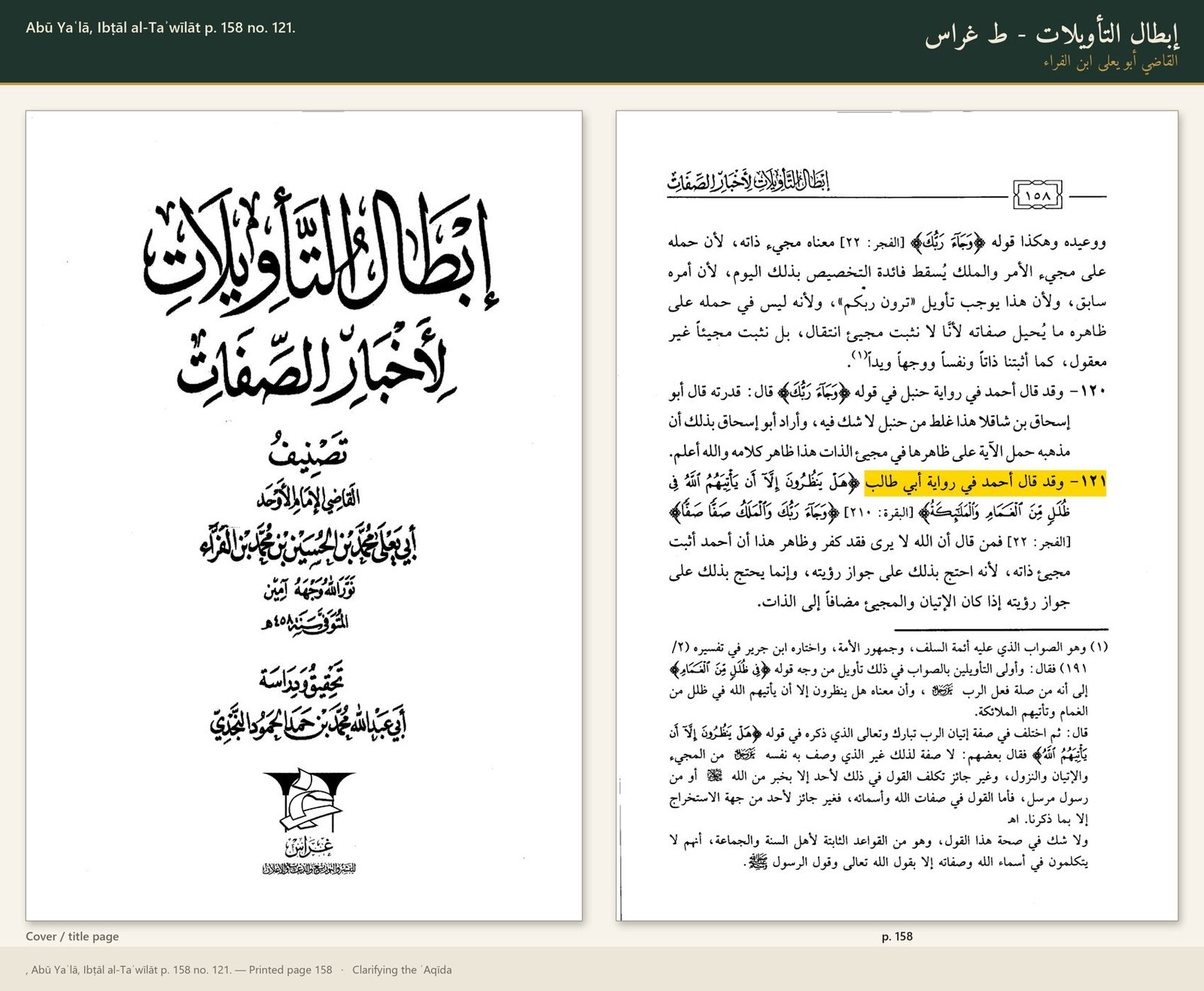
Imām Aḥmad cited “Do they await but that Allah should come to them in shadows of clouds” and “And your Lord comes, with the angels rank upon rank” as proof that Allah will be seen. Abū Yaʿlā explains that the proof holds only if the coming belongs to Allah Himself.
Ibn Kathīr said on the verse of al-Fajr:
لها" فيذهب فيشفع عند الله تعالى في أن يأتي لفصل القضاء، فيشفعه الله تعالى في ذلك.
وهي أول الشفاعات وهي المقام المحمود كما تقدم بيانه في سورة سبحان، فيجيء الربُّ ﵎ لفصل القضاء كما يشاء، والملائكة يجيئون بين يديه صفوفًا صفوفًا.
{And your Lord comes}, that is, to decide the judgement between His creation, and that is after they seek intercession with Him through the master of the children of Ādam without qualification, Muḥammad, may the blessings and peace of Allah be upon him, after they ask the Possessors of Resolve among the messengers one after another, and each of them says: I am not the one for that, until the turn reaches Muḥammad ﷺ, and he says: “I am for it, I am for it.” So he goes and intercedes with Allah, Exalted is He, that He come to decide the judgement, and Allah accepts his intercession in that. And it is the first of the intercessions, and it is the Praised Station, as was explained in Sūrat Subḥān. Then the Lord, Blessed and Exalted is He, comes to decide the judgement as He wills, and the angels come before Him in rank upon rank.
Ibn Kathīr, Tafsīr al-Qurʾān al-ʿAẓīm (Ibn al-Jawzī ed.) 7/563–564
Source, chain and authenticity
Read the page in the source edition (opens in a new tab)
The whole page in Arabic
وقوله تعالى: ﴿بَلْ لَا تُكْرِمُونَ الْيَتِيمَ﴾ فيه أمر بالإكرام له؛ كما جاء في الحديث الذي رواه عبد الله بن المبارك، عن سعيد بن أبي أيوب، عن يحيى بن أبي سليمان، عن يزيد بن أبي عتاب، عن أبي هريرة، عن النبي ﷺ: "خير بيت في المسلمين بيت فيه يتيم يحسن إليه، وشر بيت في المسلمين بيت فيه يتيم يساء إليه"، ثم قال بأصبعه: "أنا وكافل اليتيم في الجنة هكذا" (¬١).
وقال أبو داود: حدثنا محمد بن الصباح بن سفيان، أخبرنا عبد العزيز؛ يعني: ابن أبي [حازم] (¬٢)، حدثني أبي، عن سهل؛ يعني: ابن سعيد أن رسول الله ﷺ قال: "أنا وكافل اليتيم كهاتين في الجنة" وقرن بين أصبعيه الوسطى والتي تلي الإبهام (¬٣)،
﴿وَلَا تَحَاضُّونَ عَلَى طَعَامِ الْمِسْكِينِ (١٨)﴾ يعني: لا يأمرون بالإحسان إلى الفقراء والمساكين ويحث بعضهم على بعض في ذلك
﴿وَتَأْكُلُونَ التُّرَاثَ﴾ يعني: الميراث ﴿أَكْلًا لَمًّا﴾ أي: من أي جهة حصل لهم ذلك من حلال أو حرام
﴿وَتُحِبُّونَ الْمَالَ حُبًّا جَمًّا (٢٠)﴾ أي: كثيرًا، زاد بعضهم: فاحشًا.
﴿كَلَّا إِذَا دُكَّتِ الْأَرْضُ دَكًّا دَكًّا (٢١) وَجَاءَ رَبُّكَ وَالْمَلَكُ صَفًّا صَفًّا (٢٢) وَجِيءَ يَوْمَئِذٍ بِجَهَنَّمَ يَوْمَئِذٍ يَتَذَكَّرُ الْإِنْسَانُ وَأَنَّى لَهُ الذِّكْرَى (٢٣) يَقُولُ يَالَيْتَنِي قَدَّمْتُ لِحَيَاتِي (٢٤) فَيَوْمَئِذٍ لَا يُعَذِّبُ عَذَابَهُ أَحَدٌ (٢٥) وَلَا يُوثِقُ وَثَاقَهُ أَحَدٌ (٢٦) يَاأَيَّتُهَا النَّفْسُ الْمُطْمَئِنَّةُ (٢٧) ارْجِعِي إِلَى رَبِّكِ رَاضِيَةً مَرْضِيَّةً (٢٨) فَادْخُلِي فِي عِبَادِي (٢٩) وَادْخُلِي جَنَّتِي (٣٠)﴾.
يخبر تعالى عما يقع يوم القيامة من الأهوال العظيمة، فقال تعالى: ﴿كَلَّا﴾ أي: حقًا ﴿إِذَا دُكَّتِ الْأَرْضُ دَكًّا دَكًّا﴾ أي: وطئت ومهدت وسويت الأرض والجبال، وقام الخلائق من قبورهم لربهم ﴿وَجَاءَ رَبُّكَ﴾ يعني: لفصل القضاء بين خلقه وذلك بعدما يستشفعون إليه بسيد ولد آدم على الإطلاق محمد صلوات الله عليه وسلامه عليه، بعدما يسألون أولي العزم من الرسل واحدًا بعد واحد، فكلهم يقول: لست بصاحب ذاكم حتى تنتهي النوبة إلى محمد ﷺ فيقول: "أنا لها أنا
لها" فيذهب فيشفع عند الله تعالى في أن يأتي لفصل القضاء، فيشفعه الله تعالى في ذلك.
وهي أول الشفاعات وهي المقام المحمود كما تقدم بيانه في سورة سبحان (¬١)، فيجيء الربُّ ﵎ لفصل القضاء كما يشاء، والملائكة يجيئون بين يديه صفوفًا صفوفًا.
وقوله تعالى: ﴿وَجِيءَ يَوْمَئِذٍ بِجَهَنَّمَ﴾ قال الإمام مسلم بن الحجاج في صحيحه: حدثنا عمر بن حفص بن غياث، حدثنا أبي، عن العلاء بن خالد الكاهلي، عن شقيق، عن عبد الله هو: ابن مسعود قال: قال رسول الله ﷺ: "يؤتى بجهنم يومئذٍ لها سبعون ألف زمام مع كل زمام سبعون ألف ملك يجرونها" (¬٢). وهكذا رواه الترمذي، عن عبد الله بن عبد الرحمن الدارمي، عن عمر بن حفص به. ورواه أيضًا عن عبد بن حميد، عن أبي عامر، عن سفيان الثوري، عن العلاء بن خالد، عن شقيق بن سلمة -وهو أبو وائل- عن عبد الله بن مسعود قوله ولم يرفعه، وكذا رواه ابن جرير، عن الحسن بن عرفة، عن مروان بن معاوية الفزاري، عن العلاء بن خالد، عن شقيق، عن عبد الله قوله (¬٣).
وقوله تعالى: ﴿يَوْمَئِذٍ يَتَذَكَّرُ الْإِنْسَانُ﴾ أي: عمله وما كان أسلفه في قديم دهره وحديثه ﴿وَأَنَّى لَهُ الذِّكْرَى﴾ أي: وكيف تنفعه الذكرى
﴿يَقُولُ يَالَيْتَنِي قَدَّمْتُ لِحَيَاتِي (٢٤)﴾ يعني: يندم على ما كان سلف منه من المعاصي إن كان عاصيًا ويود لو كان ازداد من الطاعات إن كان طائعًا؛ كما قال الإمام أحمد بن حنبل: حدثنا علي بن إسحاق، حدثنا عبد الله -يعني: ابن المبارك-، حدثنا ثور بن يزيد، عن خالد بن معدان، عن جبير بن نفير، عن محمد بن أبي عميرة، وكان من أصحاب رسول الله ﷺ، قال: لو أن عبدًا خرّ على وجهه من يوم ولد إلى أن يموت هرمًا في طاعة الله لحقره يوم القيامة، ولودّ أنه رُدَّ إلى الدنيا كيما يزداد من الأجر والثواب (¬٤). وقد رواه أيضًا عن خالد بن معدان، عن عتبة بن عبيد، عن رسول الله ﷺ (¬٥).
قال الله تعالى: ﴿فَيَوْمَئِذٍ لَا يُعَذِّبُ عَذَابَهُ أَحَدٌ (٢٥)﴾ أي: ليس أحد أشد عذابًا من تعذيب الله من عصاه
﴿وَلَا يُوثِقُ وَثَاقَهُ أَحَدٌ (٢٦)﴾ أي: وليس أحد أشد قبضًا ووثقًا من الزبانية لمن كفر بربهم ﷿، وهذا في حق المجرمين من الخلائق والظالمين، فأما النفس الزكية المطمئنة وهي الساكنة الثابتة الدائرة مع الحق فيقال لها: ﴿يَاأَيَّتُهَا النَّفْسُ الْمُطْمَئِنَّةُ (٢٧)﴾
﴿ارْجِعِي إِلَى رَبِّكِ﴾ أي: إلى جواره وثوابه وما أعدَّ لعباده في جنته ﴿رَاضِيَةً﴾ أي: في نفسها ﴿مَرْضِيَّةً﴾ أي: قد رضيت عن الله ورضي عنها وأرضاها
﴿فَادْخُلِي فِي عِبَادِي (٢٩)﴾ أي: في جملتهم
﴿وَادْخُلِي جَنَّتِي (٣٠)﴾ وهذا يقال لها عند الاحتضار وفي يوم القيامة أيضًا، كما أن الملائكة يبشرون المؤمن عند احتضاره وعند قيامه من قبره، فكذلك ههنا.
The mufassir ties the Coming to the great intercession: the people seek a prophet to ask the Lord to come, the Prophet ﷺ intercedes that He come, and He comes. An intercession that the Lord “come” is meaningless if the Coming is the coming of His command or His reward, for the command and the reward are His to send at any moment without anyone’s intercession. And he says “as He wills”, which affirms the act and leaves its how to Him, and he distinguishes the Lord who comes from the angels who come before Him.
Part Three
The statements of the Salaf
Fifth Issue: The Salaf on the Descent and on Those Who Denied It
The Salaf did not meet the denial of the Descent with silence. When a Jahmī declared before the amir of Khurāsān that he disbelieved in the Lord described in these ḥadīths, Isḥāq ibn Rāhawayh answered him.
Al-Bayhaqī reported in al-Asmāʾ wa-l-Ṣifāt, from Isḥāq ibn Rāhawayh himself:
And Abū ʿAbdullāh al-Ḥāfiẓ informed us, saying: I heard Abū Jaʿfar Muḥammad ibn Ṣāliḥ ibn Hāniʾ say: I heard Aḥmad ibn Salamah say: I heard Isḥāq ibn Ibrāhīm al-Ḥanẓalī say: The gathering of the amir ʿAbdullāh ibn Ṭāhir brought me together with this innovator — meaning Ibrāhīm ibn Abī Ṣāliḥ — and the amir asked me about the reports of the Descent, and I recited them. Ibrāhīm said: “I disbelieve in a Lord who descends from heaven to heaven.” I said: “I believe in a Lord who does what He wills.” He said: and ʿAbdullāh was pleased with my words and rebuked Ibrāhīm. This is the meaning of the account.
al-Bayhaqī, al-Asmāʾ wa-l-Ṣifāt 2/375–376, no. 951
Source, chain and authenticity
Established. Al-Bayhaqī reported it through al-Ḥākim, from Muḥammad ibn Ṣāliḥ ibn Hāniʾ, from Aḥmad ibn Salamah, the companion of Muslim, who heard it from Isḥāq. Al-Dhahabī said of it in Tadhkirat al-Ḥuffāẓ: this is an authentic account, which al-Bayhaqī reported in al-Asmāʾ wa-l-Ṣifāt.
Ibrāhīm ibn Abī Ṣāliḥ said: I disbelieve in a Lord who descends from heaven to heaven. Isḥāq answered: I believe in a Lord who does what He wills. The exchange is the whole chapter in two sentences.
Al-Lālakāʾī reported from al-Fuḍayl ibn ʿIyāḍ:
Al-Fuḍayl ibn ʿIyāḍ said: If the Jahmī says to you, “I disbelieve in a Lord who descends, who moves”, then say: “I believe in a Lord who does what He wills.”
al-Lālakāʾī, Sharḥ Uṣūl Iʿtiqād Ahl al-Sunnah 3/501–502, no. 775
Source, chain and authenticity
Read the page in the source edition (opens in a new tab)
The whole page in Arabic
The same answer is reported from Ibn Maʿīn, in the words of the one who heard him.
And Aḥmad ibn ʿAlī al-Abbār said:
I heard Yaḥyā ibn Maʿīn say: If you hear the Jahmī say, “I disbelieve in a Lord who descends”, then say: “I believe in a Lord who does what He wants.”
al-Lālakāʾī, Sharḥ Uṣūl Iʿtiqād Ahl al-Sunnah 3/502, no. 776, through Aḥmad ibn ʿAlī al-Abbār
Source, chain and authenticity
Read the page in the source edition (opens in a new tab)
The whole page in Arabic
Al-Fuḍayl ibn ʿIyāḍ, the worshipper of the Ḥaram, and Yaḥyā ibn Maʿīn, the imam of the critics of ḥadīth, gave the same answer in the same words. It was the answer of the Sunnah to the Jahmī, transmitted from the worshippers and the scholars of ḥadīth alike.
And he reported Isḥāq's answer to the amir in a second account:
Abū ʿAbdullāh al-Ḥāfiẓ informed us, saying: I heard Abū Zakariyyā al-ʿAnbarī say: I heard Abū al-ʿAbbās Muḥammad ibn Isḥāq al-Thaqafī say: I heard al-Ḥasan ibn ʿAbd al-ʿAzīz al-Jarawī say: I heard the judge of Fāris say: Isḥāq ibn Rāhawayh said: I went in one day to ʿAbdullāh ibn Ṭāhir, and he said to me: O Abū Yaʿqūb, do you say that Allah descends every night? I said to him: And He is able. And ʿAbdullāh fell silent. Abū al-ʿAbbās said: A trustworthy man of our companions informed me, saying: I heard Isḥāq ibn Rāhawayh say: I went in to ʿAbdullāh ibn Ṭāhir, and he said to me: O Abū Yaʿqūb, do you say that Allah descends every night? I said: O amir, Allah, Exalted is He, sent us a Prophet, and reports were transmitted to us from him by which we make blood lawful and by which we make it unlawful, by which we make marriages lawful and by which we make them unlawful, by which we make property permissible and by which we make it unlawful. If this is sound, that is sound; and if this is false, that is false. He said: and ʿAbdullāh held back.
al-Bayhaqī, al-Asmāʾ wa-l-Ṣifāt 2/375, no. 950
Source, chain and authenticity
And to the amir himself Isḥāq gave the argument that binds every Muslim. The ḥadīths of the Descent are transmitted by the same chains by which blood, marriages and property are made lawful and unlawful. If these chains are sound for the rulings, they are sound for the Descent; and if they are false for the Descent, they are false for the rulings. Whoever rejects the Descent while accepting the rulings has used two scales.
The judgement of these imams falls on the doctrine, whoever holds it. The Jahmī of Khurāsān said “I disbelieve in a Lord who descends”; the one who says today that the Descent is the descent of a command or a mercy has said the same thing in other words: that the Lord Himself does not descend. The answer of Isḥāq, al-Fuḍayl and Ibn Maʿīn is the answer to both.
A related question has been raised about the sitting. Imām Aḥmad’s son gave a chapter to the Kursī, and he began it with what he saw his father do.
ʿAbdullāh said in Kitāb al-Sunnah:
[Chapter:] What was asked about what has been narrated concerning the Kursī and the sitting of the Lord, Mighty and Majestic, upon it. 584. I saw my father, may Allah have mercy on him, authenticate these ḥadīths, the ḥadīths of the vision [of Allah], and adopt them; and he compiled them in a book and narrated them to us.
ʿAbd Allāh ibn Aḥmad, al-Sunnah 1/300 no. 584
Source, chain and authenticity
His father authenticated the ḥadīths of the vision and adopted them, and this is what the sentence establishes. The heading of the chapter groups those with the reports on the Kursī, and what Wakīʿ said in that chapter about al-Aʿmash and Sufyān is his own testimony. He rebuked someone who shuddered at such a report, and he said that the earlier imams narrated them without denying them. Those are two separate things: that they did not deny such reports, which is established, and the authenticity of each report, which is examined on its own chain.
ʿAbd Allāh ibn Aḥmad reported in al-Sunnah:
1021. My father narrated to me: Wakīʿ narrated to us, from Sufyān, from ʿAmmār al-Duhnī, from Muslim al-Baṭīn, from Saʿīd ibn Jubayr, from Ibn ʿAbbās, may Allah be pleased with them both, who said: The Kursī is the place of His two feet, and the Throne: no one can measure its measure.
ʿAbd Allāh ibn Aḥmad, al-Sunnah 2/454 no. 1021; also 1/301 (323/542)
Source, chain and authenticity
Al-Ḥākim reported in al-Mustadrak:
Abū al-ʿAbbās Muḥammad ibn Aḥmad al-Maḥbūbī narrated to us: Muḥammad ibn Muʿādh narrated to us: Abū ʿĀṣim narrated to us: Sufyān narrated to us, from ʿAmmār al-Duhnī, from Muslim al-Baṭīn, from Saʿīd ibn Jubayr, from Ibn ʿAbbās, who said: The Kursī is the place of His two feet, and the Throne: its measure cannot be measured. [al-Ḥākim:] This ḥadīth is ṣaḥīḥ on the condition of the two Shaykhs, and they did not transmit it. [al-Dhahabī, Talkhīṣ:] On the condition of al-Bukhārī and Muslim.
al-Ḥākim, al-Mustadrak 2/310 no. 3116 (ed. al-ʿIlmiyyah); ed. al-Risālah 4/145 (1424/2567). Gradings: al-Ḥākim and al-Dhahabī, as stated
Source, chain and authenticity
Al-Bayhaqī said in al-Asmāʾ wa-l-Ṣifāt:
859. … from ʿUmārah ibn ʿUmayr, from Abū Mūsā, may Allah be pleased with him, who said: The Kursī is the place of the two feet, and it creaks as a camel-saddle creaks. [al-Bayhaqī:] We have also narrated this from Ibn ʿAbbās, and we mentioned that its meaning, as we see it, is that it is placed relative to the Throne as the place of the feet relative to a couch (sarīr), and that there is no affirmation of a place for Allah, glorified be He, in it.
al-Bayhaqī, al-Asmāʾ wa-l-Ṣifāt 2/296–297 no. 859. Abū Mūsā's report also in al-Ṭabarī, Jāmiʿ al-Bayān 4/538, and ʿAbd Allāh ibn Aḥmad, al-Sunnah (via al-Jāmiʿ li-ʿUlūm Aḥmad 3/307)
Source, chain and authenticity
Al-Ṭabarī reported in Jāmiʿ al-Bayān:
حدَّثني المثنَّى، قال: ثنا إسحاقُ، قال: ثنا أبو زُهَيرٍ، عن جُويبرٍ، عن الضَّحَّاكِ قولَه: ﴿وَسِعَ كُرْسِيُّهُ السَّمَاوَاتِ وَالْأَرْضَ﴾ قال: كُرْسِيُّه الذي يُوضَعُ تحتَ العَرْشِ الذي يَجْعَلُ الملوكُ عليه أقدامَهم
Mūsā ibn Hārūn narrated to me: ʿAmr ibn Ḥammād narrated to us: Asbāṭ narrated to us, from al-Suddī: 'His Kursī encompasses the heavens': the heavens and the earth are within the Kursī, and the Kursī is in front of the Throne, and it is the place of His two feet. … al-Muthannā narrated to me: Isḥāq narrated to us: Abū Zuhayr narrated to us, from Juwaybir, from al-Ḍaḥḥāk, on His word 'His Kursī encompasses the heavens and the earth': He said: His Kursī, which is placed beneath the Throne, on which kings put their feet.
al-Ṭabarī, Jāmiʿ al-Bayān (ed. al-Turkī) 4/538, on al-Baqarah 255
Source, chain and authenticity
Read the page in the source edition (opens in a new tab)
The whole page in Arabic
حدَّثني عليُّ بنُ مُسلمٍ الطُّوسيُّ، قال: ثنا عبدُ الصمدِ بنُ عبد الوارثِ، قال: ثنى أبي، قال: ثنا محمدُ بنُ جُحَادةَ، عن سلَمةَ بن كُهَيلٍ، عن عُمارةَ بن عُميرٍ، عن أبي موسى، قال: الكُرْسيُّ مَوْضِعُ القدَمين، وله أَطِيطٌ كَأَطِيطِ الرَّحْلِ (¬١).
حدَّثني موسى بنُ هارونَ، قال: ثنا عمرُو بنُ حمادٍ، قال: ثنا أسباطُ، عن السديِّ: ﴿وَسِعَ كُرْسِيُّهُ السَّمَاوَاتِ﴾: فإن السماواتِ والأرضَ في جوفِ الكُرْسِيِّ، والكُرْسِيُّ بين يَدَيِ العَرْشِ، وهو مَوْضِعُ قَدَميْه (¬٢).
حدَّثني المثنَّى، قال: ثنا إسحاقُ، قال: ثنا أبو زُهَيرٍ، عن جُويبرٍ، عن الضَّحَّاكِ قولَه: ﴿وَسِعَ كُرْسِيُّهُ السَّمَاوَاتِ وَالْأَرْضَ﴾ قال: كُرْسِيُّه الذي يُوضَعُ تحتَ العَرْشِ الذي يَجْعَلُ الملوكُ عليه أقدامَهم (¬٣).
حدَّثنا أحمدُ بنُ إسحاقَ، قال: ثنا أبو أحمدَ الزُّبَيْرِيُّ، عن سفيانَ، عن عمارٍ الدُّهْنيِّ، عن مسلمٍ البَطِينِ، قال: الكُرْسِيُّ مَوْضِعُ القدمَيْن (¬٤).
Al-Dāraquṭnī reported in al-Ṣifāt:
فَقَالَ: هَذِهِ الْأَحَادِيثُ صِحَاحٌ حَمَلَهَا أَصْحَابُ الْحَدِيثِ والفقهاء بعضهم على بَعْضٍ، وهِيَ عِنْدَنَا حَقٌّ لَا نَشُكُّ فِيهَا، وَلَكِنْ إِذَا قِيلَ: كَيْفَ وَضَعَ قَدَمَهُ؟ وَكَيْفَ ضَحِكَ؟ قُلْنَا: لَا يُفَسَّر هَذَا وَلَا سَمِعْنَا أَحَدًا يُفَسِّرُهُ
57. Muḥammad ibn Makhlad narrated to us: al-ʿAbbās ibn Muḥammad al-Dūrī narrated to us, saying: I heard Abū ʿUbayd al-Qāsim ibn Sallām, when he mentioned the chapter narrated about the vision, the Kursī and the place of the two feet, our Lord's laughing at the despair of His servants while His change [for them] is near, where our Lord was before He created the heaven, and that Hell will not be filled until your Lord, Mighty and Majestic, places His foot in it and it says 'Enough, enough', and reports like these. He said: These ḥadīths are authentic; the people of ḥadīth and the jurists have carried them one from another, and they are true according to us; we do not doubt them. But if it is said: How did He place His foot? How did He laugh? we say: This is not explained, and we have not heard anyone explain it.
al-Dāraquṭnī, al-Ṣifāt (ed. al-Faqīhī) pp. 68–69 no. 57; ed. al-Ghunaymān p. 39; Abū Yaʿlā, Ibṭāl al-Taʾwīlāt p. 53; al-Aṣbahānī, al-Ḥujjah 1/475
Source, chain and authenticity
Read the page in the source edition (opens in a new tab)
The whole page in Arabic
٥٧ حدَّثنا مُحَمَّدُ بْنُ مَخْلَدٍ٢، ثنا الْعَبَّاسُ بْنُ مُحَمَّدٍ الدُّورِيُّ٣ قَالَ: سَمِعْتُ أَبَا عُبَيْدٍ الْقَاسِمَ بْنَ سَلَّامٍ٤، وَذَكَرَ الْبَابَ الَّذِي يروى في الرُّؤْيَةَ وَالْكُرْسِيَّ وَمَوْضِعَ الْقَدَمَيْنِ، وَضَحِكِ رَبِّنَا مِنْ قُنُوطِ عِبَادِهِ، وَقُرْبِ غِيَرِهِ، وَأَيْنَ كَانَ رَبُّنَا قَبْلَ أَنْ يَخْلُقَ السَّمَاءَ وَأَنَّ جَهَنَّمَ لَا تَمْتَلِئُ حَتَّى يَضَعَ رَبُّكَ ﷿ قَدَمَهُ فِيهَا فَتَقُولُ: قَطْ قَطْ، وَأَشْبَاهَ هَذِهِ الْأَحَادِيثِ.
فَقَالَ: هَذِهِ الْأَحَادِيثُ صِحَاحٌ حَمَلَهَا أَصْحَابُ الْحَدِيثِ والفقهاء بعضهم على بَعْضٍ، وهِيَ عِنْدَنَا حَقٌّ لَا نَشُكُّ فِيهَا، وَلَكِنْ إِذَا قِيلَ: كَيْفَ وَضَعَ قَدَمَهُ؟ وَكَيْفَ ضَحِكَ؟ قُلْنَا: لَا يُفَسَّر هَذَا وَلَا سَمِعْنَا أَحَدًا يُفَسِّرُهُ١.
٥٨ حدَّثنا مُحَمَّدُ بْنُ مَخْلَدٍ، ثنا الْعَبَّاسُ بْنُ مُحَمَّدٍ الدُّورِيُّ، قَالَ: سَمِعْتُ يَحْيَى بن معين يقول: شهدت زكرياء بن عدي يسأل، وكيف؟ فَقَالَ: يَا أَبَا سُفْيَانَ إِنَّ هَذِهِ الْأَحَادِيثُ يَعْنِي مِثْلَ الْكُرْسِيِّ مَوْضِعِ الْقَدَمَيْنِ، وَنَحْوَ هَذَا. فَقَالَ وَكِيعٌ: أَدْرَكْنَا إِسْمَاعِيلَ بْنَ أَبِي خَالِدٍ، وَسُفْيَانَ وَمَسْعُودًا٢ يُحَدِّثُونَ بَهَذِهِ الْأَحَادِيثِ وَلَا يُفَسِّرُونَ شَيْئًا.
٥٩ حدَّثنا مُحَمَّدُ بْنُ مَخْلَدٍ، ثنا مُحَمَّدُ بْنُ إِسْحَاقَ الصَّاغَانِيُّ، ثنا مُحَمَّدُ بْنُ سُلَيْمَانَ لُوَيْنٌ٣ قَالَ: قِيلَ لِابْنِ عُيَيْنَةَ: هَذِهِ الْأَحَادِيثُ التي
Al-Dārimī said in Naqḍ:
(٨٤) حَدَّثَنَاه عَبْدُ اللهِ بْنُ أَبِي شَيْبَةَ، وَيَحْيَى الحِمَّانِيُّ، عَنْ وَكِيعٍ، عَنْ سُفْيَانَ، عَنْ عَمَّارٍ الدُّهْنِيِّ، عَنْ مُسْلِمٍ البَطِينِ، عَنْ سَعِيدِ بن جُبَير، عَن ابْنِ عَبَّاسٍ قَالَ: «الكُرْسِيُّ مَوْضِعُ القَدَمَيْنِ، وَالعَرْشُ لَا يُقَدِّرُ قَدْرَهُ إِلَّا الله ﷿» (٢).
فَهَذَا الَّذِي عَرَفْنَاهُ عَنِ ابْنِ عَبَّاسٍ صَحِيحًا مَشْهُورًا.
We have narrated, O Marīsī, from the trustworthy, well-known imams, from Ibn ʿAbbās, on the explanation of 'the foot', the opposite of the interpretation you claimed. (84) ʿAbd Allāh ibn Abī Shayba and Yaḥyā al-Ḥimmānī narrated it to us, from Wakīʿ, from Sufyān, from ʿAmmār al-Duhnī, from Muslim al-Baṭīn, from Saʿīd ibn Jubayr, from Ibn ʿAbbās, who said: 'The Kursī is the place of the two feet, and the Throne: no one can measure its measure except Allah, Mighty and Majestic.' This is what we know from Ibn ʿAbbās as authentic and well known.
al-Dārimī, Naqḍ (ed. al-Shawāmī) p. 146 no. 84; ed. al-Almaʿī 1/395–401
Source, chain and authenticity
Read the page in the source edition (opens in a new tab)
The whole page in Arabic
وَادَّعَيْتَ أَيُّهَا المَرِيسِيُّ أَنَّ الحَدِيثَ حَقٌّ، وَمَعْنَاهُ عِنْدَكَ: أَنَّهَا لَا تَمْتَلِئُ حَتَّى يَضَعَ الجَبَّارُ قَدَمَهُ فِيهَا، فَقُلْتَ: مَعْنَى «قَدَمِهِ»: أَهْلُ الشِّقْوَةِ الَّذِينَ سَبَقَ لَهُمْ فِي عِلْمِهِ أَنَّهُمْ صَائِرُونَ إِلَيْهَا، كَمَا قَالَ ابْنُ عَبَّاسٍ -بِبَاطِلِ زَعْمِكَ- فِي تَفْسِيرِ قَوْلِ الله تَعَالَى: ﴿وَبَشِّرِ الَّذِينَ آمَنُوا أَنَّ لَهُمْ قَدَمَ صِدْقٍ عِنْدَ رَبِّهِمْ﴾ [يونس: ٢] قَالَ: «مَا قَدَّمُوا مِنْ أَعْمَالِهِمْ».
فَقَدْ رَوَيْنَا أَيُّهَا المَرِيسِيُّ عَنِ الثِّقَاتِ الأَئِمَّةِ المَشْهُورِينَ، عَنِ ابْنِ عَبَّاسٍ ﵄ فِي تَفْسِيرِ القَدَمِ خِلَافَ مَا ادَّعَيْتَ مِنْ تَأْوِيلِكَ هَذَا.
(٨٤) حَدَّثَنَاه عَبْدُ اللهِ بْنُ أَبِي شَيْبَةَ، وَيَحْيَى الحِمَّانِيُّ، عَنْ وَكِيعٍ، عَنْ سُفْيَانَ، عَنْ عَمَّارٍ الدُّهْنِيِّ، عَنْ مُسْلِمٍ البَطِينِ، عَنْ سَعِيدِ بن جُبَير، عَن ابْنِ عَبَّاسٍ قَالَ: «الكُرْسِيُّ مَوْضِعُ القَدَمَيْنِ، وَالعَرْشُ لَا يُقَدِّرُ قَدْرَهُ إِلَّا الله ﷿» (٢).
فَهَذَا الَّذِي عَرَفْنَاهُ عَنِ ابْنِ عَبَّاسٍ صَحِيحًا مَشْهُورًا.
فَمَا بَالُكَ تَحِيدُ عَنِ المَشْهُورِ المَنْصُوصِ مِنْ قَوْله وتتعلق بالمغمور مِنْهُ، الملتبس الَّذِي يتَحَمَّل المعَانِي.
ʿAbd Allāh ibn Aḥmad reported in Kitāb al-Sunnah:
587 — My father narrated to me: Wakīʿ narrated to us the hadith of Isrāʾīl, from Abū Isḥāq, from ʿAbd Allāh ibn Khalīfah, from ʿUmar (may Allah be pleased with him), who said: “When the Lord, Mighty and Majestic, sits upon the Kursī…” A man, whom my father named, shuddered in Wakīʿ's presence; Wakīʿ became angry and said: “We found al-Aʿmash and Sufyān narrating these hadiths, not rejecting them.”
ʿAbd Allāh ibn Aḥmad, Kitāb al-Sunnah 1/302 no. 587
Source, chain and authenticity
Al-Qāḍī Ḥusayn al-Marwarrūdhī (d. 462) said in al-Taʿlīqah:
اختلف أهل القبلة إلا ما نص عليه الشافعي ﵀، وهم الذين ينفون علم الله تعالى بالمعدومات ويقولون: لم يعلم الله الأشياء حتى كانت، وهذا خلاف قوله تعالى (ولو ردوا لعادوا لما نهوا عنه)، فيكفر بهذه المخالفة، وكذا من قال بخلق القرآن، أو لم يؤمن بالقدر أو اعتقد ان الله تعالى جالس على العرش، فإنه يحكم بكفره، ولا تصح الصلاة خلف هؤلاء.
As for the people of differing schools and those who dissent in the fundamentals (uṣūl), it is to be examined: if we declare him a disbeliever for his belief, prayer behind him is not valid; and the position of most jurists is that he is not declared a disbeliever. [None of] the people of the qiblah [are declared disbelievers] except what al-Shāfiʿī, may Allah have mercy on him, stated explicitly: they are those who deny Allah's knowledge of non-existent things and say 'Allah did not know things until they existed', which contradicts His word 'And if they were returned, they would return to what they were forbidden' [al-Anʿām 28]; such a one is declared a disbeliever for this contradiction. And likewise whoever says the Qurʾān is created, or does not believe in the decree, or believes that Allah, the Exalted, is sitting (jālis) upon the Throne: he is judged a disbeliever, and prayer behind these is not valid.
al-Qāḍī Ḥusayn al-Marwarrūdhī (d. 462), al-Taʿlīqah 2/1031
Source, chain and authenticity
Read the page in the source edition (opens in a new tab)
The whole page in Arabic
فأما أهل المذاهب المختلفة والمخالفون في الأصول ينظر فيه إن كنا نكفره باعتقاده لا تصح الصلاة خلفه، ومذهب أكثر الفقهاء ألا يكفر.
اختلف أهل القبلة إلا ما نص عليه الشافعي ﵀، وهم الذين ينفون علم الله تعالى بالمعدومات ويقولون: لم يعلم الله الأشياء حتى كانت، وهذا خلاف قوله تعالى (ولو ردوا لعادوا لما نهوا عنه)، فيكفر بهذه المخالفة، وكذا من قال بخلق القرآن، أو لم يؤمن بالقدر أو اعتقد ان الله تعالى جالس على العرش، فإنه يحكم بكفره، ولا تصح الصلاة خلف هؤلاء.
قال: وكان القفال: ﵀ يرى الصلاة خلف كل واحد المعتزلة والروافض للقبلة.
وكل من لا يكفر من أهل القبلة، والمظهر للبدع تقبل شهادته، وتكره الصلاة خلفه.
ومن سب النبي ﷺ يكفر بذلك لقوله ﷺ، من سب نبيا فد كفر، ومن سب صحابيا فقد فسق.
فأما من سب الشيخين، أو الحسينين ففيه وجهان:
أحدهما: يكفر، لأن الأمة اجتمعت على إمامتهم.
والثاني: يفسق لأجل الخبر، ولا يكفر.
Part Four
The imams after them
Sixth Issue: ʿAbd al-Ghanī al-Maqdisī and the Cost of Affirming the Descent
Al-Dhahabī recorded in Siyar Aʿlām al-Nubalāʾ what ʿAbd al-Ghanī suffered for these ḥadīths:
فَعقدُوا لَهُ مَجْلِساً، فَنَاظرهُم، فَأَخذُوا عَلَيْهِ موَاضِع، مِنْهَا: قَوْلُهُ: لاَ أُنزهه تَنزِيهاً يَنفِي حَقِيْقَة النُّزَول، وَمِنْهَا: كَانَ اللهُ وَلاَ مَكَان، وَلَيْسَ هُوَ اليَوْم عَلَى مَا كَانَ، وَمِنْهَا: مَسْأَلَة الْحَرْف وَالصّوت، فَقَالُوا: إِذَا لَمْ يَكُنْ عَلَى مَا كَانَ، فَقَدْ أَثْبَت لَهُ المَكَان، وَإِذَا لَمْ تنَزهه عَنْ حقِيْقَة النُّزَول، فَقَدْ جوزت عَلَيْهِ الانتقَالَ، وَأَمَّا الْحَرْف وَالصّوت فَلَمْ يَصحَّ عَنْ إِمَامك ، وَإِنَّمَا قَالَ إِنَّهُ كَلاَم اللهِ، يَعْنِي غَيْر مَخْلُوْق.
وَارتفعت الأَصوَات، فَقَالَ وَالِي القَلْعَة الصَّارم برغش: كُلّ هَؤُلاَءِ عَلَى ضلاَلَة وَأَنْت عَلَى الحَقِّ؟
قَالَ: نَعَمْ.
فَأَمر بِكسّر مِنْبَره.
And Abū al-Muẓaffar the preacher [Sibṭ Ibn al-Jawzī] mentioned in Mirʾāt al-Zamān, saying: al-Ḥāfiẓ ʿAbd al-Ghanī used to read hadith after the Friday prayer. The judge Muḥyī al-Dīn, the preacher Ḍiyāʾ al-Dīn and a group gathered and went up to the citadel and said to its governor: “This man has misled the people and teaches anthropomorphism (tashbīh).” So they convened a session for him and he debated them. They took him to task on points, among them his statement: “I do not exalt Him (lā unazzihuhu) with an exaltation that negates the reality of descent”; and among them: “Allah was when there was no place, and He is not today as He was”; and among them: the question of letter and sound. They said: “If He is not as He was, then you have affirmed a place for Him; and if you do not exalt Him above the reality of descent, then you have permitted transfer (intiqāl) for Him; and as for letter and sound, that is not authentic from your imam — he only said that it is the Speech of Allah, meaning uncreated.” Voices were raised, and the governor of the citadel, al-Ṣārim Barghash, said: “All of these are astray and you are upon the truth?” He said: “Yes.” So he ordered his pulpit to be broken.
al-Dhahabī, Siyar Aʿlām al-Nubalāʾ 21/463; the Dār al-Ḥadīth edition 16/32
Source, chain and authenticity
Read the page in the source edition (opens in a new tab)
The whole page in Arabic
فَلَمَّا رَآهَا الكَامِل، قَالَ: أَيش أَقُوْل فِي هَذَا يَقُوْلُ بقول الله وَقول رَسُوْله ﷺ؟!
قُلْتُ (١) : وَذَكَرَ أَبُو المُظَفَّرِ الوَاعِظ فِي (مِرَآة الزَّمَانِ) ، قَالَ: كَانَ الحَافِظ عَبْد الغَنِيِّ يَقرَأُ الحَدِيْث بَعْد الجُمُعَة، قَالَ: فَاجْتَمَعَ القَاضِي مُحْيِي الدِّيْنِ، وَالخَطِيْب ضِيَاء الدِّيْنِ، وَجَمَاعَة، فَصعدُوا إِلَى القَلْعَة، وَقَالُوا لوَالِيهَا: هَذَا قَدْ أَضلّ النَّاس، وَيَقُوْلُ بالتّشبيه.
فَعقدُوا لَهُ مَجْلِساً، فَنَاظرهُم، فَأَخذُوا عَلَيْهِ موَاضِع، مِنْهَا: قَوْلُهُ: لاَ أُنزهه تَنزِيهاً يَنفِي حَقِيْقَة النُّزَول، وَمِنْهَا: كَانَ اللهُ وَلاَ مَكَان، وَلَيْسَ هُوَ اليَوْم عَلَى مَا كَانَ، وَمِنْهَا: مَسْأَلَة الْحَرْف وَالصّوت، فَقَالُوا: إِذَا لَمْ يَكُنْ عَلَى مَا كَانَ، فَقَدْ أَثْبَت لَهُ المَكَان، وَإِذَا لَمْ تنَزهه عَنْ حقِيْقَة النُّزَول، فَقَدْ جوزت عَلَيْهِ الانتقَالَ، وَأَمَّا الْحَرْف وَالصّوت فَلَمْ يَصحَّ عَنْ إِمَامك (٢) ، وَإِنَّمَا قَالَ إِنَّهُ كَلاَم اللهِ، يَعْنِي غَيْر مَخْلُوْق.
وَارتفعت الأَصوَات، فَقَالَ وَالِي القَلْعَة الصَّارم برغش: كُلّ هَؤُلاَءِ عَلَى ضلاَلَة وَأَنْت عَلَى الحَقِّ؟
قَالَ: نَعَمْ.
فَأَمر بِكسّر مِنْبَره.
قَالَ: وَخَرَجَ الحَافِظ إِلَى بَعْلَبَكَّ، ثُمَّ سَافر إِلَى مِصْرَ ... ، إِلَى أَنْ قَالَ:
فَأَفتَى فُقَهَاء مِصْر بِإِباحَة دَمه، وَقَالُوا: يُفسد عقَائِد النَّاس، وَيذَكَرَ التّجسيم.
فَكَتَبَ الوَزِيْر بنفِيه إِلَى المَغْرِب، فَمَاتَ الحَافِظ قَبْل وُصُوْل الكِتَاب.
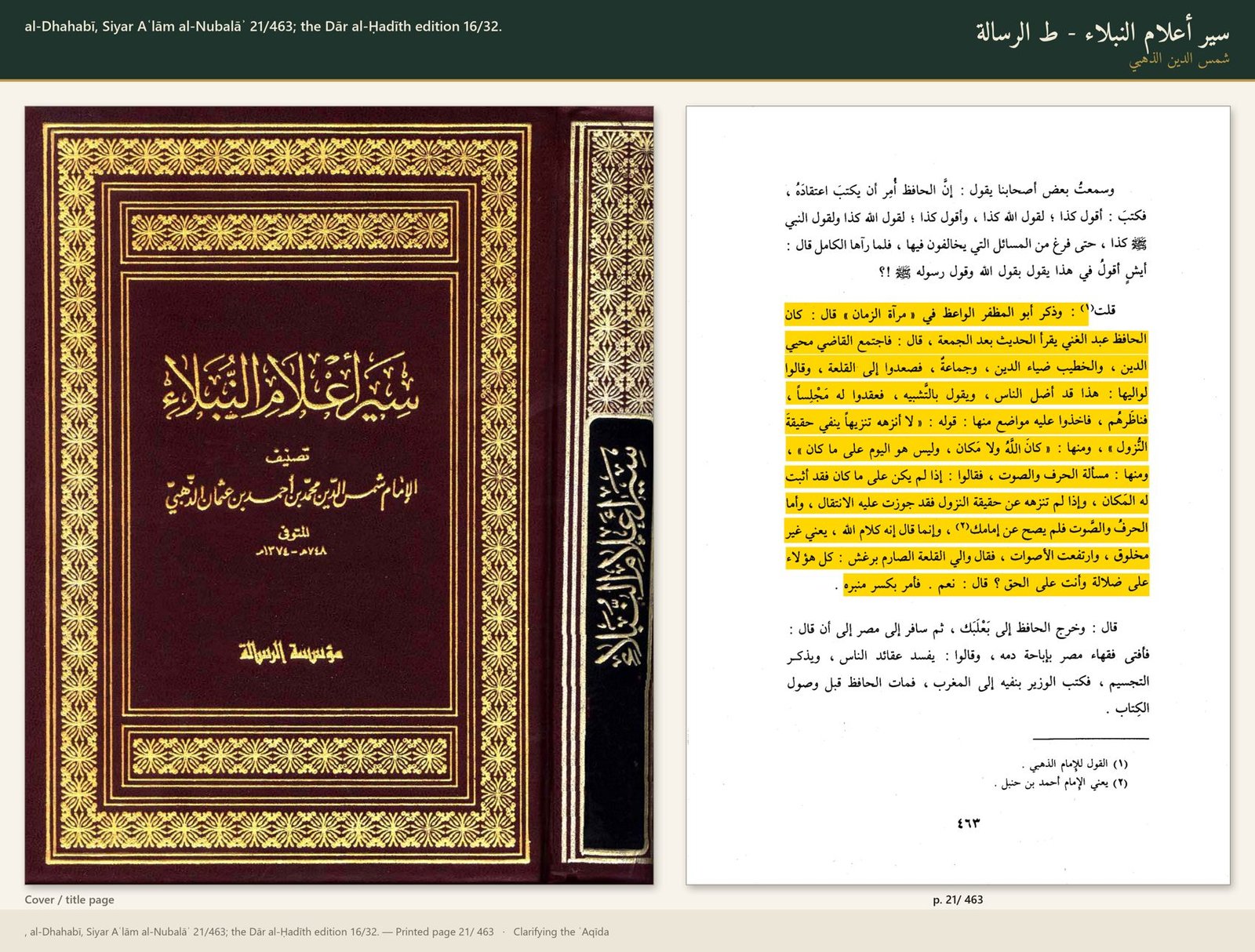
When ʿAbd al-Ghanī read these ḥadīths in Damascus, the judges and the scholars of the theologians objected, and the governor asked him whether all of them were astray and he alone upon the truth. He answered: Yes. He stood alone against the judges and the governor of his city, and he weighed the matter by the texts and did not count the men.
Part Five
Principles drawn from the evidence
Seventh Issue: The Rules Concerning the Attributes of Action
The first rule: the attributes of action are those that Allah does when He wills, such as descending, coming, rising over the Throne, being pleased and being angry. Ahl al-Sunnah affirm them as real, and they say that Allah is not hindered from doing what He wills when He wills.
The second rule: the Descent does not mean that the Throne is left empty of Him. Imām Isḥāq ibn Rāhawayh and others answered this question: He descends as He wills, and He is above the Throne. Whoever imagines that the Descent of Allah is like the descent of a creature, which leaves one place for another, has likened first, and then denied what he had likened.
The third rule: Pleasure and Anger, Love and Hatred, are attributes of Allah in their reality. The Ashʿarīs interpret them as the will to reward or punish. But Allah distinguished between them and His will: He said, “That is because they followed what angered Allah and hated what pleased Him, so He made their deeds worthless.” The anger came first, and the voiding of the deeds came from it.
Part Six
The claims of the opponents and their refutation
The Jahmiyyah, and after them the later Ashʿarīs and Māturīdīs: “His command descends”
The claim
Said by Bishr al-Marīsī and the Jahmiyyah, and by those of the later scholars who interpreted the ḥadīth
The Descent is the descent of His command, His mercy, or an angel. And: “a descent without movement is meaningless, so the ḥadīth cannot be taken as it is.”
Its origin The Jahmī Ibrāhīm ibn Abī Ṣāliḥ, before the amir of Khurāsān: “I disbelieve in a Lord who descends from heaven to heaven.”
The response
Al-Dārimī quoted his opponent in the Naqḍ:
The opponent claimed that Allah does not descend Himself; only His command and His mercy descend, and He is upon the Throne in every place, without leaving; because He is the Ever-Living, the Self-Subsisting, and the Self-Subsisting, as he claims, is the one who does not depart.
al-Dārimī, Naqḍ ʿalā al-Marīsī (ed. al-Shawāmī) p. 70
Source, chain and authenticity
Read the page in the source edition (opens in a new tab)
The whole page in Arabic
فَادَّعَى المُعَارِضُ أَنَّ اللهَ لَا يَنْزِلُ بِنَفْسِهِ إِنَّمَا يَنْزِلُ أَمْرُهُ وَرَحْمَتُهُ، وَهُوَ عَلَى العَرْشِ بِكُلِّ مَكَانٍ، مِنْ غَيْرِ زَوَالٍ؛ لِأَنَّهُ الحَيُّ القَيُّومُ، وَالقَيُّومُ -بِزَعْمِهِ- مَنْ لَا يَزُولُ.
فَيُقَالُ لِهَذَا المُعَارِضِ: وَهَذَا أَيْضًا مِنْ حُجَجِ النِّسَاءِ وَالصِّبْيَانِ وَمَنْ لَيْسَ عِنْدَهُ بَيَانٌ، وَلَا لِمَذْهَبِهِ بُرْهَانٌ؛ لِأَنَّ أَمْرَ اللهِ وَرَحْمَتَهُ يَنْزِلُ فِي كُلِّ سَاعَةٍ وَوَقْتٍ وَأَوَانٍ، فَمَا بَالُ النَّبِيِّ ﷺ يَحُدُّ لِنُزُولِهِ اللَّيْلَ دُونَ النَّهَارِ؟
وَيُوَقِّتُ مِنَ اللَّيْلِ شَطْرَهُ أَوِ الأَسْحَارَ؟ أَفَبِأَمْرِهِ وَرَحْمَتِهِ يَدْعُو العِبَادَ إِلَى الِاسْتِغْفَارِ؟ أَوْ يَقْدِرُ الأَمْرُ وَالرَّحْمَةُ أَنْ يَتَكَلَّمَا دُونَهُ؛ فَيَقُولَا: هَلْ مِنْ دَاعٍ فَأُجِيبَ؟! هَلْ مِنْ مُسْتَغْفِرٍ فأعفر لَهُ؟! هَلْ مِنْ سَائِلٍ فَأُعْطِيَ؟!
فَإِنْ قَرَّرْتَ مَذْهَبَكَ لَزِمَكَ أَنْ تَدَّعِي أَن الرَّحْمَة وَالأَمْرَ اللَّذَيْنِ يَدْعُوَانِ إِلَى الإِجَابَةِ وَالِاسْتِغْفَارِ بِكَلَامِهِمَا دُونَ الله. هَذَا مُحَالٌ عِنْدَ السُّفَهَاءِ، فَكَيْفَ عَنْدَ الفُقَهَاءِ؟! وَقَدْ عَلِمْتُمْ ذَلِكَ وَلَكِنْ تُكَابِرُونَ.
وَمَا بَالُ رَحْمَتِهِ وَأَمْرِهِ يَنْزِلَانِ مِنْ عِنْدِهِ شَطْرَ اللَّيْلِ، ثُمَّ لَا يَمْكُثَانِ إِلَّا إِلَى طُلُوعِ الفَجْرِ ثُمَّ يُرْفَعَانِ [٧/ظ]؛ لِأَنَّ رِفَاعَةَ يَرْوِيهِ يَقُولُ فِي حَدِيثِهِ: «حَتَّى يَنْفَجِرَ الفَجْرُ».
وَقَدْ عَلِمْتُمْ -إِنْ شَاءَ الله- أَنَّ هَذَا التَّأْوِيلَ أَبْطَلُ بَاطِلٍ، لَا يَقْبَلُهُ إِلَّا كُلُّ جَاهِلٍ.
* * *
The opponent in al-Dārimī’s book rests on two things: that the Self-Subsisting does not leave His place, and that His command and His mercy are what descend. A third argument, from Ibrāhīm’s rejection of what sets, was used on the same ḥadīth, as Ibn Baṭṭāl records.
Ibn Baṭṭāl gave the argument from Ibrāhīm in his commentary on al-Bukhārī:
One of the scholars was asked about the ḥadīth of the Descent, and he said: its explanation is the saying of Ibrāhīm when the star set: “I do not love those that set”. So he sought a Lord on whom transfer and movements are not possible and to whom descent does not occur in succession. And Allah praised him for that and commended him in His Book, saying “Thus did We show Ibrāhīm the dominion of the heavens and the earth, and that he be among those who are certain”, so He described him as being certain because of this saying of his.
Ibn Baṭṭāl, Sharḥ Ṣaḥīḥ al-Bukhārī 3/139
Source, chain and authenticity
Read the page in the source edition (opens in a new tab)
The whole page in Arabic
Ibn Baṭṭāl’s scholar made the setting of the star the explanation of the Descent, and so he read the ḥadīth through a proof of the theologians, which is answered at the end of this section. ʿAbd al-Ghanī had already stated the rule that excludes it: belief without modality, without likening, without taʾwīl, and without an “exaltation” that negates the reality of descent.
The sons of Shaykh Muḥammad ibn ʿAbd al-Wahhāb and Shaykh Ḥamad ibn Nāṣir ibn Muʿammar said, answering a questioner, in al-Durar al-Saniyyah:
الأعضاء والجوارح، تعالى الله عن ذلك علوا كبيرا.
فيحصل بذلك: إثبات ما وصف به نفسه في كتابه، وفي سنة رسوله ﷺ؛ ويحصل أيضا نفي التشبيه والتكييف في صفاته، ويحصل أيضا ترك التأويل، والتحريف، المؤدي إلى التعطيل، ويحصل أيضا إثبات الصفات على ما يليق بجلال الله وعظمته، لا على ما نعقله نحن من صفات المخلوقين، وأما الأشاعرة فيؤلون النصوص الواردة في كتاب الله وسنة رسوله، فيؤلون الاستواء بالاستيلاء، والنّزول بنُزول الأمر، واليدين بالقدرتين والنعمتين، والقدم بقدم صدق، وأمثال ذلك.
As for Ahl al-Sunnah wal-Jamāʿah, they describe Allah with everything with which He described Himself, as befits His majesty and greatness. They affirm the Descent, as the authentic Sunnah came with it from the Messenger of Allah ﷺ, that he said: “Our Lord descends every night to the lowest heaven when the last third of the night remains” to the end. They affirm the attribute of the two Hands as befits His majesty and greatness, and likewise the attribute of the noble Face, as befits His majesty and greatness, and likewise the Laughter that the Sunnah came with, the Wonder, the Anger, the Pleasure, the two Handfuls and the Fingers. They describe Allah with what He described Himself with or what His Messenger described Him with, and from all of that they understand only what befits Allah and His greatness, not what befits creatures of limbs and organs — exalted is Allah far above that. By this is attained the affirmation of what He described Himself with in His Book and in the Sunnah of His Messenger ﷺ; and also the negation of likening and of asking how in His attributes; and also the abandonment of taʾwīl and taḥrīf that lead to taʿṭīl; and also the affirmation of the attributes as befits the majesty and greatness of Allah, not according to what we understand of the attributes of creatures. As for the Ashʿarīs, they interpret the texts that came in the Book of Allah and the Sunnah of His Messenger: they interpret the Istiwāʾ as conquering (istīlāʾ), the Descent as the descent of the command, the two Hands as the two powers and the two blessings, the Foot as a “foot of truthfulness”, and the like.
The sons of Shaykh Muḥammad ibn ʿAbd al-Wahhāb and Shaykh Ḥamad ibn Nāṣir ibn Muʿammar, in al-Durar al-Saniyyah, Kitāb al-Asmāʾ wa-l-Ṣifāt, 3/25–26
Source, chain and authenticity
Read the page in the source edition (opens in a new tab)
The whole page in Arabic
والسنوسي قد خالف أئمة السنة في هذه المسألة ; وعبارته في أم البراهين قال: ومما تستحيل في صفته تعالى عشرون صفة، فذكر منها: وأن يكون في جهة ; قال الشارح لها، وهو محمد بن عمر التلمساني: هذا أيضا من أنواع المماثلة المستحيلة، وهي كونه تعالى في جهة، فلا يقال: إنه تعالى فوق العرش ; فقد تبين لك مخالفته السلف الصالح، ومنها: مسألة الصفات، فإن السنوسي أثبت الصفات السبع فقط.
وأما أهل السنة والجماعة فيصفون الله بجميع ما وصف به نفسه، كما يليق بجلاله وعظمته، فيثبتون النّزول، كما وردت بذلك السنة الصحيحة عن رسول الله ﷺ أنه قال: " ينْزل ربنا كل ليلة إلى سماء الدنيا، حين يبقى ثلث الليل "١ إلخ، ويثبتون صفة اليدين، كما يليق بجلاله وعظمته، وكذلك صفة الوجه الكريم، كما يليق بجلاله وعظمته، وكذلك الضحك الذي وردت به السنة، والتعجب، والغضب، والرضى، والقبضتان، والأصابع، فيصفون الله بما وصف به نفسه، أو وصفه به رسوله، ولا يفهمون من جميع ذلك إلا ما يليق بالله وعظمته، لا ما يليق بالمخلوقات من
الأعضاء والجوارح، تعالى الله عن ذلك علوا كبيرا.
فيحصل بذلك: إثبات ما وصف به نفسه في كتابه، وفي سنة رسوله ﷺ؛ ويحصل أيضا نفي التشبيه والتكييف في صفاته، ويحصل أيضا ترك التأويل، والتحريف، المؤدي إلى التعطيل، ويحصل أيضا إثبات الصفات على ما يليق بجلال الله وعظمته، لا على ما نعقله نحن من صفات المخلوقين، وأما الأشاعرة فيؤلون النصوص الواردة في كتاب الله وسنة رسوله، فيؤلون الاستواء بالاستيلاء، والنّزول بنُزول الأمر، واليدين بالقدرتين والنعمتين، والقدم بقدم صدق، وأمثال ذلك.
وأما أهل السنة والجماعة فيصفون الله بهذه الصفات، وغيرها، مما وصف به نفسه، ولا يحرفون الكلم عن مواضعه، ولا يكيفون، ولا يشبهون; والكلام عندهم في الصفات فرع على الكلام في الذات، فكما أن ذاته لا تشبه ذوات خلقه، فكذلك صفاته لا تشبه صفات خلقه، فإذا ثبت وصفه تعالى بالصفات السبع، على ما يليق بجلاله، فكذلك باقي الصفات.
وأما مسألة الحرف والصوت، فتساق هذا المساق، فإن الله تعالى: قد تكلم بالقرآن المجيد، وبجميع حروفه، فقال: "الم"، وقال: "المص"، وقال: " ق "؛ وكذلك جاء في الحديث: " فينادي يوم القيامة بصوت يسمعه من بعد، كما يسمعه من قرب "١، وفي الحديث: " لا أقول الم حرف، ولكن
Interpreting the Descent as the descent of the command is one of the taʾwīls that the sons of Shaykh Muḥammad ibn ʿAbd al-Wahhāb and Shaykh Ḥamad ibn Nāṣir ibn Muʿammar list as belonging to the Ashʿarīs, beside interpreting the Istiwāʾ as conquering and the Hands as powers. They answer all of them with one principle: Allah is described with what He described Himself with, and nothing of it is understood in the way creatures are understood.
And al-Lālakāʾī reported, through al-Abbār:
… that ʿAbdullāh ibn Ṭāhir said to Isḥāq ibn Rāhawayh: What are these ḥadīths that are narrated, that Allah, Mighty and Majestic, descends to the lowest heaven — and does Allah ascend and descend? He said: Isḥāq said to him: Do you say that Allah is able to descend and ascend without moving? He said: Yes. He said: Then why do you reject it?
al-Lālakāʾī, Sharḥ Uṣūl Iʿtiqād Ahl al-Sunnah 3/501, no. 774
Source, chain and authenticity
Read the page in the source edition (opens in a new tab)
The whole page in Arabic
Isḥāq ibn Rāhawayh turned their argument back on them. The amir asked: does Allah ascend and descend? Isḥāq asked him in return: do you say that Allah is able to descend and ascend without moving? He said: yes. Then why do you reject it? The objection rests on making the Descent of Allah like the descent of a creature; once it is granted that Allah is able to do what creatures cannot, the objection has nothing left to stand on.
And the words of the ḥadīth decide the matter. The one who descends says: Who calls upon Me, so that I answer him? Who asks of Me, so that I give him? Who seeks My forgiveness, so that I forgive him? A command does not say “I answer” and “I forgive”, and neither does an angel; for an angel to say “Who calls upon Me, so that I answer him?” would be shirk. The speaker is Allah, and the one who descends is the one who speaks.
The first of these was answered in the third century, and nothing better has been said since:
Al-Dārimī said to him:
وَيُوَقِّتُ مِنَ اللَّيْلِ شَطْرَهُ أَوِ الأَسْحَارَ؟ أَفَبِأَمْرِهِ وَرَحْمَتِهِ يَدْعُو العِبَادَ إِلَى الِاسْتِغْفَارِ؟ أَوْ يَقْدِرُ الأَمْرُ وَالرَّحْمَةُ أَنْ يَتَكَلَّمَا دُونَهُ؛ فَيَقُولَا: هَلْ مِنْ دَاعٍ فَأُجِيبَ؟! هَلْ مِنْ مُسْتَغْفِرٍ فأعفر لَهُ؟! هَلْ مِنْ سَائِلٍ فَأُعْطِيَ؟!
فَإِنْ قَرَّرْتَ مَذْهَبَكَ لَزِمَكَ أَنْ تَدَّعِي أَن الرَّحْمَة وَالأَمْرَ اللَّذَيْنِ يَدْعُوَانِ إِلَى الإِجَابَةِ وَالِاسْتِغْفَارِ بِكَلَامِهِمَا دُونَ الله. هَذَا مُحَالٌ عِنْدَ السُّفَهَاءِ، فَكَيْفَ عَنْدَ الفُقَهَاءِ؟! وَقَدْ عَلِمْتُمْ ذَلِكَ وَلَكِنْ تُكَابِرُونَ.
وَمَا بَالُ رَحْمَتِهِ وَأَمْرِهِ يَنْزِلَانِ مِنْ عِنْدِهِ شَطْرَ اللَّيْلِ، ثُمَّ لَا يَمْكُثَانِ إِلَّا إِلَى طُلُوعِ الفَجْرِ ثُمَّ يُرْفَعَانِ [٧/ظ]؛ لِأَنَّ رِفَاعَةَ يَرْوِيهِ يَقُولُ فِي حَدِيثِهِ: «حَتَّى يَنْفَجِرَ الفَجْرُ».
وَقَدْ عَلِمْتُمْ -إِنْ شَاءَ الله- أَنَّ هَذَا التَّأْوِيلَ أَبْطَلُ بَاطِلٍ، لَا يَقْبَلُهُ إِلَّا كُلُّ جَاهِلٍ.
It is said to this opponent: this too is among the arguments of women and children, and of one who has no clarity and whose doctrine has no proof. For the command of Allah and His mercy descend in every hour, time and moment. So why did the Prophet ﷺ fix His descent to the night rather than the day, and set a time for it, the middle of the night or the pre-dawn? Is it by His command and His mercy that the servants are called to seek forgiveness? Or are the command and the mercy able to speak without Him, and say: “Is there anyone calling, that I may answer? Is there anyone seeking forgiveness, that I may forgive him? Is there anyone asking, that I may give?” If you hold to your doctrine, it binds you to claim that the mercy and the command, which call to the answering of prayer and to forgiveness by their own speech, are other than Allah. This is impossible with fools, so how much more with jurists? You know this, but you are being obstinate. And what is it with His mercy and His command, that they descend from Him in the middle of the night, and then stay only until the rising of the dawn, and are then raised up; for Rifāʿah says in his report: “until the dawn breaks”. You know, if Allah wills, that this interpretation is the falsest of falsehoods, accepted only by every ignorant man.
al-Dārimī, Naqḍ ʿalā al-Marīsī (ed. al-Shawāmī) p. 70
Source, chain and authenticity
Read the page in the source edition (opens in a new tab)
The whole page in Arabic
فَادَّعَى المُعَارِضُ أَنَّ اللهَ لَا يَنْزِلُ بِنَفْسِهِ إِنَّمَا يَنْزِلُ أَمْرُهُ وَرَحْمَتُهُ، وَهُوَ عَلَى العَرْشِ بِكُلِّ مَكَانٍ، مِنْ غَيْرِ زَوَالٍ؛ لِأَنَّهُ الحَيُّ القَيُّومُ، وَالقَيُّومُ -بِزَعْمِهِ- مَنْ لَا يَزُولُ.
فَيُقَالُ لِهَذَا المُعَارِضِ: وَهَذَا أَيْضًا مِنْ حُجَجِ النِّسَاءِ وَالصِّبْيَانِ وَمَنْ لَيْسَ عِنْدَهُ بَيَانٌ، وَلَا لِمَذْهَبِهِ بُرْهَانٌ؛ لِأَنَّ أَمْرَ اللهِ وَرَحْمَتَهُ يَنْزِلُ فِي كُلِّ سَاعَةٍ وَوَقْتٍ وَأَوَانٍ، فَمَا بَالُ النَّبِيِّ ﷺ يَحُدُّ لِنُزُولِهِ اللَّيْلَ دُونَ النَّهَارِ؟
وَيُوَقِّتُ مِنَ اللَّيْلِ شَطْرَهُ أَوِ الأَسْحَارَ؟ أَفَبِأَمْرِهِ وَرَحْمَتِهِ يَدْعُو العِبَادَ إِلَى الِاسْتِغْفَارِ؟ أَوْ يَقْدِرُ الأَمْرُ وَالرَّحْمَةُ أَنْ يَتَكَلَّمَا دُونَهُ؛ فَيَقُولَا: هَلْ مِنْ دَاعٍ فَأُجِيبَ؟! هَلْ مِنْ مُسْتَغْفِرٍ فأعفر لَهُ؟! هَلْ مِنْ سَائِلٍ فَأُعْطِيَ؟!
فَإِنْ قَرَّرْتَ مَذْهَبَكَ لَزِمَكَ أَنْ تَدَّعِي أَن الرَّحْمَة وَالأَمْرَ اللَّذَيْنِ يَدْعُوَانِ إِلَى الإِجَابَةِ وَالِاسْتِغْفَارِ بِكَلَامِهِمَا دُونَ الله. هَذَا مُحَالٌ عِنْدَ السُّفَهَاءِ، فَكَيْفَ عَنْدَ الفُقَهَاءِ؟! وَقَدْ عَلِمْتُمْ ذَلِكَ وَلَكِنْ تُكَابِرُونَ.
وَمَا بَالُ رَحْمَتِهِ وَأَمْرِهِ يَنْزِلَانِ مِنْ عِنْدِهِ شَطْرَ اللَّيْلِ، ثُمَّ لَا يَمْكُثَانِ إِلَّا إِلَى طُلُوعِ الفَجْرِ ثُمَّ يُرْفَعَانِ [٧/ظ]؛ لِأَنَّ رِفَاعَةَ يَرْوِيهِ يَقُولُ فِي حَدِيثِهِ: «حَتَّى يَنْفَجِرَ الفَجْرُ».
وَقَدْ عَلِمْتُمْ -إِنْ شَاءَ الله- أَنَّ هَذَا التَّأْوِيلَ أَبْطَلُ بَاطِلٍ، لَا يَقْبَلُهُ إِلَّا كُلُّ جَاهِلٍ.
* * *
Al-Dārimī has given his judgement of this interpretation. Ibn ʿAbd al-Barr the Mālikī, from the other end of the Muslim world, gives his.
And Ibn ʿAbd al-Barr, the Mālikī, said in al-Istidhkār:
Some people have said that His command descends, and His mercy and blessing descend. This is nothing, because His command, in whatever He wills of mercy and vengeance, descends by night and day, without being timed to a third of the night or anything else.
Ibn ʿAbd al-Barr, al-Istidhkār 2/529
Source, chain and authenticity
Read the page in the source edition (opens in a new tab)
The whole page in Arabic
وَرَوَى حَمَّادُ بْنُ زَيْدٍ عَنْ عَاصِمِ بْنِ بَهْدَلَةَ عَنْ زِرِّ بْنِ حُبَيْشٍ عن بن مَسْعُودٍ قَالَ اللَّهُ فَوْقَ الْعَرْشِ لَا يَخْفَى عَلَيْهِ شَيْءٌ مِنْ أَعْمَالِكُمْ
وَسُئِلَ سُفْيَانُ الثَّوْرِيُّ عَنْ قَوْلِهِ ﷿ (وَهُوَ مَعَكُمْ أَيْنَ ما كنتم) الحديد ٤ قال علمه
وقال بن الْمُبَارَكِ الرَّبُّ ﵎ عَلَى السَّمَاءِ السَّابِعَةِ عَلَى الْعَرْشِ
وَقَدْ ذَكَرْنَا الْأَسَانِيدَ عَنْ هَؤُلَاءِ وَغَيْرِهِمْ بِهَذَا الْمَعْنَى فِي التَّمْهِيدِ
وَأَمَّا قَوْلُهُ ﷺ فِي هَذَا الْحَدِيثِ يَنْزِلُ رَبُّنَا الَّذِي عَلَيْهِ أَهْلُ الْعِلْمِ مِنْ أَهْلِ السُّنَّةِ وَالْحَقِّ وَالْإِيمَانِ بِمِثْلِ هَذَا وَشِبْهِهِ مِنَ الْقُرْآنِ وَالسُّنَنِ دُونَ كَيْفِيَّةٍ فَيَقُولُونَ يَنْزِلُ وَلَا يَقُولُونَ كَيْفَ النُّزُولُ وَلَا يَقُولُونَ كَيْفَ الِاسْتِوَاءُ وَلَا كَيْفَ الْمَجِيءُ فِي قَوْلِهِ ﷿ (وَجَاءَ رَبُّكَ وَالْمَلَكُ صَفًّا صَفًّا) الْفَجْرَ ٢٢ وَلَا كَيْفَ التَّجَلِّي فِي قَوْلِهِ (فَلَمَّا تَجَلَّى رَبُّهُ لِلْجَبَلِ) الْأَعْرَافِ ١٤٣
حَدَّثَنَا مُحَمَّدُ بْنُ خَلِيفَةَ قَالَ حَدَّثَنَا مُحَمَّدُ بْنُ الْحُسَيْنِ قَالَ حَدَّثَنَا عُمَرُ بْنُ أَيُّوبَ السَّفْطِيُّ قَالَ حَدَّثَنَا أَبُو مَعْمَرٍ الْقُطَيْعِيُّ قَالَ قَالَ عَبَّادُ بْنُ الْعَوَّامِ قَدِمَ عَلَيْنَا شَرِيكٌ وَاسِطَ فَقُلْنَا لَهُ إِنَّ عِنْدَنَا قَوْمًا يُنْكِرُونَ هَذِهِ الْأَحَادِيثَ (أَنَّ اللَّهَ ﷿ يَنْزِلُ إِلَى سَمَاءِ الدُّنْيَا كُلَّ لَيْلَةٍ) فَقَالَ إِنَّمَا جَاءَنَا بِهَذِهِ الْأَحَادِيثِ مَنْ جَاءَنَا بِالسُّنَنِ عَنْ رَسُولِ اللَّهِ ﷺ فِي الصَّلَاةِ وَالزَّكَاةِ وَالصِّيَامِ وَالْحَجِّ وَإِنَّمَا عَرَفْنَا اللَّهَ ﷿ بِهَذِهِ الْأَحَادِيثِ
وَحَدَّثَنَا مُحَمَّدُ بْنُ خَلِيفَةَ قَالَ حَدَّثَنَا مُحَمَّدُ بْنُ الْحُسَيْنِ قَالَ حَدَّثَنَا الْحَسَنُ بْنُ عَلِيٍّ الْجَصَّاصُ وَأَبُو سَعِيدٍ قَالَا حَدَّثَنَا الرَّبِيعُ بْنُ سُلَيْمَانَ قَالَ قَالَ الشَّافِعِيُّ لَيْسَ فِي سُنَّةِ رَسُولِ اللَّهِ ﷺ إلا اتِّبَاعُهَا وَلَا نَعْتَرِضُ عَلَيْهِ بِكَيْفٍ وَلَا يَسْعُ عَالِمًا فِيمَا ثَبَتَ مِنَ السُّنَّةِ إِلَّا التَّسْلِيمُ لِأَنَّ اللَّهَ قَدْ فَرَضَ اتِّبَاعَهَا
وَقَدْ قَالَ قَوْمٌ إِنَّهُ يَنْزِلُ أَمْرُهُ وَتَنْزِلُ رَحْمَتُهُ وَنِعْمَتُهُ وَهَذَا لَيْسَ بِشَيْءٍ لِأَنَّ أَمْرَهُ بِمَا شَاءَ مِنْ رَحْمَتِهِ وَنِقْمَتِهِ يَنْزِلُ بِاللَّيْلِ وَالنَّهَارِ بِلَا تَوْقِيتِ ثُلُثِ اللَّيْلِ وَلَا غَيْرِهِ
وَلَوْ صَحَّ مَا رُوِيَ فِي ذَلِكَ عَنْ مَالِكٍ كَانَ مَعْنَاهُ أَنَّ الْأَغْلَبَ مِنَ اسْتِجَابَةِ دُعَاءِ مَنْ دَعَاهُ مِنْ عِبَادِهِ فِي رَحْمَتِهِ وَعَفْوِهِ يَكُونُ ذلك الوقت
As for the setting of the star, the argument was invented by the Jahmiyyah. Āfil in Arabic is what sets and disappears, and every Arab knew it, and the Qurʾān does not call a thing āfil for moving. The sun moves all day and Ibrāhīm did not reject it until it set. Those who build their creed upon this verse have made Ibrāhīm a student of the proof from accidents, a proof that he never heard, and they have reversed what the verse is for. He was refuting a people who worshipped stars.
“If He descends, does the Throne become empty of Him?”
The claim
Said by the Jahmiyyah and the later Ashʿarīs against everyone who affirms the ḥadīth
If He descends, either the Throne becomes empty of Him, and then He is inside the world with the world around Him, or it does not become empty, and then He has not descended. So the Descent must be the descent of His command or His mercy.
Its origin The Jahmiyyah. Isḥāq ibn Rāhawayh answered them before the governor of Khurāsān.
The response
This is the question that they think ends the matter. A man who affirms the Descent and goes silent when it is put to him has not answered, and a man who calls the question an innovation has not answered either. Ibn Taymiyyah gave the answer, and he began by asking who is putting the question.
Ibn Taymiyyah said in Sharḥ Ḥadīth al-Nuzūl:
وَقَوْلُ الْمَسْئُولِ: هَذَا قَوْلٌ مُبْتَدَعٌ وَرَأْيٌ مُخْتَرَعٌ - حَيْدَةٌ مِنْهُ عَنْ الْجَوَابِ - يَدُلُّ عَلَى جَهْلِهِ بِالْجَوَابِ السَّدِيدِ؛ وَلَكِنْ لَا يَدُلُّ هَذَا عَلَى أَنَّ نَفْيَ الْمُعْتَرِضِ لِمَا أَخْبَرَ بِهِ الرَّسُولُ حَقٌّ وَلَا عَلَى أَنَّ تَأْوِيلَهُ بِنُزُولِ أَمْرِهِ وَرَحْمَتِهِ تَأْوِيلٌ صَحِيحٌ. وَمِمَّا يُبَيِّنُ ذَلِكَ: أَنَّ هَذَا الْمُعْتَرِضَ إمَّا أَنْ يُقِرَّ بِأَنَّ اللَّهَ فَوْقَ الْعَرْشِ وَإِمَّا أَنْ لَا يَكُونَ مُقِرًّا بِذَلِكَ. فَإِنْ لَمْ يَكُنْ مُقِرًّا بِذَلِكَ؛ كَانَ قَوْلُهُ: هَلْ يَخْلُو الْعَرْشُ مِنْهُ أَمْ لَا يَخْلُو؟ كَلَامًا بَاطِلًا؛ لِأَنَّ هَذَا التَّقْسِيمَ فَرْعُ ثُبُوتِ كَوْنِهِ عَلَى الْعَرْشِ. وَإِنْ قَالَ الْمُعْتَرِضُ: أَنَا ذَكَرْت هَذَا التَّقْسِيمَ لِأَنْفِيَ نُزُولَهُ وَأَنْفِيَ الْعُلُوَّ - لِأَنَّهُ إنْ قَالَ: يَخْلُو مِنْهُ الْعَرْشُ لَزِمَ أَنْ يَخْلُوَ مِنْ اسْتِوَائِهِ عَلَى الْعَرْشِ وَعُلُوِّهِ عَلَيْهِ وَأَنْ لَا يَكُونَ وَقْتَ النُّزُولِ هُوَ الْعَلِيَّ الْأَعْلَى بَلْ يَكُونُ فِي جَوْفِ الْعَالَمِ وَالْعَالَمُ مُحِيطٌ بِهِ. وَإِنْ قَالَ: إنَّ الْعَرْشَ لَا يَخْلُو مِنْهُ قِيلَ لَهُ: فَإِذَا لَمْ يَخْلُ الْعَرْشُ مِنْهُ لَمْ يَكُنْ قَدْ نَزَلَ فَإِنَّ نُزُولَهُ بِدُونِ خُلُوِّ الْعَرْشِ مِنْهُ لَا يُعْقَلُ
As for the question of the questioner: Does the Throne become empty of Him or not? And the silence of the one answering, because he does not know what to answer: it is a silence about what he does not know the reality of. The question put to him, if it is a denial of what the Messenger ﷺ affirmed, is an error; if it is seeking guidance, it is good; and if it is to show up the one asked as ignorant, then there is a distinction in that. For the one who affirms only what the Messenger ﷺ affirmed, and denies knowledge of the modality, has spoken rightly, and the question does not touch him, and the objection of the one who objects with this question is false. And the saying of the one asked, “This is the saying of an innovator and an invented opinion”, is a flight from the answer that shows he does not know the right answer. But this does not show that the objector’s denial of what the Messenger informed of is true, nor that his interpretation by the descent of His command and His mercy is a sound interpretation. What makes that clear is that this objector either affirms that Allah is above the Throne or does not. If he does not affirm that, then his saying “Does the Throne become empty of Him or not?” is false speech, because this division is a branch of His being upon the Throne. And if the objector says: I gave this division to deny His Descent and to deny the Highness, because if one says that the Throne becomes empty of Him, it follows that it is empty of His rising over it and His Highness over it, and that at the time of the Descent He is not the Most High but is inside the world with the world around Him; and if one says that the Throne does not become empty of Him, it is said to him: If the Throne is not empty of Him then He has not descended, for a descent without the Throne being empty of Him is not comprehensible.
Ibn Taymiyyah, Sharḥ Ḥadīth al-Nuzūl, in Majmūʿ al-Fatāwā 5/366
Source, chain and authenticity
So the Jahmī who asks this has no standing to ask it. The question assumes that He is upon the Throne, and he denies that. He is arguing from a premise that he rejects, against a text that he rejects, in order to give it a meaning that nobody in the first three generations gave it. Those who affirm have answered him in the words of the imams, and Ibn Taymiyyah reports them.
He said:
Then after this, when He descends, does the Throne become empty of Him or not? This is another question, and the people of affirmation spoke on it. Among them are those who said that the Throne does not become empty of Him, and that is reported from Imām Aḥmad ibn Ḥanbal in his letter to Musaddad, and from Isḥāq ibn Rāhawayh, Ḥammād ibn Zayd, ʿUthmān ibn Saʿīd al-Dārimī and others. Among them are those who rejected that and attacked this letter, and said: Its narrator from Aḥmad ibn Ḥanbal is unknown. And the first saying is well known among the imams, such as Ḥammād ibn Zayd and Isḥāq ibn Rāhawayh.
Ibn Taymiyyah, Sharḥ Ḥadīth al-Nuzūl, in Majmūʿ al-Fatāwā 5/375
Source, chain and authenticity
Read the page in the source edition (opens in a new tab)
The whole page in Arabic
ثُمَّ بَعْدَ هَذَا إذَا نَزَلَ هَلْ يَخْلُو مِنْهُ الْعَرْشُ أَوْ لَا يَخْلُو؟ " هَذِهِ مَسْأَلَةٌ أُخْرَى " تَكَلَّمَ فِيهَا أَهْلُ الْإِثْبَاتِ. فَمِنْهُمْ مَنْ قَالَ: لَا يَخْلُو مِنْهُ الْعَرْشُ وَنُقِلَ ذَلِكَ عَنْ الْإِمَامِ أَحْمَد بْنِ حَنْبَلٍ فِي رِسَالَتِهِ إلَى مُسَدَّدٍ وَعَنْ إسْحَاقَ بْنِ رَاهَوَيْه وَحَمَّادِ بْنِ زَيْدٍ وَعُثْمَانَ بْنِ سَعِيدٍ الدارمي وَغَيْرِهِمْ. وَمِنْهُمْ مَنْ أَنْكَرَ ذَلِكَ وَطَعَنَ فِي هَذِهِ الرِّسَالَةِ وَقَالَ: رَاوِيهَا عَنْ أَحْمَد بْنِ حَنْبَلٍ مَجْهُولٌ لَا يُعْرَفُ. وَالْقَوْلُ الْأَوَّلُ مَعْرُوفٌ عِنْدَ الْأَئِمَّةِ كَحَمَّادِ بْنِ زَيْدٍ وَإِسْحَاقَ بْنِ رَاهَوَيْه
Ḥammād ibn Zayd’s word is the one given in the chapter on place and direction: He is in His place, and He draws near to His creation however He wills. The Descent of the Lord is not the descent of a creature. A creature that goes down leaves the place above it, because it needs a place and the place holds it. The opponent cannot find this in the Lord unless he first makes Him a creature. Nobody has shown that a descent in which the higher does not become empty is impossible for the One who has nothing like Him. All that has been shown is that he cannot picture it, and his picture is not the measure of his Lord.
And his own answer gives him nothing. If it is the command that descends, the command does not say “Who is calling upon Me, so that I answer him?” Ibn Taymiyyah asks in the same work what the people would say to a herald of the king who cried in the market “I am the one who commands you”. They would say: Who are you? An angel does not say “Who is asking of Me, so that I give him?” and “I do not ask about My servants other than Me”. And the command of Allah does not cease to come down in every moment of the day and the night, so nothing would be singled out by the last third.
The governor’s commander said to Isḥāq that the Coming was on the Day of Resurrection, and Isḥāq answered with one question: “Who will prevent the One who comes on the Day of Resurrection from doing it today?”
“The earth is round, so it is always the last third somewhere”
The claim
Said by Ibn Ḥazm and the later theologians, and repeated by modern writers as a proof from astronomy
The earth is round, and the last third of the night is always present in some land. So if the ḥadīth is taken as it stands, He would never cease descending and ascending, and He would always be beneath the Throne. So it cannot mean a descent of the Lord.
Its origin The objection is not new. Ibn Taymiyyah records it and answers it in the eighth century.
The response
This is presented as something the imams did not know. Ibn Taymiyyah states the difference of the lands from east to west and from north to south, in more detail than those who raise it, and he answers it.
Ibn Taymiyyah said:
As for the objector’s saying that the night differs with the difference of the lands and the seasons, in coming earlier and later and in length and shortness, it is said to him: The answer to this is like the answer to your saying “Does the Throne become empty of Him or not?” For if it is possible that He descends and the Throne is not empty of Him, then the earlier and later times of the Descent and its length and shortness are likewise, because this is a descent that is not measured by the descent of the creatures.
Ibn Taymiyyah, Sharḥ Ḥadīth al-Nuzūl, in Majmūʿ al-Fatāwā 5/418
Source, chain and authenticity
Read the page in the source edition (opens in a new tab)
The whole page in Arabic
وَأَمَّا قَوْلُ الْمُعْتَرِضِ: إنَّ اللَّيْلَ يَخْتَلِفُ بِاخْتِلَافِ الْبُلْدَانِ وَالْفُصُولِ فِي التَّقَدُّمِ وَالتَّأَخُّرِ وَالطُّولِ وَالْقِصَرِ. فَيُقَالُ لَهُ: الْجَوَابُ عَنْ هَذَا كَالْجَوَابِ عَنْ قَوْلِك: هَلْ يَخْلُو مِنْهُ الْعَرْشُ أَوْ لَا يَخْلُو مِنْهُ؟ وَذَلِكَ أَنَّهُ إذَا جَازَ أَنَّهُ يَنْزِلُ وَلَا يَخْلُو مِنْهُ الْعَرْشُ؛ فَتَقَدُّمُ النُّزُولِ وَتَأَخُّرُهُ وَطُولُهُ وَقِصَرُهُ كَذَلِكَ؛ بِنَاءً عَلَى أَنَّ هَذَا نُزُولٌ لَا يُقَاسُ بِنُزُولِ الْخَلْقِ. وَجِمَاعُ الْأَمْرِ أَنَّ الْجَوَابَ عَنْ مِثْلِ هَذَا السُّؤَالِ يَكُونُ بِأَنْوَاعِ. (أَحَدُهَا: أَنْ يُبَيِّنَ أَنَّ الْمُنَازِعَ النَّافِيَ يَلْزَمُهُ مِنْ اللَّوَازِمِ مَا هُوَ أَبْعَدُ عَنْ الْمَعْقُولِ الَّذِي يَعْتَرِفُ بِهِ مِمَّا يَلْزَمُ الْمُثْبِتُ فَإِنْ كَانَ مِمَّا يُحْتَجُّ بِهِ مِنْ الْمَعْقُولِ حُجَّةً صَحِيحَةً؛ لَزِمَ بُطْلَانُ النَّفْيِ فَيَلْزَمُ الْإِثْبَاتُ؛ إذْ الْحَقُّ لَا يَخْلُو عَنْ النَّقِيضَيْنِ. وَإِنْ كَانَ بَاطِلًا؛ لَمْ يَبْطُلْ بِهِ الْإِثْبَاتُ فَلَا يُعَارِضُ مَا ثَبَتَ بِالْفِطْرَةِ الْعَقْلِيَّةِ وَالشِّرْعَةِ النَّبَوِيَّةِ وَهَذَا كَمَا إذَا قَالَ: لَوْ كَانَ فَوْقَ الْعَرْشِ لَكَانَ جِسْمًا وَذَلِكَ مُمْتَنِعٌ؛ فَيُقَالُ لَهُ: لِلنَّاسِ هُنَا ثَلَاثَةُ أَقْوَالٍ:
That is the root of the answer. The objection works only against a descent in which a body travels down, stays in one place for a time, and goes back up. Then he takes up its details, and he shows that the objector has not understood what follows even on his own picture.
He said:
Further, just as the third of the night differs with the longitude of the land, it differs with its latitude too. The further a land is into the north, the longer its night in winter and the shorter in summer; and what is near the equator has a shorter night in winter than the night of that land, and a longer night in summer than its night, so that their night and day are nearer to being equal. So the divine Descent for every people is the measure of the third of their night, and its measure differs with the measures of the night in the north and the south, as it differs in the east and the west.
Ibn Taymiyyah, Sharḥ Ḥadīth al-Nuzūl, in Majmūʿ al-Fatāwā 5/475
Source, chain and authenticity
Read the page in the source edition (opens in a new tab)
The whole page in Arabic
So this imam of the eighth century knew that the night moves round the earth and differs by latitude and longitude, and he affirmed the ḥadīth. The Messenger ﷺ said “every night” and “when the last third of the night remains”, and he said it to people who travelled and who knew that the sun sets in one land before another. He gave each people their own last third, and the promise is to each of them in their own night. A man in Makkah and a man in Khurāsān both pray in their last third, and each of them is addressed.
The objector has no way to keep his own answer either. If the Descent is the descent of the command or the mercy, then on his own astronomy the command is always descending and always ascending, and the mercy is always at the lowest heaven. So his objection falls on his own interpretation. He does not find that strange, because he has no difficulty with the command doing two things at once. His only difficulty is with the Lord, for he has measured the Lord by a body. The Lord hears all who call upon Him at the same moment, in every language, on the whole of the earth, and no call distracts Him from another. Whoever affirms that does not stop at this.
Ibn Ḥazm put the same objection in the form of a dilemma: either He never stops descending, since the night never leaves the earth, or He descends and ascends at once, which joins opposites. Both horns assume that the Descent of the Lord is the movement of one body from one place to another, so that while it is with one people it cannot be with another. The Lord is not occupied by one thing from another, and Ibn Taymiyyah showed it from the Sunnah and from the Companions.
Ibn Taymiyyah said in Sharḥ Ḥadīth al-Nuzūl:
And the Lord, Glorified is He, is not occupied by one hearing from another, and the questions do not confuse Him. Rather He, Glorified is He, will speak to the servants on the Day of Resurrection and take them to account, and this does not occupy Him from that. Ibn ʿAbbās was asked: How will He speak to them all on the Day of Resurrection in a single hour? He said: As He provides for them in a single hour. And he ﷺ said: “There is none of you but his Lord will be alone with him, as one of you is alone with the moon on the night it is full.” And Allah, Glorified is He, in this world hears the supplication of those who supplicate and answers those who ask, with the difference of languages and the variety of needs. One of us may have a strength of hearing by which he hears the speech of a number of speakers, as some teachers of recitation hear the recitation of several; but it is only a small number close to him. And one of us finds in himself a nearness, a drawing close and an inclination to some of those present and absent and not to others, and he finds that nearness and closeness differing. And the Lord, the Exalted, is All-Encompassing, All-Knowing: His hearing has encompassed all voices, and His giving has encompassed all needs.
Ibn Taymiyyah, Sharḥ Ḥadīth al-Nuzūl, in Majmūʿ al-Fatāwā 5/246
Source, chain and authenticity
Every Muslim who affirms that Allah hears all the supplications of all the people of the earth at one time, in all their languages, has already accepted what the objection says is impossible. He will judge all of creation at once on the Day of Resurrection, and each man will be alone with his Lord. If He can be alone with each of them at once, He can be near to each land in its own last third.
And creation itself shows it. The sun is one body in one course. By that one course it is night for some and day for others, morning for one city and evening for another, summer in the north and winter in the south, all at once. If a single created thing has such effects in different lands at the same moment, then the Creator, who has nothing like Him, is further from the dilemma. The objection takes what is true of a body moving from place to place, applies it to the Lord, and then calls the ḥadīth impossible. That is likening first and denial after, which is the way of the Jahmiyyah in every attribute.
In the same treatise he named the root error of the objection in one sentence:
Ibn Taymiyyah said in Sharḥ Ḥadīth al-Nuzūl:
And by this the answer is obtained to what was argued by the one who said that the third of the night differs with the difference of lands. A group argued with this, and they made it a proof for what they interpret the ḥadīth of the Descent to mean. But what they mentioned is only valid if His Descent is made to be of the kind of the descent of the bodies of men from a roof to the ground, and it resembles the saying of the one who said that the Throne becomes empty of Him, such that some created things become above Him and some beneath Him!
Ibn Taymiyyah, Sharḥ Ḥadīth al-Nuzūl p. 106
Source, chain and authenticity
Read the page in the source edition (opens in a new tab)
The whole page in Arabic
وبهذا يحصل الجواب عما احتج به من قال: إن ثلث الليل يختلف باختلاف البلاد ـ وهذا قد احتج به طائفة ـ وجعلوا هذا دليلًا على ما يتأولون عليه حديث النزول. وهذا الذي ذكروه إنما يصح إذا جعل نزوله من جنس نزول أجسام الناس من السطح إلى الأرض، وهو يشبه قول من قال: يخلو العرش منه بحيث يصير بعض المخلوقات فوقه وبعضها تحته!
فإذا قدر النزول هكذا كان ممتنعًا؛ لما ذكروه من أنه لا يزال تحت العرش في غالب الأوقات أو جميعها، فإن بين طرفي العمارة نحو ليلة؛ فإنه يقال: بين ابتداء العمارة من المشرق ومنتهاها من المغرب مقدار مائة وثمانين درجة فلكية، وكل خمس عشرة فهي ساعة معتدلة، والساعة المعتدلة هي ساعة من اثنتي عشرة ساعة بالليل أو النهار، إذا كان الليل والنهار متساويين ـ كما يستويان في أول الربيع الذي تسميه العرب الصيف، وأول الخريف الذي تسميه الربيع ـ بخلاف ما إذا كان أحدهما أطول من الآخر، وكل واحد اثنتا عشرة ساعة، فهذه الساعات مختلفة في الطول والقصر، فتغرب الشمس عن أهل المشرق قبل غروبها عن أهل المغرب، كما تطلع على هؤلاء قبل هؤلاء بنحو اثنتي عشرة ساعة أو أكثر.
فإن الشمس على أي موضع كانت مرتفعة من الأرض الارتفاع التام ـ كما يكون عند نصف النهار ـ فإنها تضيء على ما أمامها وخلفها من المشرق والمغرب تسعين درجة شرقية وتسعين غربية، والمجموع مقدار حركتها: اثنتا عشرة ساعة، ستة شرقية، وستة غربية، وهو النهار المعتدل.
ولا يزال لها هذا النهار، لكن يخفي ضوؤها بسبب ميلها إلى جانب الشمال والجنوب، فإن المعمور من الأرض من الناحية الشمالية من الأرض التي هي شمال خط الاستواء المحاذي لدائرة معتدل النهار التي نسبتها إلى القطبين ـ الشمالي والجنوبي ـ نسبة واحدة؛ ولهذا يقال في حركة الفلك: إنها على ذلك المكان دولابية مثل الدولاب، وأنها عند القطبين
Then he explained the matter in detail, from the degrees of the sun’s course and the lengths of the night in the north and the south, and he concluded with the answer of the Sunnah.
He said:
So the Divine Descent for every people is the measure of the third of their night, and its measure differs with the measures of the night in the north and the south, just as it differs in the east and the west. And also, when it becomes the third of the night for a people, then a moment after it, it is the third of the night for the lands near them, and so the Divine Descent of which the truthful and believed one informed takes place for those people as well when the third of their night remains, and so on to the end of the inhabited earth.
Ibn Taymiyyah, Sharḥ Ḥadīth al-Nuzūl p. 112
Source, chain and authenticity
Read the page in the source edition (opens in a new tab)
The whole page in Arabic
وأما إذا كان لكل بلد ثلث غير الثلث الآخر، وأن أول كل بلد بعد الثلث الآخر، يقدر ما بينهما، وكذلك آخر ثلث ليل البلد الشرقي ينقضي قبل انقضاء ثلث ليل البلد الغربي، وأيضًا، إن كانت مداخلة، فلابد أن يدوم النزول على كل بلد ثلث ليلهم إلى طلوع فجرهم، فيلزم من ذلك أن يقدر أثلاث بقدر عدد البلاد.
وأيضًا، فكما أن ثلث الليل يختلف بطول البلد، فهو يختلف بعرضها أيضًا. فكلما كان البلد أدخل في الشمال، كان ليله في الشتاء أطول، وفي الصيف أقصر. وما كان قريبًا من خط الاستواء يكون ليله في الشتاء أقصر من ليل ذاك وليله في الصيف أطول من ليل ذاك، فيكون ليلهم ونهارهم أقرب إلى التساوي.
وحينئذ، فالنزول الإلهي لكل قوم هو مقدار ثلث ليلهم، فيختلف مقداره بمقادير الليل في الشمال والجنوب، كما اختلف في المشرق والمغرب. وأيضًا، فإنه إذا صار ثلث الليل عند قوم، فبعده بلحظة ثلث الليل عند ما يقاربهم من البلاد، فيحصل النزول الإلهي الذي أخبر به الصادق المصدق ـ أيضًا ـ عند أولئك إذا بقي ثلث ليلهم، وهكذا إلى آخر العمارة.
فلو كان كما توهمه الجاهل، من أنه يكون تحت العرش، وتكون فوقه السماء وتحته السماء؛ لكان هذا ممتنعًا من وجوه كثيرة:
منها: أنه لا يكون فوق العرش قط بل لا يزال تحته، ومنها: أنه يجب على هذا التقدير أن يكون الزمان بقدر ما هو مرات كثيرة جدًا ليقع كذلك، ومنها: أنه مع دوام نزوله إلى سماء هؤلاء إلى طلوع فجرهم، إن أمكن مع ذلك، أن يكون قد نزل على غيرهم أيضًا، ممن ثلث ليلهم يخالف ثلث هؤلاء في التقديم والتأخير والطول والقصر.
فهذا خلاف ما تخيلوه، فإنهم لا يمكنهم أن يتخيلوا نازلًا كنزول العباد، من يكون نازلا على سماء هؤلاء ثلث ليلهم، وهو ـ أيضًا ـ في تلك الساعة نازلًا على سماء آخرين، مع أنه يجب أن يتقدم على أولئك أو يتأخر عنهم، أو يزيد أو يقصر.
Hence, the Descent is to the people of every land in the last third of their own night, and the ḥadīth itself says so, for the Lord says in it: “Who is calling upon Me, that I answer him? Who is asking of Me, that I give him?” The address is to the people whose night it is. The objector has measured the action of the Lord by the action of a body that cannot be in two relations at once. Allah hears the supplication of all who call upon Him at one moment in every land and in every tongue, and no one says that His hearing of one caller prevents Him from hearing another. Likewise He is with His servants in every land by His knowledge while He is above His Throne. Whoever accepts this in the Hearing and the Knowledge and rejects it in the Descent has likened in the one and not in the other, and the Descent is from above, as its name requires.
Nor does the objection force the reading of mercy or command. His command and His mercy descend at every hour of the night and the day, as Ibn ʿAbd al-Barr said, and so that reading leaves nothing particular to the last third, which is the one thing that the ḥadīth specifies.
“Anger and pleasure are the eternal will: it is impossible that anything should anger Him”
The claim
Ibn Fūrak, reporting al-Ashʿarī's position, and after him al-Bāqillānī and al-Rāzī
It is not permissible to say in the literal sense that the servant angered Him or pleased Him, because change is impossible for Him. Anger and pleasure are His eternal will to punish and reward, and nothing else.
Its origin The premise that actions do not subsist in Him is the premise of the Jahmiyyah, by which they denied the Attributes of action.
The response
The Ashʿarīs state this doctrine in plain words, and Ibn Fūrak records it as the position of al-Ashʿarī himself.
Ibn Fūrak said in Mujarrad Maqālāt al-Ashʿarī:
…and his disbelief and sins proceed from the eternal displeasure against him. It is not permissible to say, in the literal sense, 'I caused Him to be displeased', 'I caused Him to be angry' or 'I caused Him to be pleased', because it is impossible that change should reach Him from another or that change be possible for Him in any respect. And His word 'So when they angered Us' [al-Zukhruf 55] admits of interpretation as meaning…
Ibn Fūrak, Mujarrad Maqālāt al-Ashʿarī
He quotes the verse “So when they angered Us” in Sūrat al-Zukhruf and says that it admits of interpretation, so the verse states the very thing he has just declared impermissible to state. Allah says that they angered Him, and Ibn Fūrak says that it is not permissible to say so. The opening words of the passage are also to be noted: the disbelief of the disbeliever proceeds from the eternal displeasure, which makes his disbelief the effect and the displeasure the cause. Allah said the opposite in that verse.
Al-Ṭabarī said in Jāmiʿ al-Bayān:
We have mentioned that the meaning of repentance from the servant to his Lord is his turning back to obedience to Him and his return to what pleases Him, by abandoning the things that displease Him on which he had persisted, which his Lord disliked. Likewise, Allah's turning to His servant in repentance is that He grants him that, and turns, for his sake, from His anger against him to pleasure with him, and from punishment to pardon and overlooking.
al-Ṭabarī, Jāmiʿ al-Bayān 1/587
Source, chain and authenticity
Read the page in the source edition (opens in a new tab)
The whole page in Arabic
القولُ في تأويلِ قولِه جلَّ وعزَّ: ﴿فَتَابَ عَلَيْهِ﴾.
وقولُه: ﴿فَتَابَ عَلَيْهِ﴾. يعنى على آدمَ، والهاءُ التى في ﴿عَلَيْهِ﴾ عائدةٌ على آدمَ. وقولُه: ﴿فَتَابَ عَلَيْهِ﴾. يعْنى: رزَقه التوبةَ مِن خطيئتِه. والتوبةُ معناها الإنابةُ إلى اللهِ جلَّ ثناؤُه، والأَوْبةُ إلى طاعتِه مما يَكْرَهُ مِن معصيتِه.
القولُ في تأويلِ قولِه جلَّ ثناؤُه: ﴿إِنَّهُ هُوَ التَّوَّابُ الرَّحِيمُ (٣٧)﴾.
وتأويلُ قولِه: ﴿إِنَّهُ هُوَ التَّوَّابُ الرَّحِيمُ﴾. أن اللهَ جل ثناؤُه هو التوابُ على مَن تاب إليه مِن عبادِه المُذْنبِين مِن ذنوبِه، التاركُ مُجازاتَه بإنابتِه إلى طاعتِه بعدَ معصيتِه بما سلَف مِن ذنبِه. وقد ذكَرْنا أن معنى التوبةِ مِن العبدِ إلى ربِّه إنابتُه إلى طاعتهِ، وأوْبتُه إلى ما يُرْضِيه، بتركِه ما يَسْخَطُه مِن الأمورِ التى كان عليها مُقيمًا مما يَكْرَهُه ربُّه. فكذلك توبةُ اللهِ على عبدِه، هو أن يَرْزُقَه ذلك، ويؤوبَ له (¬١) مِن غضبِه عليه إلى الرضا عنه، ومِن العقوبةِ إلى العفوِ والصَّفْحِ عنه.
وأما قولُه: ﴿الرَّحِيمُ﴾ فإنه يعنى أنه المُتَفَضِّلُ عليه مع التوبةِ بالرحمةِ، ورحمتُه إياه إقالتُه (¬٢) عثرتَه وصَفْحُه عن عقوبةِ جُرْمِه.
He turns, for his sake, from His anger against him to pleasure with him. That is the language of the imam of the mufassirūn, who died in 310 and whom no one accuses of tajsīm. The Prophet ﷺ said of the Day of Resurrection in the ḥadīth of intercession, in al-Bukhārī and Muslim, that the Lord has become angry that day with an anger such as He has never been angry with before, nor will be after. An anger with a before and an after is what Ibn Fūrak says cannot be, and the Prophet ﷺ is the one who said it.
“Mālik said: His command descends”
The claim
Said by later Ashʿarī writers, citing Ibn ʿAbd al-Barr
Imām Mālik was asked about the ḥadīth of the Descent and said: His command descends. So the imam of Madīnah interpreted it, and taʾwīl is the way of the Salaf.
Its origin A single report in al-Tamhīd, and before it Ḥabīb, the scribe of Mālik.
The response
Ibn ʿAbd al-Barr gives the report, and it has to be read with what stands before it on the same page.
Ibn ʿAbd al-Barr said in al-Tamhīd:
People have disputed about it a great deal. What the majority of the imams of Ahl al-Sunnah hold is that they say: He descends, as the Messenger of Allah ﷺ said; and they believe this ḥadīth and do not give it a modality. What is said of the modality of the Descent is what is said of the modality of the Rising and the Coming, and the proof in that is one. A group of the people of report also said that His command descends and His mercy descends, and that was reported from Ḥabīb, the scribe of Mālik, and others. Others of them rejected it and said: This is nothing, because His command and His mercy never cease descending, by night and by day; and Exalted is the King, the Compeller, who when He wills a thing says to it “Be” and it is, at whatever time He wills, and He singles out with His mercy whom He wills, whenever He wills. There is no god but He, the Great, the Exalted. And Muḥammad ibn ʿAlī al-Jabalī, who was of the trustworthy Muslims in Qayrawān, reported: Jāmiʿ ibn Sawādah narrated to us in Egypt: Muṭarrif narrated to us, from Mālik ibn Anas, that he was asked about the ḥadīth “Allah descends in the night to the lowest heaven”, and Mālik said: His command descends.
Ibn ʿAbd al-Barr, al-Tamhīd (Maghribī ed.) 7/143
Source, chain and authenticity
Read the page in the source edition (opens in a new tab)
The whole page in Arabic
As for its chain, it rests on Jāmiʿ ibn Sawādah, an Egyptian. Al-Mizzī mentions him only among those who narrate from Muṭarrif, and no praise of him is known from the critics, nor any grading. Ḥabīb, the scribe of Mālik, the other name that is given, is known to the critics for what he did to Mālik’s books. So against the man who reports Mālik’s word on the Istiwāʾ through Ibn Wahb and Yaḥyā ibn Yaḥyā, with chains that the ḥuffāẓ graded, the opponent brings one line through an unknown man.
As for the page on which it stands, Ibn ʿAbd al-Barr has stated what the majority of the imams hold, and he has stated that the saying of “His command” was rejected, and why. Mālik’s own student Ibn Wahb reports him as saying that the how is lifted away. If he had held that it was only the command, there would be no how to lift. And the same Ibn ʿAbd al-Barr says on this very ḥadīth, in the passage given in the chapter on the Highness, that it is proof that Allah is in the heaven above the Throne, against the Jahmiyyah.
And the man who cites this has a difficulty that his own imam raises. Al-Rāzī says in Taʾsīs al-Taqdīs that a report from a single narrator is not built upon in matters of the Essence of Allah and His attributes, though it comes from the Companions in the Ṣaḥīḥ. So the report of Abū Hurayrah from the Prophet ﷺ is not accepted from him on this question, and the report of an unknown Egyptian from Muṭarrif from Mālik is accepted. He has no answer to that.
Even if it were established, it would be the sentence of Mālik that “His command descends” taken by itself, and the Prophet ﷺ has said what the One who descends says: “Who is calling upon Me?” The command does not say that.
“Imām Aḥmad interpreted only three ḥadīths”
The claim
Said by al-Ghazālī, from “some of the Ḥanbalīs”, and repeated by later Ashʿarī writers
Imām Aḥmad himself interpreted three ḥadīths: “The Black Stone is the right hand of Allah on earth”, “the hearts of the servants are between two of the fingers of the Most Merciful”, and “I find the breath of the Most Merciful from the direction of Yemen”. So taʾwīl was the way of the imams, and the rest is a matter of degree.
Its origin A report in al-Ghazālī with no chain.
The response
The claim is quoted very often, and it goes back to one report that al-Ghazālī gave from some of the Ḥanbalīs. Ibn Taymiyyah gave its standing among the companions of Aḥmad.
Ibn Taymiyyah said in Sharḥ Ḥadīth al-Nuzūl:
Most of the companions of Aḥmad did not establish any difference from him on taʾwīl, neither in these attributes nor in others. As for what Abū Ḥāmid al-Ghazālī reported from some of the Ḥanbalīs, that Aḥmad interpreted only three things: “The Black Stone is the right hand of Allah on the earth”, “and the hearts of the servants are between two of the fingers of the Most Merciful”, and “I find the breath of the Most Merciful from the direction of Yemen”, this account is a lie against Aḥmad. Nobody transmitted it from him with a chain, and none of his companions is known to have transmitted it from him. And this Ḥanbalī whom Abū Ḥāmid mentioned is unknown: neither his knowledge of what he said nor his truthfulness in what he said is known.
Ibn Taymiyyah, Sharḥ Ḥadīth al-Nuzūl, in Majmūʿ al-Fatāwā 5/398
Source, chain and authenticity
Read the page in the source edition (opens in a new tab)
The whole page in Arabic
وَقَدْ تَأَوَّلَ قَوْمٌ - مِنْ الْمُنْتَسِبِينَ إلَى " السُّنَّةِ وَالْحَدِيثِ " - حَدِيثَ النُّزُولِ وَمَا كَانَ نَحْوَهُ مِنْ النُّصُوصِ الَّتِي فِيهَا فِعْلُ الرَّبِّ اللَّازِمِ: كَالْإِتْيَانِ وَالْمَجِيءِ وَالْهُبُوطِ وَنَحْوِ ذَلِكَ وَنَقَلُوا فِي ذَلِكَ قَوْلًا لِمَالِكٍ وَلِأَحْمَدَ بْنِ حَنْبَلٍ حَتَّى ذَكَرَ الْمُتَأَخِّرُونَ مِنْ أَصْحَابِ أَحْمَد - كَأَبِي الْحَسَنِ بْنِ الزَّاغُونِي وَغَيْرِهِ - عَنْ أَحْمَد فِي تَأْوِيلِ هَذَا الْبَابِ رِوَايَتَيْنِ؛ بِخِلَافِ غَيْرِ هَذَا الْبَابِ فَإِنَّهُ لَمْ يُنْقَلْ عَنْهُ فِي تَأْوِيلِهِ نِزَاعًا. وَطَرَدَ ابْنُ عَقِيلٍ الرِّوَايَتَيْنِ فِي " التَّأْوِيلِ " فِي غَيْرِ هَذِهِ الصِّفَةِ؛ وَهُوَ تَارَةً يُوجِبُ التَّأْوِيلَ وَتَارَةً يُحَرِّمُهُ وَتَارَةً يُسَوِّغُهُ. وَالتَّأْوِيلُ عِنْدَهُ تَارَةً " لِلصِّفَاتِ الْخَبَرِيَّةِ مُطْلَقًا " وَيُسَمِّيهَا الْإِضَافَاتِ - لَا الصِّفَاتِ - مُوَافَقَةً لِمَنْ أَخَذَ ذَلِكَ عَنْهُ مِنْ الْمُعْتَزِلَةِ كَأَبِي عَلِيِّ بْنِ الْوَلِيدِ وَأَبِي الْقَاسِمِ بْنِ التَّبَّانِ - وَكَانَا مِنْ أَصْحَابِ أَبِي الْحُسَيْنِ الْبَصْرِيِّ - وَأَبُو الْفَرَجِ بْنُ الْجَوْزِيِّ مَعَ ابْنِ عَقِيلٍ عَلَى ذَلِكَ فِي بَعْضِ كُتُبِهِ مِثْلُ " كَفِّ التَّشْبِيهِ بِكَفِّ التَّنْزِيهِ " وَيُخَالِفُهُ فِي بَعْضِ كُتُبِهِ.
وَالْأَكْثَرُونَ مِنْ أَصْحَابِ أَحْمَد لَمْ يُثْبِتُوا عَنْهُ نِزَاعًا فِي التَّأْوِيلِ لَا فِي هَذِهِ الصِّفَاتِ وَلَا فِي غَيْرِهَا. وَأَمَّا مَا حَكَاهُ أَبُو حَامِدٍ الْغَزَالِيُّ عَنْ بَعْضِ الْحَنْبَلِيَّةِ: أَنَّ أَحْمَد لَمْ يَتَأَوَّلْ إلَّا " ثَلَاثَةَ أَشْيَاءَ ": ﴿الْحَجَرُ الْأَسْوَدُ يَمِينُ اللَّهِ فِي الْأَرْضِ﴾ ﴿وَقُلُوبُ الْعِبَادِ بَيْنَ أُصْبُعَيْنِ مِنْ أَصَابِعِ الرَّحْمَنِ﴾ ﴿وَإِنِّي أَجِدُ نَفَسَ الرَّحْمَنِ مِنْ قِبَلِ الْيَمَنِ﴾ فَهَذِهِ الْحِكَايَةُ كَذِبٌ عَلَى أَحْمَد لَمْ يَنْقُلْهَا أَحَدٌ عَنْهُ بِإِسْنَادِ؛ وَلَا يَعْرِفُ أَحَدٌ مِنْ أَصْحَابِهِ نَقْلَ ذَلِكَ عَنْهُ. وَهَذَا الْحَنْبَلِيُّ الَّذِي ذَكَرَ عَنْهُ أَبُو حَامِدٍ مَجْهُولٌ لَا يُعْرَفُ لَا عِلْمُهُ بِمَا قَالَ وَلَا صِدْقُهُ فِيمَا قَالَ. وَأَيْضًا: وَقَعَ النِّزَاعُ بَيْنَ أَصْحَابِهِ. هَلْ اخْتَلَفَ اجْتِهَادُهُ فِي تَأْوِيلِ الْمَجِيءِ وَالْإِتْيَانِ وَالنُّزُولِ وَنَحْوِ ذَلِكَ؟ لِأَنَّ حَنْبَلًا نُقِلَ عَنْهُ فِي " الْمِحْنَةِ " أَنَّهُمْ لَمَّا احْتَجُّوا عَلَيْهِ بِقَوْلِ النَّبِيِّ ﷺ ﴿تَجِيءُ الْبَقَرَةُ وَآلُ عِمْرَانَ كَأَنَّهُمَا غَمَامَتَانِ أَوْ غَيَايَتَانِ أَوْ فِرْقَانِ مِنْ طَيْرٍ صَوَافَّ﴾ وَنَحْوِ ذَلِكَ مِنْ الْحَدِيثِ الَّذِي فِيهِ إتْيَانُ الْقُرْآنِ وَمَجِيئُهُ. وَقَالُوا لَهُ: لَا يُوصَفُ بِالْإِتْيَانِ وَالْمَجِيءِ إلَّا مَخْلُوقٌ؛ فَعَارَضَهُمْ أَحْمَد بِقَوْلِهِ: - وَأَحْمَد وَغَيْرُهُ مِنْ أَئِمَّةِ السُّنَّةِ - فَسَّرُوا هَذَا الْحَدِيثَ بِأَنَّ الْمُرَادَ بِهِ مَجِيءُ ثَوَابِ الْبَقَرَةِ وَآلِ عِمْرَانَ كَمَا ذَكَرَ مِثْلَ ذَلِكَ مِنْ مَجِيءِ الْأَعْمَالِ فِي الْقَبْرِ وَفِي الْقِيَامَةِ وَالْمُرَادُ مِنْهُ ثَوَابُ الْأَعْمَالِ. وَالنَّبِيُّ ﷺ قَالَ: ﴿اقْرَءُوا الْبَقَرَةَ وَآلَ عِمْرَانَ فَإِنَّهُمَا يَجِيئَانِ يَوْمَ الْقِيَامَةِ كَأَنَّهُمَا غَيَايَتَانِ أَوْ غَمَامَتَانِ أَوْ فِرْقَانِ مِنْ طَيْرٍ صَوَافَّ يُحَاجَّانِ
And the second of the three answers itself. Aḥmad showed his son how Yaḥyā al-Qaṭṭān counted the fingers on his own hand when he narrated it, as the chapter on the Hands gives with its chain. The man who interprets the fingers away does not do that.
As for the first, the report of the Black Stone is not established from the Prophet ﷺ, and Ibn Taymiyyah said elsewhere that even its wording explains itself: “the right hand of Allah on earth”, so it is not His Hand, and whoever touches it is as one who takes Allah’s hand in pledge. There is nothing there to interpret. The third is the breath, nafas, which in the Arabic of that ḥadīth is the relief that Allah sends, and it came from Yemen with the Anṣār. It was never an attribute that anyone explained away. So the three examples are an invented report, a ḥadīth that Aḥmad affirmed, and two texts whose plain sense was never an attribute.
Sources
- Abū Yaʿlā, Ibṭāl al-Taʾwīlāt
- Abū ʿAwānah, Mustakhraj
- Ibn Baṭṭāl, Sharḥ Ṣaḥīḥ al-Bukhārī
- Ibn Fūrak, Mujarrad Maqālāt al-Ashʿarī
- Ibn Fūrak, Mujarrad Maqālāt al-Ashʿarī (scan
- Ibn Kathīr, Tafsīr al-Qurʾān al-ʿAẓīm (Ibn al-Jawzī ed.)
- Ibn Mandah, Kitāb al-Tawḥīd (ed. al-Faqīhī)
- Ibn Taymiyyah, Sharḥ Ḥadīth al-Nuzūl
- Ibn Taymiyyah, Sharḥ Ḥadīth al-Nuzūl, in Majmūʿ al-Fatāwā
- Ibn ʿAbd al-Barr, al-Istidhkār
- Ibn ʿAbd al-Barr, al-Tamhīd (Maghribī ed.)
- Qurʾān
- The sons of Shaykh Muḥammad ibn ʿAbd al-Wahhāb and Shaykh Ḥamad ibn Nāṣir ibn Muʿammar, in al-Durar al-Saniyyah
- al-Bayhaqī, al-Asmāʾ wa-l-Ṣifāt
- al-Bukhārī, al-Ṣaḥīḥ
- al-Dhahabī, Siyar Aʿlām al-Nubalāʾ
- al-Dāraquṭnī, al-Ṣifāt (ed. al-Faqīhī)
- al-Dārimī, Naqḍ (ed. al-Shawāmī)
- al-Dārimī, Naqḍ ʿalā al-Marīsī (ed. al-Shawāmī)
- al-Lālakāʾī, Sharḥ Uṣūl Iʿtiqād Ahl al-Sunnah
- al-Qāḍī Ḥusayn al-Marwarrūdhī (d.
- al-Ḥākim, al-Mustadrak
- al-Ṭabarī, Jāmiʿ al-Bayān
- al-Ṭabarī, Jāmiʿ al-Bayān (ed. al-Turkī)
- ʿAbd Allāh ibn Aḥmad, Kitāb al-Sunnah
- ʿAbd Allāh ibn Aḥmad, al-Sunnah
- ʿAbd al-Ghanī al-Maqdisī, al-Iqtiṣād fī al-Iʿtiqād
Subjects Nuzul · Nuzool · Allah descends · hadith of descent · last third of the night round earth · does the Throne become empty · Imam Malik nuzul