Part One
The creed of Ahl al-Sunnah wa-l-Jamāʿah in summary
First Issue: The Words Kalām (كَلَام) and Nidāʾ (نِدَاء) in the Language
Kalām in the speech of the Arabs is the wording and the meaning together. They do not call a thought in the soul speech unless they restrict it, as Allah said: “And they say within themselves (fī anfusihim).” The Prophet ﷺ said: “Allah has pardoned my nation what it says to itself, so long as it does not act on it or speak it.” He made speaking something other than what the soul says to itself. So the Ashʿarī claim that the real speech of Allah is a single meaning in the soul, without letters and without sound, is a claim against the language in which the Qurʾān was revealed.
Nidāʾ, calling, in the language is speech in a raised voice, heard from afar, and munājāh is speech in a low voice to one who is near. Allah said of Mūsā: “And We called him from the right side of the Mount and brought him near, in intimate converse.” He mentioned both the call and the intimate converse. Neither can be understood of a meaning without sound, and the Arab who heard the verse understood from it only that Mūsā heard the voice of his Lord.
Al-Jawharī said in al-Ṣiḥāḥ, under the root nūn–dāl–wāw:
Al-nidāʾ is the voice (al-ṣawt); it is also said al-nudāʾ, with ḍammah, like al-duʿāʾ and al-rughāʾ. Nādāhu, munādātan wa-nidāʾan, means: he cried out to him.
al-Jawharī, al-Ṣiḥāḥ, 6/2505 (root n-d-w)
Source, chain and authenticity
Read the page in the source edition (opens in a new tab)
The whole page in Arabic
[نخا] النَخْوَةُ: الكِبْرُ والعظمة. يقال: انْتَخى فلانٌ علينا، أي افتخر وتعظم.
[ندا] النِداءُ: الصوت، وقد يضم مثل الدُعاءُ والرُغاءُ. وناداهُ مُناداةً ونداء، أي صاح به.
Al-Rāghib al-Aṣfahānī, who wrote his lexicon for the words of the Qurʾān in particular, gives the same definition.
And al-Rāghib said in al-Mufradāt fī Gharīb al-Qurʾān:
Al-nidāʾ is the raising of the voice and its being made manifest; and the word is sometimes said of the bare voice.
al-Rāghib al-Aṣfahānī, al-Mufradāt fī Gharīb al-Qurʾān, p. 796
Source, chain and authenticity
Read the page in the source edition (opens in a new tab)
The whole page in Arabic
ما بِالدَّارِ نَاخِرٌ «١» .
نخل
النَّخْلُ معروف، وقد يُستعمَل في الواحد والجمع. قال تعالى: كَأَنَّهُمْ أَعْجازُ نَخْلٍ مُنْقَعِرٍ
[القمر/ ٢٠] وقال: كَأَنَّهُمْ أَعْجازُ نَخْلٍ خاوِيَةٍ [الحاقة/ ٧] ، وَنَخْلٍ طَلْعُها هَضِيمٌ
[الشعراء/ ١٤٨] ، وَالنَّخْلَ باسِقاتٍ لَها طَلْعٌ نَضِيدٌ
[ق/ ١٠] وجمعه: نَخِيلٌ، قال: وَمِنْ ثَمَراتِ النَّخِيلِ
[النحل/ ٦٧] والنَّخْلُ نَخْل الدّقيق بِالْمُنْخُل، وانْتَخَلْتُ الشيءَ: انتقيتُه فأخذْتُ خِيارَهُ.
ندد
نَدِيدُ الشيءِ: مُشارِكه في جَوْهَره، وذلك ضربٌ من المُماثلة، فإنّ المِثْل يقال في أيِّ مشاركةٍ كانتْ، فكلّ نِدٍّ مثلٌ، وليس كلّ مثلٍ نِدّاً، ويقال: نِدُّهُ ونَدِيدُهُ ونَدِيدَتُهُ، قال تعالى:
فَلا تَجْعَلُوا لِلَّهِ أَنْداداً
[البقرة/ ٢٢] ، وَمِنَ النَّاسِ مَنْ يَتَّخِذُ مِنْ دُونِ اللَّهِ أَنْداداً [البقرة/ ١٦٥] ، وَتَجْعَلُونَ لَهُ أَنْداداً [فصلت/ ٩] وقرئ: (يوم التَّنَادِّ) [غافر/ ٣٢] «٢» أي: يَنِدُّ بعضُهم من بعض. نحو: يَوْمَ يَفِرُّ الْمَرْءُ مِنْ أَخِيهِ [عبس/ ٣٤] .
ندم
النَّدْمُ والنَّدَامَةُ: التَّحَسُّر من تغيُّر رأي في أمر فَائِتٍ. قال تعالى: فَأَصْبَحَ مِنَ النَّادِمِينَ
[المائدة/ ٣١] وقال: عَمَّا قَلِيلٍ لَيُصْبِحُنَّ نادِمِينَ
[المؤمنون/ ٤٠] وأصله من مُنَادَمَةِ الحزن له. والنَّدِيمُ والنَّدْمَانُ والْمُنَادِمُ يَتَقَارَبُ.
قال بعضهم: المُنْدَامَةُ والمُدَاوَمَةُ يتقاربان. وقال بعضهم: الشَّرِيبَانِ سُمِّيَا نَدِيمَيْنِ لما يتعقّبُ أحوالَهما من النَّدَامَةِ على فعليهما.
ندا
النِّدَاءُ: رفْعُ الصَّوت وظُهُورُهُ، وقد يقال ذلك للصَّوْت المجرَّد، وإيّاه قَصَدَ بقوله: وَمَثَلُ الَّذِينَ كَفَرُوا كَمَثَلِ الَّذِي يَنْعِقُ بِما لا يَسْمَعُ إِلَّا دُعاءً وَنِداءً
[البقرة/ ١٧١] أي: لا يعرف إلّا الصَّوْت المجرَّد دون المعنى الذي يقتضيه تركيبُ الكلام. ويقال للمركَّب الذي يُفْهَم منه المعنى ذلك، قال تعالى: وَإِذْ نادى رَبُّكَ مُوسى
[الشعراء/ ١٠] وقوله: وَإِذا نادَيْتُمْ إِلَى الصَّلاةِ
[المائدة/ ٥٨] ، أي: دَعَوْتُمْ، وكذلك: إِذا نُودِيَ لِلصَّلاةِ مِنْ يَوْمِ الْجُمُعَةِ
[الجمعة/ ٩] ونِدَاءُ الصلاة مخصوصٌ في
Neither lexicographer allows the call to be anything other than a voice, and the second of them was explaining the vocabulary of the Qurʾān itself. No Arab understood by nidāʾ a meaning that stays in the soul and is never heard, and the Qurʾān was revealed in the language of those Arabs.
In the Sharīʿah, the speech of Allah is an attribute of His. He speaks when He wills, with what He wills, with letters and a voice that His creation hear, and His voice does not resemble the voices of creatures. The kind of His speech is eternal, and the particular words are spoken when He wills. The Qurʾān is His speech, letters and meanings, not created, from Him it began and to Him it will return.
Part Two
The texts of the Qurʾān and the Sunnah
Second Issue: Allah Speaks and Calls: The Speech of Allah in His Book
The Book of Allah states His speech with the verb kallama and its emphatic verbal noun, with the verb nādā and its noun nidāʾ, and with qālah in the past and the future, attached to times and places and heard by those addressed.
Allah, the Exalted, said in Sūrat al-Nisāʾ:
And messengers whom We have related to you before, and messengers whom We have not related to you. And Allah spoke to Mūsā with direct speech (taklīman).
Sūrat al-Nisāʾ, 4:164 Read the verse (opens in a new tab)
The verb is confirmed by its own verbal noun, taklīman, and al-Naḥḥās reported the agreement of the grammarians that a verb confirmed by its verbal noun is not a figure of speech. So the verse shuts out the reading that Allah created speech in something else and attributed it to Himself. Sūrat Ṭā Hā gives the account of that speaking.
And He said of Mūsā at the fire:
Then when he came to it, he was called: 'O Mūsā! Indeed, I am your Lord, so remove your sandals; you are in the sacred valley of Ṭuwā. And I have chosen you, so listen to what is revealed.'
Sūrat Ṭā Hā, 20:11–13 Read the verse (opens in a new tab)
Sūrat al-Nāziʿāt names the place of the call, the sacred valley of Ṭuwā, and so the call is tied to a place and to a night.
And He said in Sūrat al-Nāziʿāt:
When his Lord called him in the sacred valley of Ṭuwā.
Sūrat al-Nāziʿāt, 79:16 Read the verse (opens in a new tab)
He was called, and told: I am your Lord, and: listen to what is revealed. The verb of calling is in the passive, nūdiyah, with Allah as the One who calls, and the command to listen proves that what was said was heard.
And He said in Sūrat Maryam:
And We called him from the right side of the Mount, and We brought him near in intimate converse.
Sūrat Maryam, 19:52 Read the verse (opens in a new tab)
The verse of Maryam places the call and the intimate converse side by side. The call is loud speech heard from afar, and the intimate converse is quiet speech to one who is near. Both are kinds of voice. Whoever says that the speech of Allah has no voice must empty both words of their meaning. What, then, did Mūsā hear, and what was he told to listen to?
And He said of Ādam and Ḥawwāʾ:
So he brought them down by deception. And when they tasted of the tree, their private parts became apparent to them, and they began to fasten over themselves the leaves of the Garden. And their Lord called to them: Did I not forbid you from that tree, and tell you that Satan is to you a clear enemy?
Sūrat al-Aʿrāf, 7:22 Read the verse (opens in a new tab)
He called to Ādam and Ḥawwāʾ in the Garden, and He will call the mushrikūn on the Day of Resurrection, and the same verb is used for both.
And He said of the Day of Resurrection:
And the Day He will call them and say: Where are My partners whom you used to claim?
Sūrat al-Qaṣaṣ, 28:62 Read the verse (opens in a new tab)
Allah described His speech in the Qurʾān with the word nidāʾ again and again, and attached it to particular times and places. He called Mūsā from the right side of the Mount, and then brought him near in intimate converse. He called Ādam and Ḥawwāʾ after they ate from the tree. He will call the mushrikūn on the Day of Resurrection and ask them where their partners are. Every one of these calls happened at a moment it had not happened before, and every one was heard by the one called.
Every one of those calls is reported with its time, and the call to Mūsā with its place as well, as Sūrat al-Nāziʿāt states it.
And He said in Sūrat al-Nāziʿāt:
When his Lord called him in the sacred valley of Ṭuwā.
Sūrat al-Nāziʿāt, 79:16 Read the verse (opens in a new tab)
The verb is nādā, and the place and the occasion are stated with it. What has always been does not occur in a sacred valley on a particular night, and so the call is speech that Allah spoke when He willed, as the verses of His words show.
Third Issue: His Words Have No End, and He Speaks When He Wills
Allah, the Exalted, said in Sūrat al-Kahf:
Say: If the sea were ink for the words of my Lord, the sea would be exhausted before the words of my Lord were exhausted, even if We brought the like of it as a supplement.
Sūrat al-Kahf, 18:109 Read the verse (opens in a new tab)
Sūrat Luqmān repeats the comparison, with every tree on the earth for pens and seven seas for ink.
And He said in Sūrat Luqmān:
And if whatever trees are upon the earth were pens, and the sea, with seven seas after it to replenish it, the words of Allah would not be exhausted. Indeed Allah is Mighty, Wise.
Sūrat Luqmān, 31:27 Read the verse (opens in a new tab)
Words that the seas cannot exhaust are many words, spoken one after another without end. The Ashʿarī doctrine makes the speech of Allah one indivisible meaning that is command, prohibition and report all at once, and a single meaning is neither exhausted by ink nor left unexhausted by it. The two verses describe something that their doctrine does not contain.
And He said in Sūrat al-Baqarah:
And when your Lord said to the angels: I am placing upon the earth a successor. They said: Will You place upon it one who will cause corruption in it and shed blood, while we glorify You with praise and sanctify You? He said: I know what you do not know.
Sūrat al-Baqarah, 2:30 Read the verse (opens in a new tab)
Allah said: “And when your Lord said to the angels.” The word idh refers to a particular time in the past. The saying happened then, before the creation of Ādam, and the angels answered it, and He answered them. Such speech takes place when Allah wills, in its time, and it is real speech with a real answer.
And He said in Sūrat Yā Sīn:
His command, when He wills a thing, is only that He says to it: Be, and it is.
Sūrat Yā Sīn, 36:82 Read the verse (opens in a new tab)
Allah said: His command, when He wills a thing, is only that He says to it: Be, and it is. The imams argued from this verse against the Jahmiyyah: if the word “Be” were itself created, it would have needed another “Be” to bring it into being, and that one another, without end. So the word by which things are created is not itself created; it is the speech of Allah.
And He said of the calf of the Children of Israel:
And the people of Mūsā, after him, took from their ornaments a calf, a body that lowed. Did they not see that it did not speak to them and did not guide them to a way? They took it, and they were wrongdoers.
Sūrat al-Aʿrāf, 7:148 Read the verse (opens in a new tab)
The Qurʾān rebukes those who took the calf because it could not speak, and the rebuke is repeated in Sūrat Ṭā Hā.
And He said in Sūrat Ṭā Hā:
Did they not see that it did not return to them any word, and that it possessed for them neither harm nor benefit?
Sūrat Ṭā Hā, 20:89 Read the verse (opens in a new tab)
When the Children of Israel took the calf, Allah rebuked them with a proof: did they not see that it did not speak to them, and did not return to them any word? He made the absence of speech a sign that the calf was not a god. If the true God did not speak, what would this proof be worth? The calf would share the very deficiency by which Allah showed its falsehood.
Al-Sijzī and the imams before him drew from this that speech is an attribute of perfection, and that its absence is a deficiency. The Jahmiyyah who said that Allah does not speak, and the later schools who said He speaks with a speech that is never heard, have described their Lord with what Allah used as a mark of the false god.
Fourth Issue: The Speech and the Voice in the Sunnah of the Messenger ﷺ
Al-Bukhārī said in Kitāb al-Tawḥīd of his Ṣaḥīḥ:
Chapter: the saying of Allah, Exalted is He: {Intercession will not benefit with Him except for one whom He permits; until, when the terror is lifted from their hearts, they say: What did your Lord say? They say: The truth; and He is the Most High, the Most Great}. And He did not say: What did your Lord create? And He said, exalted is His mention: {Who is it that can intercede with Him except by His permission?} And Masrūq said, from Ibn Masʿūd: When Allah speaks the revelation, the inhabitants of the heavens hear something; and when the terror is lifted from their hearts and the voice has become still, they know that it is the truth, and they call out: {What did your Lord say? They say: The truth.} And it is mentioned from Jābir, from ʿAbdullāh ibn Unays, who said: I heard the Prophet ﷺ say: “Allah will gather the servants, and He will call them with a voice that the one far away hears as the one near hears it: I am the King, I am the Judge.”
al-Bukhārī, al-Ṣaḥīḥ (al-Sulṭāniyyah), Kitāb al-Tawḥīd, 9/141
Source, chain and authenticity
Al-Bukhārī gave the report of Ibn Masʿūd with its chain from Masrūq, and the ḥadīth of ʿAbd Allāh ibn Unays in the form “it is mentioned”, which he uses for what he holds sound in meaning but whose chain is not on the condition of his Ṣaḥīḥ. He gave the full ḥadīth with its chain in al-Adab al-Mufrad and Khalq Afʿāl al-ʿIbād.
Al-Bukhārī gave a chapter of Kitāb al-Tawḥīd to the verse: “until, when the terror is lifted from their hearts, they say: What did your Lord say? They say: The truth.” He drew the conclusion himself in the heading: and He did not say, what did your Lord create. The angels asked about something said, not something made.
He then brought the report of Ibn Masʿūd, that when Allah speaks the revelation the inhabitants of the heavens hear something, and the terror is lifted from their hearts when the voice becomes still. And he brought the ḥadīth of ʿAbdullāh ibn Unays, that Allah will gather the servants and call them with a voice heard by the far as by the near. Al-Bukhārī placed these texts in his book on tawḥīd, against the Jahmiyyah, because the Voice was one of the points on which they denied the speech of Allah.
Al-Bukhārī reported in al-Adab al-Mufrad, from Jābir ibn ʿAbdullāh:
[Jābir ibn ʿAbd Allāh travelled to ʿAbd Allāh ibn Unays, who said:] I heard the Prophet ﷺ say: 'Allah will gather the servants (or: the people) naked, uncircumcised, buhman.' We said: What is buhman? He said: 'They will have nothing with them. Then He will call them with a voice which the one far away hears (I think he said: as the one near hears it): I am the King…'
al-Bukhārī, al-Adab al-Mufrad no. 970 (ed. al-Zuhayrī, p. 540)
Source, chain and authenticity
Ḥasan. Its chain passes through ʿAbd Allāh ibn Muḥammad ibn ʿAqīl, over whom the critics differed, and the scholars judged it ḥasan. Al-Bukhārī mentioned Jābir's journey of a month to hear this one ḥadīth in Kitāb al-ʿIlm of his Ṣaḥīḥ, and cited its wording in Kitāb al-Tawḥīd.
Read the page in the source edition (opens in a new tab)
The whole page in Arabic
صحيح ـ «الصحيحة» (١٦٠) : خ تعليقاً. [ «المسند» (٣: ٤٩٥) ]
٤٤٣- باب الرجل يقبل ابنته
٩٧١ - عَنْ عَائِشَةَ أُمِّ الْمُؤْمِنِينَ ﵂ قالت:
Jābir travelled a month’s journey to hear this one ḥadīth from ʿAbdullāh ibn Unays, and the Companions did not travel for a word whose meaning they did not know. The call is made with the words “I am the King”, and those words are heard. The ḥadīth of Ibn Masʿūd then describes what the people of the heavens hear when He speaks the revelation.
Abū Dāwūd reported in his Sunan from ʿAbdullāh ibn Masʿūd that the Messenger of Allah ﷺ said:
عن عبدِ الله، قال: قال رسولُ الله ﷺ: "إذا تَكَلَّمَ الله بالوحي سَمعَ أهلُ السماء للسّماء صَلْصَلةَ كجَرِّ السِّلَسلَة على الصَّفا، فيُصعَقون
4738. Aḥmad ibn Abī Surayj al-Rāzī, ʿAlī ibn al-Ḥusayn ibn Ibrāhīm and ʿAlī ibn Muslim narrated to us, saying: Abū Muʿāwiyah narrated to us: al-Aʿmash narrated to us, from Muslim, from Masrūq, from ʿAbd Allāh [ibn Masʿūd], who said: The Messenger of Allah ﷺ said: 'When Allah speaks the revelation, the people of heaven hear a ringing (ṣalṣalah) from heaven, like a chain being dragged over smooth stone, and they swoon…'
Abū Dāwūd, al-Sunan no. 4738 (ed. al-Arnaʾūṭ 7/117)
Source, chain and authenticity
Authentic in its chain: Abū Muʿāwiyah, from al-Aʿmash, from Muslim ibn Ṣubayḥ, from Masrūq, from Ibn Masʿūd — Kūfan imams, every one trustworthy. Al-Bukhārī cited the words of Ibn Masʿūd in Kitāb al-Tawḥīd of his Ṣaḥīḥ.
Read the page in the source edition (opens in a new tab)
The whole page in Arabic
قال أبو داود: هذا دليل على أن القرآن ليس بمخلوق (¬٢).
٤٧٣٨ - حدَّثنا أحمدُ بنُ أبي سريج الرازيُّ وعلي بنُ الحسين بن إبراهيمَ وعليُّ ابنُ مسلمٍ، قالوا: حدَّثنا أبو معاويةَ، حدَّثنا الأعمش، عن مسلمٍ، عن مسروقٍ
عن عبدِ الله، قال: قال رسولُ الله ﷺ: "إذا تَكَلَّمَ الله بالوحي سَمعَ أهلُ السماء للسّماء صَلْصَلةَ كجَرِّ السِّلَسلَة على الصَّفا، فيُصعَقون، فلا يَزالونَ كذلك حتى يأتيهُم جبريلُ ﵇، حتى إذا جاءَهم
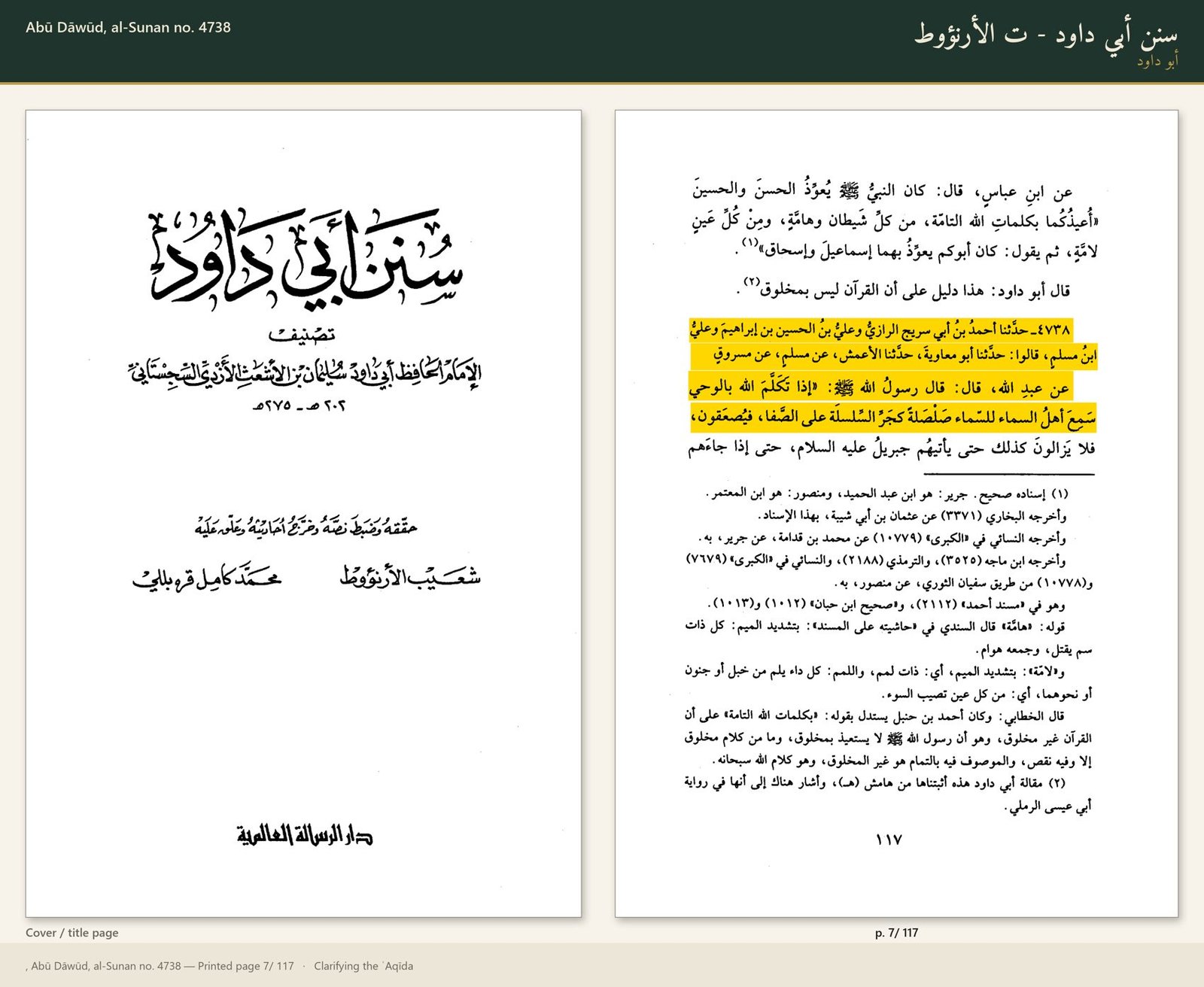
The people of the heavens hear the speech of Allah as a ringing like a chain dragged over smooth stone, and they swoon. They hear it, and it overwhelms them; and when the terror is lifted from their hearts they ask: what did your Lord say? Speech that is heard and that causes the angels to swoon is not a meaning hidden in the soul.
And al-Bukhārī said in Khalq Afʿāl al-ʿIbād:
And it is mentioned of the Prophet ﷺ that he liked a man to be low-voiced and disliked his being loud-voiced; and that Allah, Mighty and Majestic, calls with a voice which the far one hears as the near one hears it; and this belongs to none other than Allah, glorified be His mention. Abū ʿAbd Allāh [al-Bukhārī] said: And in this is evidence that the voice of Allah does not resemble the voices of creatures, because the voice of Allah, glorified be His mention, is heard from afar as it is heard from near, and the angels swoon at His voice; but when the angels call one another they do not swoon. And He, Mighty and Majestic, said: 'So do not set up equals to Allah' [al-Baqarah 22].
al-Bukhārī, Khalq Afʿāl al-ʿIbād p. 98; quoted in Ibn Qudāmah, Ithbāt Ṣifat al-ʿUluww p. 116 and Ibn Taymiyyah, al-Fatāwā al-Kubrā 6/485
Source, chain and authenticity
Read the page in the source edition (opens in a new tab)
The whole page in Arabic
Al-Bukhārī drew the rule from it: the voice of Allah does not resemble the voices of creatures, for it is heard from afar as from near, and the angels swoon at it while they do not swoon at one another’s voices. Then he recited: so do not set up equals to Allah. So he affirmed the Voice and denied its likeness to created voices together.
Fifth Issue: The Letters of the Qurʾān Are the Speech of Allah
The Prophet ﷺ counted the reward of recitation by letters, and he named the letters of the opening of al-Baqarah one by one. What is recited, letter by letter, is the Book of Allah.
Al-Tirmidhī reported from ʿAbdullāh ibn Masʿūd that the Messenger of Allah ﷺ said:
سَمِعتُ عبد اللهِ بن مسعودٍ يقولُ: قال رسولُ اللهِ ﷺ: "من قَرأ حَرْفًا من كِتابِ اللهِ، فله به حَسنةٌ، والحَسنةُ بِعَشْرِ أمْثالِها، لا أقولُ الم حَرْفٌ، وَلكنْ ألِفٌ حَرْفٌ، ولامٌ حَرْفٌ، وَمِيمٌ حَرْفٌ"
Muḥammad ibn Bashshār narrated to us, saying: Abū Bakr al-Ḥanafī narrated to us, saying: al-Ḍaḥḥāk ibn ʿUthmān narrated to us, from Ayyūb ibn Mūsā, who said: I heard Muḥammad ibn Kaʿb al-Quraẓī say: I heard ʿAbdullāh ibn Masʿūd say: The Messenger of Allah ﷺ said: “Whoever reads a letter of the Book of Allah has a good deed for it, and the good deed is multiplied ten times. I do not say that Alif Lām Mīm is a letter; rather, Alif is a letter, Lām is a letter, and Mīm is a letter.”
al-Tirmidhī, al-Jāmiʿ (al-Risālah) 5/176, no. 3135, from ʿAbdullāh ibn Masʿūd
Source, chain and authenticity
Al-Tirmidhī said: this ḥadīth is ḥasan ṣaḥīḥ, gharīb from this route. The editors of the Risālah edition judged its chain ḥasan: al-Ḍaḥḥāk ibn ʿUthmān is truthful and good in ḥadīth, and the rest of its men are trustworthy men of al-Bukhārī and Muslim. It is also reported from Ibn Masʿūd as his own saying, by Ibn al-Mubārak, ʿAbd al-Razzāq, al-Dārimī and al-Ṭabarānī.
Read the page in the source edition (opens in a new tab)
The whole page in Arabic
وفي البابِ عن عليٍّ، وسَعدٍ.
٣١٣٤ - حدَّثنا قُتيبةُ، قال: حدَّثنا عبد الواحدِ بن زِيادٍ، عن عبد الرحمنِ بن إسحاقَ، عن النُّعمانِ بن سعدٍ
عن عليِّ بن أبي طالبٍ، قال: قال رسولُ اللهِ ﷺ: "خَيْرُكُم من تَعلَّمَ القرآنَ وعلّمَه" (¬١).
هذا حديثٌ لا نعرفُه من حديثِ عَليٍّ عن النّبيِّ ﷺ إلّا من حديثِ عَبد الرحمنِ بن إسحاقَ.
١٧ - باب ما جاء فِيمنْ قرأ حَرْفًا من القُرآنِ ما لَهُ من الأجْرِ
٣١٣٥ - حدَّثَنا محمدُ بن بَشَّارٍ، قال: حدَّثنا أبو بكرٍ الحَنفيُّ، قال: حدَّثنا الضَّحَّاكُ بن عثمانَ، عن أيُّوبَ بن موسى، قال. سَمِعتُ محمدَ بن كَعْبٍ القُرَظيَّ يقولُ:
سَمِعتُ عبد اللهِ بن مسعودٍ يقولُ: قال رسولُ اللهِ ﷺ: "من قَرأ حَرْفًا من كِتابِ اللهِ، فله به حَسنةٌ، والحَسنةُ بِعَشْرِ أمْثالِها، لا أقولُ الم حَرْفٌ، وَلكنْ ألِفٌ حَرْفٌ، ولامٌ حَرْفٌ، وَمِيمٌ حَرْفٌ" (¬١).
هذا حديثٌ حسنٌ صحيحٌ غريبٌ من هذا الوجه. سَمِعتُ قُتيبةَ بن سعيدٍ يقولُ: بَلغَني أنّ محمدَ بنَ كَعْبٍ القُرَظيَّ وُلِدَ في حياةِ النّبيِّ ﷺ.
ويُرْوى هذا الحديثُ مِن غيرِ هذا الوجه عن ابنِ مسعودٍ، رواهُ أبو الأحْوَصِ عن عبد الله بنِ مسعودٍ ورَفَعَهُ بَعضُهم، ووَقَفَهُ بَعضُهم عن ابنِ مسعودٍ.
ومحمدُ بن كَعْبٍ القُرَظي يُكنى أبا حمزةَ.
٣١٣٦ - حدَّثنا نصرُ بن عليٍّ الجَهْضَميُّ، قال: حدثنا عبدُ الصَّمد بن عبد الوارث، قال: حدَّثنا شُعبةُ، عن عاصمٍ، عن أبي صالحٍ
عن أبي هُريرةَ، عن النّبيِّ ﷺ قال: يَجيءُ القُرآنُ (¬٢) يومَ القيامةِ
Alif is a letter, Lām is a letter, Mīm is a letter: the Prophet ﷺ called the letters of the Book of Allah letters, and gave the reward for each. Allah opened sūrahs of His Book with these separate letters, Alif Lām Mīm, Alif Lām Mīm Ṣād and Qāf, and they are His speech, spoken by Him and conveyed by Jibrīl. Whoever says that the speech of Allah has no letters has said that these openings are not the speech of Allah.
Allah, the Exalted, said at the opening of Sūrat Yūsuf:
Indeed, We have sent it down as an Arabic Qurʾān so that you may understand.
Sūrat Yūsuf, 12:2 Read the verse (opens in a new tab)
What was sent down is Arabic, and Arabic is letters and words. The Ashʿarī says that the eternal speech is neither Arabic nor Hebrew, so by his own statement what this verse calls “Qurʾān” is not the speech of Allah in reality.
And He said in Sūrat al-Nāziʿāt:
When his Lord called him in the sacred valley of Ṭuwā.
Sūrat al-Nāziʿāt, 79:16 Read the verse (opens in a new tab)
And He said in Sūrat Yūsuf:
Indeed, We have sent it down as an Arabic Qurʾān so that you may understand.
Sūrat Yūsuf, 12:2 Read the verse (opens in a new tab)
Part Three
The statements of the Salaf
Sixth Issue: The Salaf on the Speech and the Voice
ʿAbdullāh ibn Aḥmad said in Kitāb al-Sunnah:
534. And my father, may Allah have mercy on him, said: The ḥadīth of Ibn Masʿūd, may Allah be pleased with him: 'When Allah, Mighty and Majestic, speaks, a voice is heard from Him like the dragging of a chain over smooth stone.' My father said: And the Jahmiyyah deny this. And my father said: These are disbelievers who want to deceive people. Whoever claims that Allah, Mighty and Majestic, did not speak is a disbeliever. Indeed, we narrate these ḥadīths as they have come.
ʿAbd Allāh ibn Aḥmad, al-Sunnah 1/281 no. 534
Source, chain and authenticity
Imām Aḥmad, commenting on the ḥadīth of Ibn Masʿūd that when Allah speaks a voice is heard from Him, said that whoever claims that Allah did not speak is a disbeliever, and that these ḥadīths are narrated as they came. Al-Naḍr ibn Muḥammad said that whoever holds the words “I am Allah” to be created has disbelieved, and Ibn al-Mubārak confirmed him: Allah would not command us to worship a created thing.
And he said:
20. Abū ʿAmr Muḥammad ibn ʿAbd al-ʿAzīz ibn Abī Rizma narrated to me, saying: I heard Abū al-Wazīr Muḥammad ibn Aʿyan say: I heard al-Naḍr ibn Muḥammad say: Whoever says of this verse, 'Indeed, I am Allah; there is no god but Me, so worship Me' [Ṭāhā 14], that it is created, is a disbeliever. So I went to ʿAbd Allāh ibn al-Mubārak and told him. He said: Abū Muḥammad spoke the truth, may Allah keep him well; Allah would not command us to worship a created thing.
ʿAbd Allāh ibn Aḥmad, al-Sunnah 1/110–111 no. 20; also Ibn Baṭṭah, al-Ibānah 6/37 and 6/318; Masāʾil Abī Dāwūd p. 359
Source, chain and authenticity
Al-Naḍr ibn Muḥammad and Ibn al-Mubārak reasoned from the words themselves: “Indeed, I am Allah; there is no god but Me, so worship Me.” If these words were created in a tree, then a created thing said “I am Allah” and commanded worship of itself, and Allah does not command us to worship a created thing. The argument of the two imams is the argument of the Qurʾān against the calf: a god is known by his speech.
Seventh Issue: The Salaf on the Voice, the Letters and the Uncreated Qurʾān
The formula that Allah spoke to Mūsā without a voice was already in circulation in the time of Imām Aḥmad, and his son put it to him in those words.
ʿAbdullāh, the son of Imām Aḥmad, said in Kitāb al-Sunnah:
I asked my father, may Allah have mercy on him, about people who say: when Allah, Mighty and Majestic, spoke to Mūsā, He did not speak with a voice. My father said: “Yes indeed, your Lord, Mighty and Majestic, spoke with a voice. These ḥadīths we narrate as they have come.”
ʿAbdullāh ibn Aḥmad, Kitāb al-Sunnah 1/280, no. 533
Source, chain and authenticity
Authentic: ʿAbd Allāh heard it from his father directly, with no one between them.
Read the page in the source edition (opens in a new tab)
The whole page in Arabic
٥٣٣ - سَأَلْتُ أَبِي ﵀ عَنْ قَوْمٍ، يَقُولُونَ: لَمَّا كَلَّمَ اللَّهُ ﷿ مُوسَى لَمْ يَتَكَلَّمْ بِصَوْتٍ فَقَالَ أَبِي: «بَلَى إِنَّ رَبَّكَ ﷿ تَكَلَّمَ بِصَوْتٍ هَذِهِ الْأَحَادِيثُ نَرْوِيهَا كَمَا جَاءَتْ»
The question put to Imām Aḥmad was the doctrine of the Kullābiyyah: that Allah spoke to Mūsā without a voice. His answer was “Yes indeed (balā), your Lord spoke with a voice”, using the particle of affirmation that answers a negation, and he grounded it in the ḥadīths, which are narrated as they came. And in the next report in the same book he called those who deny it disbelievers who want to deceive people.
And he reported, through his father, from Mālik ibn Anas:
My father, may Allah have mercy on him, narrated to me: Surayj ibn al-Nuʿmān narrated to us: ʿAbdullāh ibn Nāfiʿ narrated to us, saying: Mālik ibn Anas used to say: “Faith is saying and action.” And he used to say: “Allah spoke to Mūsā.” And Mālik said: “Allah is in the heaven, and His knowledge is in every place; nothing is empty of it.”
ʿAbdullāh ibn Aḥmad, Kitāb al-Sunnah 1/280, no. 532
Source, chain and authenticity
Its chain: Aḥmad, from Surayj ibn al-Nuʿmān, a trustworthy Baghdādī, from ʿAbd Allāh ibn Nāfiʿ al-Ṣāʾigh, the companion of Mālik who sat with him for forty years.
Read the page in the source edition (opens in a new tab)
The whole page in Arabic
٥٣٣ - سَأَلْتُ أَبِي ﵀ عَنْ قَوْمٍ، يَقُولُونَ: لَمَّا كَلَّمَ اللَّهُ ﷿ مُوسَى لَمْ يَتَكَلَّمْ بِصَوْتٍ فَقَالَ أَبِي: «بَلَى إِنَّ رَبَّكَ ﷿ تَكَلَّمَ بِصَوْتٍ هَذِهِ الْأَحَادِيثُ نَرْوِيهَا كَمَا جَاءَتْ»
Mālik, the imam of Madīnah, said: faith is saying and action; Allah spoke to Mūsā; Allah is in the heaven and His knowledge is in every place. He joined the Speech to the Highness in one breath because the deniers had joined them in one denial: the Lord who does not speak is the Lord who is not above, and both are the Lord of Jahm.
Al-Bukhārī opened Khalq Afʿāl al-ʿIbād with this report:
Al-Ḥakam ibn Muḥammad al-Ṭabarī narrated to me — I wrote from him in Makkah — saying: Sufyān ibn ʿUyaynah narrated to us, saying: I met our shaykhs for seventy years, among them ʿAmr ibn Dīnār, and they were saying: “The Qurʾān is the speech of Allah, and it is not created.”
al-Bukhārī, Khalq Afʿāl al-ʿIbād, p. 29
Source, chain and authenticity
Al-Bukhārī heard it himself from al-Ḥakam ibn Muḥammad in Makkah. Al-Ṭabarī reported it in Ṣarīḥ al-Sunnah through the same al-Ḥakam with the wording “from Him it began and to Him it returns”, which shows it was known in both wordings. ʿAmr ibn Dīnār met a number of the Companions; the seventy years take the report back into their time.
Al-Ṭabarī preserved the same statement from Ibn ʿUyaynah by another route, and his wording adds “from Him it began and to Him it returns”.
And al-Ṭabarī reported it in Ṣarīḥ al-Sunnah:
And Muḥammad ibn Manṣūr al-Āmulī narrated to me: al-Ḥakam ibn Muḥammad al-Āmulī Abū Marwān narrated to us: Ibn ʿUyaynah narrated to us, saying: I heard ʿAmr ibn Dīnār say: I met our shaykhs for seventy years saying: “The Qurʾān is the speech of Allah; from Him it began and to Him it returns.”
al-Ṭabarī, Ṣarīḥ al-Sunnah, p. 19, no. 16
Source, chain and authenticity
Sufyān ibn ʿUyaynah met the generation before him for seventy years, among them ʿAmr ibn Dīnār, who had met the Companions, and they all said: the Qurʾān is the speech of Allah; it is not created; from Him it began and to Him it returns. “From Him it began” means that He spoke it, and it did not begin from a tree, from the air or from Jibrīl. “To Him it returns” means that it will be taken up from the copies and the hearts at the end of time.
Ibn Taymiyyah cites the same answer of Aḥmad in Darʾ Taʿāruḍ as the text by which the creed of the Salaf on the Voice is known.
ʿAbdullāh, the son of Imām Aḥmad, said in Kitāb al-Sunnah:
533. I asked my father, may Allah have mercy on him, about people who say: When Allah, Mighty and Majestic, spoke to Mūsā, He did not speak with a voice. My father said: Rather, your Lord, Mighty and Majestic, spoke with a voice; these ḥadīths we narrate as they have come.
ʿAbd Allāh ibn Aḥmad, al-Sunnah 1/280 no. 533; also Darʾ 2/39
Source, chain and authenticity
Read the page in the source edition (opens in a new tab)
The whole page in Arabic
٥٣٣ - سَأَلْتُ أَبِي ﵀ عَنْ قَوْمٍ، يَقُولُونَ: لَمَّا كَلَّمَ اللَّهُ ﷿ مُوسَى لَمْ يَتَكَلَّمْ بِصَوْتٍ فَقَالَ أَبِي: «بَلَى إِنَّ رَبَّكَ ﷿ تَكَلَّمَ بِصَوْتٍ هَذِهِ الْأَحَادِيثُ نَرْوِيهَا كَمَا جَاءَتْ»
Aḥmad answered with “rather”, the particle that overturns a negation, and he grounded the answer on the ḥadīths and on nothing else. He also approved what another imam of his time said of those who deny the voice, in a report that al-Khallāl preserved.
Al-Khallāl reported from al-Marrūdhī, and Ibn Taymiyyah quoted it in Darʾ Taʿāruḍ:
Al-Khallāl said: Abū Bakr al-Marrūdhī informed us: I heard Abū ʿAbdullāh, when it was said to him that ʿAbd al-Wahhāb [al-Warrāq] had spoken and said: 'Whoever claims that Allah spoke to Mūsā without a voice is a Jahmī, an enemy of Allah and an enemy of Islam'. Abū ʿAbdullāh smiled and said: How excellent is what he said! May Allah keep him well!
Ibn Taymiyyah, Darʾ Taʿāruḍ 2/39; Sharḥ al-ʿAqīdah al-Aṣfahāniyyah p. 68 (11248/64); al-Fatāwā al-Kubrā 6/485; al-Tisʿīniyyah 2/590
Source, chain and authenticity
Read the page in the source edition (opens in a new tab)
The whole page in Arabic
وقال عبد الله بن أحمد: سألت أبي عن قوم يقولون: لما كلم موسى لم يتكلم بصوت، فقال أبي: بلى، تكلم ﵎ بصوت، وهذه الأحاديث نرويها كما جاءت، وحديث ابن مسعود: (إذا تكلم الله بالوحي سمع له صوت كجر السلسلة على الصفوان) قال أبي: والجهمية تنكره، قال أبي: وهؤلاء كفار يريدون أن يموهوا على الناس، من زعم أن الله لم يتكلم فهو كافر، إنما نروي هذه الأحاديث كما جاءت) .
ʿAbd al-Wahhāb al-Warrāq said that whoever claims that Allah spoke to Mūsā without a voice is a Jahmī, an enemy of Allah and an enemy of Islam, and Aḥmad smiled and said: how excellent is what he said. The judgement was given in the third century on the exact formula that the Kullābiyyah would later make the creed of their school, speech without a voice. Aḥmad did not wait for the doctrine to acquire a respectable name before judging it, and the judgement falls on the doctrine wherever it is found; the ruling on a particular person is a separate matter, with its own conditions.
Al-Dārimī said to al-Marīsī in his Naqḍ:
Had you read the Qurʾān and understood its meaning from Allah, you would have known with certainty that He is perceived by a clear sense in this world and the Hereafter: for Mūsā perceived from Him in this world the voice and the speech, and that is [through] one of the greatest of the senses.
al-Dārimī, Naqḍ ʿalā al-Marīsī (ed. al-Shawāmī) p. 160; ed. al-Almaʿī 1/429
Source, chain and authenticity
Read the page in the source edition (opens in a new tab)
The whole page in Arabic
أَخْبَرَنَا اللهُ فِي كِتَابِهِ أَنَّهُ ذُو سَمْعٍ وَبَصَرٍ، وَيَدَيْنِ، وَوَجْهٍ، وَنَفْسٍ، وَعِلْمٍ، وَكَلَامٍ، وَأَنَّهُ فَوْقَ عَرْشِهِ فَوْقَ سَمَاوَاتِهِ، فَآمَنَّا بِجَمِيعِ مَا وَصَفَ بِهِ نَفْسَهُ كَمَا وَصَفَهُ بِلَا كَيفَ، وَنَفَيْتَهَا أَنْتَ عَنْهُ كُلَّهَا أَجْمَعَ بِعَمَايَاتٍ مِنَ الحُجَجِ، وَتَكْيِيفٍ.
فَادَّعَيْتَ أَنَّ وَجْهَهُ: كُلُّهُ، وَأَنَّهُ لَا يُوصَفُ بِنَفْسٍ، وَأَنَّ سَمْعَهُ: إِدْرَاكُ الصَّوْتِ إِيَّاهُ، وَأَنَّ بَصَرَهُ: مُشَاهَدَةُ الأَلْوَان؛ كَالجِبَالِ وَالحِجَارَةِ وَالأَصْنَامِ الَّتِي تَنْظُرُ إِلَيْكِ بِعُيُونٍ لَا تُبْصِرُ، وَأَنَّ يَدَيْهِ: رِزْقَاهُ، مُوَسَّعُهُ وَمَقْتُورُهُ، وَأَنَّ عِلْمَهُ وَكَلَامَهُ: مَخْلُوقَانِ مُحْدَثَانِ. وَأَنَّ أَسْمَاءَهُ: مُسْتَعَارَةٌ مَخْلُوقَةٌ مُحْدَثَةٌ، وَأَنَّ فَوْقَ عَرْشِهِ مِنْهُ مِثْلَ مَا هُو فيَ أَسْفَلِ سَافِلِينَ، وَأَنَّهُ فِي صِفَاتِهِ، كَقَوْل النَّاس فِي كَذَا، وكَقَوْل العرب فِي كَذَا، تَضْرِبُ لَهُ الأَمْثَالَ تَشْبِيهًا بِغَيْرِ شَكْلِهَا، وَتَمْثِيلًا بِغَيْرِ مِثْلِهَا، فَأَيُّ تَكْيِيفٍ بأَوْحَشَ مِنْ هَذَا؛ إِذْ نَفَيْتَ هَذِهِ الصِّفَاتِ، وَغَيْرَهَا عَنِ اللهِ تَعَالَى بِهَذِهِ الأَمْثَالِ وَالضَّلَالَاتِ المُضِلَّاتِ؟
وَادَّعَيْتَ فِي تَأْوِيلِكَ أَنَّ مَعْبُودَكَ أَصَمُّ لَا يَسْمَعُ، أَبْكَمُ لَا يَتَكَلَّمُ، أَعْمَى لَا يُبْصِرُ، أَجْذَمُ لَا يَدَ لَهُ، مُقْعَدٌ لَا يَقُومُ وَلَا يَتَحَرَّكُ، جَاهِلٌ لَا يَعْلَمُ، مُضْمَحِلٌّ ذَاهِبٌ لَا يُوصَفُ بِحَدٍّ، وَلَا بِنَفْسٍ، وَلَا يُدْرَكُ بِحَاسَّةٍ فِي دَعْوَاكَ.
وَهَذَا خِلَافُ صِفَةِ رَبِّ العَالَمِينَ، فَالحَمْدُ لله الَّذِي مَنَّ عَلَيْنَا بِمَعْرِفَتِهِ، وَطَبَعَ عَلَى قَلْبكَ بِجَهَالَتِهِ، ولَو قد قَرَأْتَ القُرْآنَ وَعَقِلْتَ عَنِ اللهِ مَعْنَاهُ؛ لَعَلِمْتَ يَقِينًا أَنَّهُ يُدْرَكُ بِحَاسَّةٍ بَيِّنَةٍ فِي الدُّنْيَا وَالآخِرَةِ، فَقَدْ أَدْرَكَ مِنْهُ مُوسَى فِي الدُّنْيَا الصَّوْتَ، وَالكَلَامَ، وَهُوَ مِنْ أَعْظَمِ الحَوَاسِّ، قَالَ الله تَعَالَى: ﴿وَكَلَّمَ اللَّهُ مُوسَى تَكْلِيمًا (١٦٤)﴾ [النساء: ١٦٤].
Mūsā perceived the voice and the speech from Him by a clear sense. Al-Dārimī therefore makes it a matter of sense perception: hearing is one of the greatest of the senses. The answer of the later Ashʿarī, that Mūsā perceived the eternal meaning by a faculty created in him, is what al-Dārimī’s argument removes, as that is knowing and not hearing.
Eighth Issue: The Word Muḥdath, and What al-Bukhārī Meant by It
During the Miḥnah the Jahmiyyah used the word muḥdath to mean “created”, and argued from a verse of Sūrat al-Anbiyāʾ. For this reason, some of the imams refused the word altogether. Others explained it. Al-Bukhārī gave it a chapter of his Ṣaḥīḥ.
Al-Bukhārī said in the Book of Tawḥīd:
⦗١٥٣⦘
عَنِ النَّبِيِّ ﷺ إِنَّ اللهَ يُحْدِثُ مِنْ أَمْرِهِ مَا يَشَاءُ وَإِنَّ مِمَّا أَحْدَثَ أَنْ لَا تَكَلَّمُوا فِي الصَّلَاةِ
Chapter: the saying of Allah, the Exalted, “Every day He is upon some affair”, and “No new reminder comes to them from their Lord”, and His saying, the Exalted, “Perhaps Allah will bring about a new matter after that”; and that His bringing about does not resemble the bringing about of creatures, because of His saying, the Exalted, “There is nothing like Him, and He is the All-Hearing, the All-Seeing.” And Ibn Masʿūd said, from the Prophet ﷺ: “Allah brings about of His command whatever He wills, and among what He has brought about is that you do not speak in the prayer.”
al-Bukhārī, al-Ṣaḥīḥ, Kitāb al-Tawḥīd (al-Sulṭāniyyah 9/152–153)
Source, chain and authenticity
Authentic. It is in the Ṣaḥīḥ of al-Bukhārī, and the ummah received the two Ṣaḥīḥs with acceptance; its full chain is given in the Arabic above.
So the Qurʾān was new to those to whom it came, at the time it came, and that is what the verse states. It is not created. Al-Bukhārī says “His bringing about does not resemble the bringing about of creatures”, and he supports this with “nothing is like Him”. Three things are denied by this one chapter. The Muʿtazilī is denied, who says that “new” means created. The Ashʿarī is denied, who says that nothing can be new of His speech. And the likening of it to the speech of creatures is denied. Ibn Taymiyyah cites this chapter in Darʾ Taʿāruḍ 2/300 in the same argument.
Part Four
The imams after them
Ninth Issue: The Imams After Them
Ibn Taymiyyah said:
And nidāʾ (calling) in the language of the Arabs is a raised voice; nidāʾ is not applied to what is not a voice, neither literally nor metaphorically. And since calling is a species of voice, what indicates the species necessarily indicates the genus — just as, if a proof shows that there is a human here, one knows that there is an animal here.
Ibn Taymiyyah, Majmūʿ al-Fatāwā 6/531
Source, chain and authenticity
Read the page in the source edition (opens in a new tab)
The whole page in Arabic
وَهَذَا كَمَا أَنَّهُ إذَا أَخْبَرَ أَنَّ لَهُ عِلْمًا وَقُدْرَةً دَلَّ عَلَى أَنَّ لَهُ صِفَةً؛ لِأَنَّ الْعِلْمَ وَالْقُدْرَةَ نَوْعٌ مِنْ الصِّفَاتِ وَإِذَا كَانَ لَفْظُ الْقُرْآنِ لَمْ يُذْكَرْ فِيهِ أَنَّ الْعِلْمَ صِفَةٌ وَلَا الْقُدْرَةَ صِفَةٌ. وَكَذَلِكَ إذَا أَخْبَرَ فِي الْقُرْآنِ أَنَّهُ يَخْلُقُ وَيَرْزُقُ وَيُحْيِي وَيُمِيتُ دَلَّ عَلَى أَنَّهُ فَاعِلٌ فَإِنَّ هَذِهِ أَنْوَاعٌ تَحْتَ جِنْسِ الْفِعْلِ وَإِنْ كَانَ ثُبُوتُ هَذِهِ الصِّفَةِ بِمَا قَدْ دَلَّ عَلَيْهِ الْقُرْآنُ - فِي غَيْرِ مَوْضِعٍ - كَانَ مَا جَاءَ مِنْ الْأَحَادِيثِ مُوَافِقًا لِدَلَالَةِ الْقُرْآنِ وَلَمْ تَكُنْ هَذِهِ الصِّفَةُ ثَابِتَةً بِمُجَرَّدِ هَذَا الْخَبَرِ.
الْوَجْهُ الثَّالِثُ أَنَّ مَا أَخْبَرَ اللَّهُ بِهِ فِي كِتَابِهِ مِنْ تَكْلِيمِ مُوسَى وَسَمْعِ مُوسَى لِكَلَامِ اللَّهِ يَدُلُّ عَلَى أَنَّهُ كَلَّمَهُ بِصَوْتِ؛ فَإِنَّهُ لَا يُسْمَعُ إلَّا الصَّوْتُ؛ وَذَلِكَ أَنَّ اللَّهَ قَالَ فِي كِتَابِهِ عَنْ مُوسَى: ﴿فَاسْتَمِعْ لِمَا يُوحَى﴾ وَقَالَ فِي كِتَابِهِ: ﴿إنَّا أَوْحَيْنَا إلَيْكَ كَمَا أَوْحَيْنَا إلَى نُوحٍ وَالنَّبِيِّينَ مِنْ بَعْدِهِ وَأَوْحَيْنَا إلَى إبْرَاهِيمَ وَإِسْمَاعِيلَ وَإِسْحَاقَ وَيَعْقُوبَ وَالْأَسْبَاطِ وَعِيسَى وَأَيُّوبَ وَيُونُسَ وَهَارُونَ وَسُلَيْمَانَ وَآتَيْنَا دَاوُدَ زَبُورًا
Ibn Taymiyyah draws the inference from the language to the creed. Since a call is a species of voice, every verse in which Allah calls is a proof of the voice, as a proof that a man is present is a proof that a living thing is present. The Kullābī who affirms that Allah called and denies that He has a voice has affirmed the species and denied the genus.
And he said in al-ʿAqīdah al-Wāsiṭiyyah:
And of faith in Allah and His Books is faith that the Qurʾān is the speech of Allah, sent down, not created; from Him it began and to Him it will return; that Allah, Exalted is He, spoke it in reality; and that this Qurʾān which He sent down upon Muḥammad ﷺ is the speech of Allah in reality, not the speech of anyone else. It is not permissible to say without qualification that it is a reproduction (ḥikāyah) of the speech of Allah or an expression (ʿibārah) of it. Rather, when people recite it or write it in the copies of the Muṣḥaf, it does not by that cease to be the speech of Allah, Exalted is He, in reality; for speech is attributed in reality to the one who said it first, not to the one who said it conveying and delivering it. And it is the speech of Allah, its letters and its meanings: the speech of Allah is not the letters without the meanings, nor the meanings without the letters.
Ibn Taymiyyah, al-ʿAqīdah al-Wāsiṭiyyah, in Majmūʿ al-Fatāwā 3/144
Source, chain and authenticity
Read the page in the source edition (opens in a new tab)
The whole page in Arabic
وَمِنْ الْإِيمَانِ بِاَللَّهِ وَكُتُبِهِ: الْإِيمَانُ بِأَنَّ الْقُرْآنَ كَلَامُ اللَّهِ مُنَزَّلٌ غَيْرُ مَخْلُوقٍ مِنْهُ بَدَأَ وَإِلَيْهِ يَعُودُ؛ وَأَنَّ اللَّهَ تَعَالَى تَكَلَّمَ بِهِ حَقِيقَةً وَأَنَّ هَذَا الْقُرْآنَ الَّذِي أَنْزَلَهُ عَلَى مُحَمَّدٍ ﷺ هُوَ كَلَامُ اللَّهِ حَقِيقَةً لَا كَلَامُ غَيْرِهِ؛ وَلَا يَجُوزُ إطْلَاقُ الْقَوْلِ بِأَنَّهُ حِكَايَةٌ عَنْ كَلَامِ اللَّهِ أَوْ عِبَارَةٌ عَنْهُ بَلْ إذَا قَرَأَهُ النَّاسُ أَوْ كَتَبُوهُ بِذَلِكَ فِي الْمَصَاحِفِ: لَمْ يَخْرُجْ بِذَلِكَ عَنْ أَنْ يَكُونَ كَلَامَ اللَّهِ تَعَالَى حَقِيقَةً فَإِنَّ الْكَلَامَ إنَّمَا يُضَافُ حَقِيقَةً إلَى مَنْ قَالَهُ مُبْتَدِئًا لَا إلَى مَنْ قَالَهُ مُبَلِّغًا مُؤَدِّيًا. وَهُوَ كَلَامُ اللَّهِ؛ حُرُوفُهُ وَمَعَانِيهِ؛ لَيْسَ كَلَامُ اللَّهِ الْحُرُوفَ دُونَ الْمَعَانِي وَلَا الْمَعَانِيَ دُونَ الْحُرُوفِ.
فَصْلٌ:
وَقَدْ دَخَلَ أَيْضًا فِيمَا ذَكَرْنَاهُ مِنْ الْإِيمَانِ بِهِ وَبِكُتُبِهِ وَبِرُسُلِهِ: الْإِيمَانُ بِأَنَّ الْمُؤْمِنِينَ يَرَوْنَهُ يَوْمَ الْقِيَامَةِ عِيَانًا بِأَبْصَارِهِمْ كَمَا يَرَوْنَ الشَّمْسَ صَحْوًا لَيْسَ دُونَهَا سَحَابٌ وَكَمَا يَرَوْنَ الْقَمَرَ لَيْلَةَ الْبَدْرِ لَا يضامون فِي رُؤْيَتِهِ يَرَوْنَهُ سُبْحَانَهُ وَهُمْ فِي عَرَصَاتِ الْقِيَامَةِ ثُمَّ يَرَوْنَهُ بَعْدَ دُخُولِ الْجَنَّةِ كَمَا يَشَاءُ اللَّهُ ﷾.
Ibn Taymiyyah gathered the creed of Ahl al-Sunnah on the Qurʾān in one paragraph of al-ʿAqīdah al-Wāsiṭiyyah. It is the speech of Allah, sent down, not created. From Him it began and to Him it will return. He spoke it in reality. It is not a reproduction of His speech or an expression of it. When it is recited and written it remains His speech, because speech belongs to the one who first said it, not to the one who conveys it. And it is His speech with its letters and its meanings together.
Each clause answers an opponent. “Not created” answers the Jahmiyyah and the Muʿtazilah. “Spoke it in reality” answers those who say Allah created the speech in something else. “Not a reproduction” answers the Kullābiyyah, and “not an expression” answers the Ashʿarīs. “Letters and meanings” answers both those who make the speech the meaning alone and those who make it the letters alone.
Ibn Taymiyyah gathered the matter in several of his works, as compiled in al-Munāẓarāt al-ʿAqadiyyah:
وقد "استفاضت الآثار عن النبي ﷺ، والصحابة، والتابعين، ومن بعدهم من أئمة السنة أنه -سبحانه- ينادي بصوت: نادى موسى، وينادي عباده يوم القيامة بصوت، ويتكلم بصوت"، "والنداء في لغة العرب هو صوت رفيع؛ لا يطلق النداء على ما ليس بصوت لا حقيقة، ولا مجازاً" "باتفاق أهل اللغة". و"هذا مما اتفق عليه سلف المسلمين وجمهورهم"
Allah, the Exalted, has informed in the Qurʾān of His calling (nidāʾ) His servants in more than ten places, and a call is only a voice, by the agreement of the people of the language and of people generally [Minhāj al-Sunnah 5/423]. And 'the reports have spread widely from the Prophet ﷺ, the Companions, the Successors and the imams of the Sunnah after them that He, glorified be He, calls with a voice: He called Mūsā, He will call His servants on the Day of Resurrection with a voice, and He speaks with a voice' [Majmūʿ 12/304–305]. 'And nidāʾ in the language of the Arabs is a raised voice; the term nidāʾ is not applied to what is not a voice, neither literally nor figuratively' [Majmūʿ 6/531, 12/130] 'by the agreement of the people of the language' [Majmūʿ 12/40]. And 'this is something on which the Salaf of the Muslims and their majority agree' [Majmūʿ 12/40].
Ibn Taymiyyah, as compiled in al-Munāẓarāt al-ʿAqadiyyah li-Shaykh al-Islām Ibn Taymiyyah p. 550
Source, chain and authenticity
Read the page in the source edition (opens in a new tab)
The whole page in Arabic
وقد "استفاضت الآثار عن النبي ﷺ، والصحابة، والتابعين، ومن بعدهم من أئمة السنة أنه -سبحانه- ينادي بصوت: نادى موسى، وينادي عباده يوم القيامة بصوت، ويتكلم بصوت" (¬٢)، "والنداء في لغة العرب هو صوت رفيع؛ لا يطلق النداء على ما ليس بصوت لا حقيقة، ولا مجازاً" (¬٣) "باتفاق أهل اللغة" (¬٤). و"هذا مما اتفق عليه سلف المسلمين وجمهورهم" (¬٥).
المسألة الخامسة: محاولة الخصوم إثبات التأويل عن السلف:
تمهيد:
قرر شيخ الإسلام ﵀ أثناء مناظرته في العقيدة الواسطية، وجوب إثبات الصفات لله ﷿ من غير تمثيل ولا تعطيل ولا تحريف ولا تكييف، وأكد أن هذه العقيدة عليها إجماع السلف، وأنهم كانوا يثبتون ما ورد في النصوص من صفات الله ﷿ من غير تمثيل لها بصفات المخلوقين، ومن غير تحريف لها عن معناها الحق وصرفها عن ظاهرها التي دلت عليه، بل يقرون بها كما هي حق على حقيقتها، ويفوضون علم كيفيتها إلى الله سبحانه، وبين ﵀ أن هذا الأمر
Ibn Taymiyyah counts the call in more than ten places of the Qurʾān, and he states the agreement of the people of the language that a call is only a voice. The number has weight: an opponent can interpret one verse away, and he cannot interpret ten in one wording without admitting that he has abandoned the wording.
And he said in Majmūʿ al-Fatāwā:
… and a proof that He called him; and calling is only an audible voice; nidāʾ without an audible voice is not intelligible in the language of the Arabs, neither literally nor metaphorically.
Ibn Taymiyyah, Majmūʿ al-Fatāwā 12/130
Source, chain and authenticity
Read the page in the source edition (opens in a new tab)
The whole page in Arabic
His second statement closes the door of the figure as well. A call without an audible voice is unknown in the Arabic of the Arabs, literally or as a figure, so the Kullābī cannot claim that the verses of calling are metaphors. A figure is drawn from a reality that the language already knows, and the language knows no silent call.
Tenth Issue: Al-Sijzī: Speech Is Letters and Sound
Abū Naṣr al-Sijzī wrote to the people of Zabīd, in his treatise against those who deny the letter and the voice — and Ibn Taymiyyah quoted it in Darʾ Taʿāruḍ al-ʿAql wa-l-Naql:
والقلانسي١ والصالحي٢ والأشعري٣. وأقرانهم الذين يتظاهرون
بالرد على المعتزلة١ وهم معهم بل أخس حالاً منهم في الباطن في أن الكلام لا يكون إلا حرفاً وصوتاً ذا تأليف واتساق٢ وإن اختلفت به اللغات.
وعبر عن هذا المعنى الأوائل الذين تكلموا في العقليات٣ وقالوا: الكلام حروف متسقة، وأصوات مقطعة.
Know — may Allah guide us and you — that there was no disagreement among mankind, with all their different creeds, from the beginning of time until the time in which Ibn Kullāb, al-Qalānisī, al-Ṣāliḥī and al-Ashʿarī appeared, and their peers who make a show of refuting the Muʿtazilah while they are with them — rather, worse than them inwardly — that speech is only letters and sound, composed and ordered, even if the languages in which it is spoken differ. The first ones who spoke of rational matters expressed this meaning, and said: speech is ordered letters and divided sounds.
Abū Naṣr al-Sijzī, al-Radd ʿalā Man Ankara al-Ḥarf wa-l-Ṣawt (Risālah ilā Ahl Zabīd), pp. 115–117
Source, chain and authenticity
Read the page in the source edition (opens in a new tab)
The whole page in Arabic
اعلموا- أرشدنا الله وإياكم- أنه لم يكن خلاف بين الخلق على اختلاف نِحَلهم من أول الزمان إلى الوقت الذي ظهر فيه ابن كلاب٣
والقلانسي١ والصالحي٢ والأشعري٣. وأقرانهم الذين يتظاهرون
بالرد على المعتزلة١ وهم معهم بل أخس حالاً منهم في الباطن في أن الكلام لا يكون إلا حرفاً وصوتاً ذا تأليف واتساق٢ وإن اختلفت به اللغات.
وعبر عن هذا المعنى الأوائل الذين تكلموا في العقليات٣ وقالوا: الكلام حروف متسقة، وأصوات مقطعة.
وقالت العرب٤: الكلام: اسم وفعل وحرف جاء لمعنى [٤ – أ] فالاسم
Al-Sijzī wrote in the fifth century to the people of Zabīd, and his words show where the doctrine of speech without sound came from. Before Ibn Kullāb, al-Qalānisī, al-Ṣāliḥī and al-Ashʿarī, all mankind, the believers, the people of the scriptures, the Arabs and even the philosophers, knew that speech is letters and sound. The Arabs divided speech into noun, verb and particle; the philosophers called it ordered letters and divided sounds. The meaning in the soul without letters is a doctrine that none of them knew, and its authors, he said, make a show of refuting the Muʿtazilah while they are with them in the end, for both make the Arabic Qurʾān a creature.
Eleventh Issue: The Judgement on the One Who Says That the Qurʾān Is Created
Ibn Taymiyyah quoted the creed of Abū Nuʿaym al-Aṣbahānī, the author of Ḥilyat al-Awliyāʾ, in Majmūʿ al-Fatāwā:
Al-Ḥāfiẓ Abū Nuʿaym al-Aṣbahānī, the author of Ḥilyat al-Awliyāʾ and other well-known works, said in the creed that he compiled: Our way is the way of the Salaf who follow the Book, the Sunnah and the consensus of the ummah. He said: and among what they believed is that Allah has never ceased to be perfect in all His eternal attributes; He does not pass away or change; He never ceased to be Knowing with knowledge, Seeing with sight, Hearing with hearing, Speaking with speech; and He originated things from nothing. And that the Qurʾān is the speech of Allah, and likewise the rest of His revealed books are His speech, uncreated; and that the Qurʾān from all aspects, recited, read, memorised, heard, written and uttered, is the speech of Allah in reality, not a report or a translation; and that it is, by our utterances, the speech of Allah, uncreated; and that the Wāqifah and the Lafẓiyyah are of the Jahmiyyah; and that whoever intends the Qurʾān in any way, wanting thereby the creation of the speech of Allah, is in their view of the Jahmiyyah; and that the Jahmī in their view is a disbeliever.
Ibn Taymiyyah, Majmūʿ al-Fatāwā 5/190
Source, chain and authenticity
Read the page in the source edition (opens in a new tab)
The whole page in Arabic
وَقَالَ الْحَافِظُ أَبُو نُعَيْمٍ الأصبهاني - صَاحِبُ " حِلْيَةِ الْأَوْلِيَاءِ " وَغَيْرِ ذَلِكَ مِنْ الْمُصَنَّفَاتِ الْمَشْهُورَةِ فِي الِاعْتِقَادِ الَّذِي جَمَعَهُ: - طَرِيقُنَا طَرِيقُ السَّلَفِ الْمُتَّبِعِينَ الْكِتَابَ وَالسُّنَّةَ وَإِجْمَاعَ الْأُمَّةِ. قَالَ: وَمِمَّا اعْتَقَدُوهُ أَنَّ اللَّهَ لَمْ يَزَلْ كَامِلًا بِجَمِيعِ صِفَاتِهِ الْقَدِيمَةِ لَا يَزُولُ وَلَا يَحُولُ؛ لَمْ يَزَلْ عَالِمًا بِعِلْمِ بَصِيرًا بِبَصَرِ سَمِيعًا بِسَمْعِ مُتَكَلِّمًا بِكَلَامِ وَأَحْدَثَ الْأَشْيَاءَ مِنْ غَيْرِ شَيْءٍ وَأَنَّ الْقُرْآنَ كَلَامُ اللَّهِ. وَكَذَلِكَ سَائِرُ كُتُبِهِ الْمُنَزَّلَةِ كَلَامُهُ غَيْرُ مَخْلُوقٍ وَأَنَّ الْقُرْآنَ مِنْ جَمِيعِ الْجِهَاتِ مَقْرُوءًا وَمَتْلُوًّا وَمَحْفُوظًا وَمَسْمُوعًا وَمَكْتُوبًا وَمَلْفُوظًا كَلَامُ اللَّهِ حَقِيقَةً لَا حِكَايَةً وَلَا تَرْجَمَةً وَأَنَّهُ بِأَلْفَاظِنَا كَلَامُ اللَّهِ غَيْرُ مَخْلُوقٍ وَأَنَّ الْوَاقِفَةَ وَاللَّفْظِيَّةَ مِنْ الْجَهْمِيَّة وَأَنَّ مَنْ قَصَدَ الْقُرْآنَ بِوَجْهِ مِنْ الْوُجُوهِ يُرِيدُ بِهِ خَلْقَ كَلَامِ اللَّهِ فَهُوَ عِنْدُهُمْ مِنْ الْجَهْمِيَّة وَأَنَّ الجهمي عِنْدَهُمْ كَافِرٌ. وَذَكَرَ أَشْيَاءَ إلَى أَنْ قَالَ:
So the imams judged the doctrine, in the wording of a man who died in 430. “Not a report or a translation” falls directly on the Ashʿarī saying that the Qurʾān is an expression of the speech of Allah. The general ruling that the Salaf gave is on the saying. A particular person is judged only after the proof has been established against him and what prevents the ruling is removed, as Ibn Taymiyyah explained at length, and as he practised with those who debated him.
Part Five
Principles drawn from the evidence
Twelfth Issue: The Rules Concerning the Speech of Allah
The first rule: Allah has spoken and still speaks. He spoke to Mūsā, He spoke to the angels, He will speak to the believers on the Day of Resurrection and in Paradise, and He will speak to the people of the Fire in rebuke. Whoever says that He spoke once in eternity and does not speak afterwards has denied the many texts in which Allah says, “and when your Lord said to the angels”, in the past tense, at a particular time.
The second rule: what is recited, written and memorised is the speech of Allah. The voice of the reciter is his own and the ink is created, but what he recites is the speech of Allah. Whoever says that the Qurʾān in our copies is only an expression of the speech of Allah has made the Book that the Muslims hold between two covers something other than the speech of their Lord.
Part Six
The claims of the opponents and their refutation
The Kullābiyyah and the Ashʿarīs: “speech without sound”, “a meaning in the soul”, “the recited Qurʾān is an expression”
The claim
Said by Ibn Kullāb, and after him by the Ashʿarīs and the Māturīdīs
“The speech of Allah is a single eternal meaning subsisting in His Essence, without letters and without sound. What is heard and recited is an expression (ʿibārah) of it, and the Arabic Qurʾān that is recited and written is created. The proof is the verse: ‘and they say within themselves’.”
Its origin Ibn Kullāb, who sought a middle way between Ahl al-Sunnah and the Muʿtazilah; its result, that the recited Qurʾān is created, is the doctrine of the Muʿtazilah.
The response
Allah said that He called Mūsā and told him to listen. A call is a raised voice in the language the Qurʾān was revealed in, and listening is only to what is heard. Imām Aḥmad declared a disbeliever whoever claims that Allah did not speak, and narrated the ḥadīths of the voice as they came.
The sons of Shaykh Muḥammad ibn ʿAbd al-Wahhāb and Shaykh Ḥamad ibn Nāṣir ibn Muʿammar said, answering a questioner, in al-Durar al-Saniyyah:
As for the question of the letter and the voice, it is to be taken the same way. Allah, Exalted is He, spoke the glorious Qurʾān and all of its letters: He said “Alif Lām Mīm”, and He said “Alif Lām Mīm Ṣād”, and He said “Qāf”. And so it came in the ḥadīth: “Then He will call on the Day of Resurrection with a voice that the one far away hears as the one near hears it.”
The sons of Shaykh Muḥammad ibn ʿAbd al-Wahhāb and Shaykh Ḥamad ibn Nāṣir ibn Muʿammar, in al-Durar al-Saniyyah, Kitāb al-Asmāʾ wa-l-Ṣifāt, 3/26
Source, chain and authenticity
Read the page in the source edition (opens in a new tab)
The whole page in Arabic
فيحصل بذلك: إثبات ما وصف به نفسه في كتابه، وفي سنة رسوله ﷺ؛ ويحصل أيضا نفي التشبيه والتكييف في صفاته، ويحصل أيضا ترك التأويل، والتحريف، المؤدي إلى التعطيل، ويحصل أيضا إثبات الصفات على ما يليق بجلال الله وعظمته، لا على ما نعقله نحن من صفات المخلوقين، وأما الأشاعرة فيؤلون النصوص الواردة في كتاب الله وسنة رسوله، فيؤلون الاستواء بالاستيلاء، والنّزول بنُزول الأمر، واليدين بالقدرتين والنعمتين، والقدم بقدم صدق، وأمثال ذلك.
وأما أهل السنة والجماعة فيصفون الله بهذه الصفات، وغيرها، مما وصف به نفسه، ولا يحرفون الكلم عن مواضعه، ولا يكيفون، ولا يشبهون; والكلام عندهم في الصفات فرع على الكلام في الذات، فكما أن ذاته لا تشبه ذوات خلقه، فكذلك صفاته لا تشبه صفات خلقه، فإذا ثبت وصفه تعالى بالصفات السبع، على ما يليق بجلاله، فكذلك باقي الصفات.
وأما مسألة الحرف والصوت، فتساق هذا المساق، فإن الله تعالى: قد تكلم بالقرآن المجيد، وبجميع حروفه، فقال: "الم"، وقال: "المص"، وقال: " ق "؛ وكذلك جاء في الحديث: " فينادي يوم القيامة بصوت يسمعه من بعد، كما يسمعه من قرب "١، وفي الحديث: " لا أقول الم حرف، ولكن
The sons of Shaykh Muḥammad ibn ʿAbd al-Wahhāb and Shaykh Ḥamad ibn Nāṣir ibn Muʿammar apply to the letter and the voice the rule that they apply to every attribute: it is taken as it came. The opponents answer from two verses that call a thought in the soul “saying”, and the first of them is in Sūrat al-Mujādilah.
Allah, the Exalted, said in Sūrat al-Mujādilah:
Have you not seen those who were forbidden from secret counsel, and then they return to what they were forbidden from, and they hold secret counsel in sin, aggression and disobedience to the Messenger? And when they come to you, they greet you with that with which Allah does not greet you, and they say within themselves: Why does Allah not punish us for what we say? Hell is sufficient for them; they will burn in it, and wretched is the destination.
Sūrat al-Mujādilah, 58:8 Read the verse (opens in a new tab)
The verse is against them. Allah said “they say within themselves”, and He restricted the saying with the words “within themselves”. In the Arabic of the Qurʾān an unrestricted word is understood in its plain meaning, and a restriction shows that the plain meaning was not intended without it. Had “saying” meant a thought in the soul when it stands alone, there would have been no need to add “within themselves”.
And He said in Sūrat al-Mulk:
And keep your speech secret or declare it openly; indeed He knows well what is within the breasts.
Sūrat al-Mulk, 67:13 Read the verse (opens in a new tab)
The Qurʾān also calls a whisper speech: “And keep your speech secret or declare it openly.” A whisper is still speech with words, spoken quietly. So the opponents' two verses together prove only that speech can be loud or quiet, not that speech is a meaning without words.
Al-Bukhārī reported in his Ṣaḥīḥ from Abū Hurayrah that the Prophet ﷺ said:
Muslim ibn Ibrāhīm narrated to us: Hishām narrated to us: Qatādah narrated to us, from Zurārah ibn Awfā, from Abū Hurayrah, from the Prophet ﷺ, who said: “Allah has pardoned my nation what their souls say to them, so long as they do not act on it or speak it.” Qatādah said: If he divorces within himself, it is nothing.
al-Bukhārī, al-Ṣaḥīḥ (al-Sulṭāniyyah), 7/46, no. 5269
Source, chain and authenticity
Authentic: al-Bukhārī (5269) through Hishām al-Dastuwāʾī, from Qatādah, from Zurārah ibn Awfā, from Abū Hurayrah; and Muslim reported it as well.
The Prophet ﷺ settled the question in the ḥadīth of Abū Hurayrah. Allah has pardoned what the souls of this nation say to them so long as they do not act on it or speak it. He separated what the soul says to itself from speaking, and made speaking something that has not yet happened while the thought remains in the soul. The scholars of fiqh built rulings on this ḥadīth: Qatādah said that whoever divorces within himself has not divorced at all. If the thought in the soul were speech, his divorce would have taken effect.
On this doctrine the Muṣḥaf the Muslims hold is not the speech of Allah, and what Jibrīl brought down was not the speech of Allah but words that indicate it. Then who composed those words? If Jibrīl, the Qurʾān is the speech of Jibrīl. If Muḥammad ﷺ, it is his speech, and that is the saying of the mushrikūn: “This is nothing but the word of a human being.” If Allah created them in something, they are created speech, and that is the doctrine of the Muʿtazilah under another name.
Allah said: “And if anyone of the mushrikūn seeks your protection, grant him protection so that he hears the speech of Allah.” The mushrik heard the recitation of the Prophet ﷺ, and Allah called what he heard the speech of Allah. Ibn Taymiyyah’s rule answers the rest: speech belongs to the one who said it first, not to the one who conveys it. When a poet’s verse is recited, people say “these are the words of the poet”, though the voice is the voice of the reciter.
Their authorities did not leave this as an inference drawn by their opponents. They wrote it themselves about the words that the Muslims recite.
Fakhr al-Dīn al-Rāzī said in Mafātīḥ al-Ghayb:
The answer: 'Qurʾān' is a name applied equivocally to the eternal attribute subsisting in the essence of Allah, the Exalted, and to these letters and sounds. There is no dispute that the words composed of these letters and sounds are originated and created, and the challenge [to produce its like] concerns them, not the eternal attribute.
al-Rāzī, Mafātīḥ al-Ghayb 17/254; also Ibn ʿĀdil, al-Lubāb 10/334
Source, chain and authenticity
Read the page in the source edition (opens in a new tab)
The whole page in Arabic
السُّؤَالُ الْأَوَّلُ: لِمَ قَالَ فِي سُورَةِ البقرة: مِنْ مِثْلِهِ وقال هاهنا: فَأْتُوا بِسُورَةٍ مِثْلِهِ.
وَالْجَوَابُ: أَنَّ مُحَمَّدًا ﵇ كَانَ رَجُلًا أُمِّيًّا، لَمْ يُتَلْمَذْ لِأَحَدٍ وَلَمْ يُطَالِعْ كِتَابًا فَقَالَ فِي سُورَةِ الْبَقَرَةِ:
فَأْتُوا بِسُورَةٍ مِنْ مِثْلِهِ يَعْنِي فَلْيَأْتِ إِنْسَانٌ يُسَاوِي مُحَمَّدًا ﵇ فِي عَدَمِ التَّلْمَذِ وَعَدَمِ مُطَالَعَةِ الْكُتُبِ وَعَدَمِ الِاشْتِغَالِ بِالْعُلُومِ بِسُورَةٍ تُسَاوِي هَذِهِ السُّورَةَ، وَحَيْثُ ظَهَرَ الْعَجْزُ ظَهَرَ الْمُعْجِزُ فَهَذَا لَا يَدُلُّ عَلَى أَنَّ السُّورَةَ فِي نَفْسِهَا مُعْجِزَةٌ، وَلَكِنَّهُ يَدُلُّ عَلَى أَنَّ ظُهُورَ مِثْلِ هَذِهِ السُّورَةِ مِنْ إِنْسَانٍ مِثْلِ مُحَمَّدٍ ﵇ فِي عَدَمِ التَّلْمَذِ وَالتَّعَلُّمِ مُعْجِزٌ، ثُمَّ إِنَّهُ تَعَالَى بَيَّنَ فِي هَذِهِ السُّورَةِ أَنَّ تِلْكَ السُّورَةَ فِي نَفْسِهَا مُعْجِزٌ، فَإِنَّ الْخَلْقَ وَإِنْ تَلْمَذُوا وَتَعَلَّمُوا وَطَالَعُوا وَتَفَكَّرُوا، فَإِنَّهُ لَا يُمْكِنُهُمُ الْإِتْيَانُ بِمُعَارَضَةِ سُورَةٍ وَاحِدَةٍ مِنْ هَذِهِ السُّوَرِ، فَلَا جَرَمَ قَالَ تَعَالَى فِي هَذِهِ الْآيَةِ: فَأْتُوا بِسُورَةٍ مِثْلِهِ وَلَا شَكَّ أَنَّ هَذَا تَرْتِيبٌ عَجِيبٌ فِي بَابِ التَّحَدِّي وَإِظْهَارِ الْمُعْجِزِ.
السُّؤَالُ الثَّانِي: قَوْلُهُ: فَأْتُوا بِسُورَةٍ مِثْلِهِ هَلْ يَتَنَاوَلُ جَمِيعَ السُّوَرِ الصِّغَارِ وَالْكِبَارِ، أَوْ يَخْتَصُّ بِالسُّوَرِ الْكِبَارِ.
الْجَوَابُ: هَذِهِ الْآيَةُ فِي سُورَةِ يُونُسَ وَهِيَ مَكِّيَّةٌ، فَالْمُرَادُ مِثْلُ هَذِهِ السُّورَةِ، لِأَنَّهَا أَقْرَبُ مَا يُمْكِنُ أَنْ يُشَارَ إِلَيْهِ.
السُّؤَالُ الثَّالِثُ: أَنَّ الْمُعْتَزِلَةَ تَمَسَّكُوا بِهَذِهِ الْآيَةِ عَلَى أَنَّ الْقُرْآنَ مَخْلُوقٌ، قَالُوا: إِنَّهُ ﵇ تَحَدَّى الْعَرَبَ بِالْقُرْآنِ، وَالْمُرَادُ مِنَ التَّحَدِّي: أَنَّهُ طَلَبَ مِنْهُمُ الْإِتْيَانَ بِمِثْلِهِ، فَإِذَا عَجَزُوا عَنْهُ ظَهَرَ كَوْنُهُ حُجَّةً مِنْ عِنْدِ اللَّه عَلَى صِدْقِهِ، وَهَذَا إِنَّمَا يُمْكِنُ لَوْ كَانَ الْإِتْيَانُ بِمِثْلِهِ صَحِيحَ الْوُجُودِ فِي الْجُمْلَةِ وَلَوْ كَانَ قَدِيمًا لَكَانَ الْإِتْيَانُ بِمِثْلِ الْقَدِيمِ مُحَالًا فِي نَفْسِ الْأَمْرِ، فَوَجَبَ أَنْ لَا يَصِحَّ التَّحَدِّي.
وَالْجَوَابُ: أَنَّ الْقُرْآنَ اسْمٌ يُقَالُ بِالِاشْتِرَاكِ عَلَى الصِّفَةِ الْقَدِيمَةِ الْقَائِمَةِ بِذَاتِ اللَّه تَعَالَى، وَعَلَى هَذِهِ الْحُرُوفِ وَالْأَصْوَاتِ، وَلَا نِزَاعَ فِي أَنَّ الْكَلِمَاتِ الْمُرَكَّبَةَ مِنْ هَذِهِ الْحُرُوفِ وَالْأَصْوَاتِ مُحْدَثَةٌ مَخْلُوقَةٌ، وَالتَّحَدِّي إِنَّمَا وَقَعَ بِهَا لَا بِالصِّفَةِ الْقَدِيمَةِ.أَمَّا قَوْلُهُ: وَادْعُوا مَنِ اسْتَطَعْتُمْ مِنْ دُونِ اللَّهِ إِنْ كُنْتُمْ صادِقِينَ فَالْمُرَادُ مِنْهُ: تَعْلِيمُ أَنَّهُ كَيْفَ يُمْكِنُ الْإِتْيَانُ بِهَذِهِ الْمُعَارَضَةِ لَوْ كَانُوا قَادِرِينَ عَلَيْهَا، وَتَقْرِيرُهُ أَنَّ الْجَمَاعَةَ إِذَا تَعَاوَنَتْ وَتَعَاضَدَتْ صَارَتْ تِلْكَ الْعُقُولُ الْكَثِيرَةُ كَالْعَقْلِ الْوَاحِدِ، فَإِذَا تَوَجَّهُوا نَحْوَ شَيْءٍ وَاحِدٍ، قَدَرَ مَجْمُوعُهُمْ عَلَى مَا يَعْجَزُ كُلُّ وَاحِدٍ مِنْهُمْ، فَكَأَنَّهُ تَعَالَى يَقُولُ: هَبْ أَنَّ عَقْلَ الْوَاحِدِ وَالِاثْنَيْنِ مِنْكُمْ لَا يَفِي بِاسْتِخْرَاجِ مُعَارَضَةِ الْقُرْآنِ فَاجْتَمِعُوا وَلْيُعِنْ بَعْضُكُمْ بَعْضًا فِي هَذِهِ الْمُعَارَضَةِ، فَإِذَا عَرَفْتُمْ عَجْزَكُمْ حَالَةَ الِاجْتِمَاعِ وَحَالَةَ الِانْفِرَادِ عَنْ هَذِهِ الْمُعَارَضَةِ، فَحِينَئِذٍ يَظْهَرُ أَنَّ تَعَذُّرَ هَذِهِ
“There is no dispute that the words composed of these letters and sounds are originated and created.” “There is no dispute”, he says, and Aḥmad was flogged in the dispute. The verse “Indeed, I am Allah, there is no god but Me” in Sūrat Ṭā Hā is among these words. So on al-Rāzī’s statement, a created thing said “I am Allah; worship Me”.
Al-Taftāzānī said in Sharḥ al-ʿAqāʾid al-Nasafiyyah, as al-Khalwatī quotes him:
Mawlā Saʿd al-Dīn al-Taftāzānī said: 'The verified position is that the speech of Allah, the Exalted, is a name shared between the eternal inner speech (al-kalām al-nafsī), where the meaning of the attribution [to Allah] is its being an attribute of Allah, the Exalted, and the originated verbal speech composed of sūras and verses, where the meaning of the attribution is that it is created by Allah, the Exalted, not one of the compositions of creatures. As for what occurs in the expression of some of the shaykhs, that it is figurative (majāz), that does not mean it was not coined for the composed text; rather it means that speech, in reality and essentially, is a name for the meaning subsisting in the self…'
al-Taftāzānī, Sharḥ al-ʿAqāʾid al-Nasafiyyawitness: al-Khalwatī, Ḥāshiyah ʿalā Muntahā al-Irādāt 7/250, quoting al-Taftāzānī explicitly. Also quoted in Madhhab Jumhūr al-Ashāʿirah fī al-Qurʾān p. 31
Source, chain and authenticity
Read the page in the source edition (opens in a new tab)
The whole page in Arabic
ــ
قال المولى سعد الدين التفتازاني (٢): (التحقيق: أن كلام اللَّه تعالى اسمٌ مشترك بين الكلام النفسيِّ القديم، ومعنى الإضافة: كونُه صفةً للَّه تعالى، وبين اللفظِ الحادثِ المؤلَّفِ من السور والآيات، ومعنى الإضافة: أنه مخلوق للَّه تعالى، ليس من تأليفات المخلوقين، وما وقع في عبارة بعض المشائخ أنه مجازٌ، فليس معناه أنه غيرُ موضوعٍ للنظمِ المؤلَّف، بل معناه: أن الكلام في التحقيق وبالذات اسمٌ للمعنى القائمِ بالنفس، وتسميةُ اللفظ به، ووضعُه لذلك، إنما هو باعتبار دلالته على المعنى، فلا نزاع لهم في الوضع والتسمية). انتهى (٣). ومنه تعلم ما في
So the name is shared: the eternal inner speech, and a composed text that is “created by Allah”. They do not say that the recited Qurʾān was composed by a creature, and they do say what the Muʿtazilah said of it, that Allah created it. Al-Naḍr and Ibn al-Mubārak said long before that Allah would not command us to worship a created thing, and that argument applies to the wording as these authors define it.
And Ibn Ḥajar reported the position in Fatḥ al-Bārī:
وَيُحْكَى عَنْ أَبِي مَنْصُورٍ الْمَاتُرِيدِيِّ مِنَ الْحَنَفِيَّةِ نَحْوُهُ لَكِنْ قَالَ: خَلَقَ صَوْتًا حِينَ نَادَاهُ فَأَسْمَعَهُ كَلَامَهُ
…and that His speaking to whomever He spoke to is only the creation of a perception in him by which he hears the speech; and His call to Mūsā has always been, but He made him hear that call when He spoke to him intimately. And something similar is related (yuḥkā) from Abū Manṣūr al-Māturīdī of the Ḥanafīs, except that he said: He created a sound when He called him, and made him hear His speech.
Ibn Ḥajar, Fatḥ al-Bārī 13/455
Source, chain and authenticity
Read the page in the source edition (opens in a new tab)
The whole page in Arabic
وَيُحْكَى عَنْ أَبِي مَنْصُورٍ الْمَاتُرِيدِيِّ مِنَ الْحَنَفِيَّةِ نَحْوُهُ لَكِنْ قَالَ: خَلَقَ صَوْتًا حِينَ نَادَاهُ فَأَسْمَعَهُ كَلَامَهُ، وَزَعَمَ بَعْضُهُمْ أَنَّ هَذَا هُوَ مُرَادُ السَّلَفِ الَّذِينَ قَالُوا: إِنَّ الْقُرْآنَ لَيْسَ بِمَخْلُوقٍ، وَأَخَذَ بِقَوْلِ ابْنِ كِلَابٍ الْقَابِسِيِّ، وَالْأَشْعَرِيِّ وَأَتْبَاعِهِمَا وَقَالُوا: إِذَا كَانَ الْكَلَامُ قَدِيمًا لِعَيْنِهِ لَازِمًا لِذَاتِ الرَّبِّ وَثَبَتَ أَنَّهُ لَيْسَ بِمَخْلُوقٍ فَالْحُرُوفُ لَيْسَتْ قَدِيمَةً؛ لِأَنَّهَا مُتَعَاقِبَةٌ، وَمَا كَانَ مَسْبُوقًا بِغَيْرِهِ لَمْ يَكُنْ قَدِيمًا، وَالْكَلَامُ الْقَدِيمُ مَعْنًى قَائِمٌ بِالذَّاتِ لَا يَتَعَدَّدُ وَلَا يَتَجَزَّأُ بَلْ هُوَ مَعْنًى وَاحِدٌ إِنْ عَبَّرَ عَنْهُ بِالْعَرَبِيَّةِ فَهُوَ قُرْآنٌ أَوْ بِالْعِبْرَانِيَّةِ فَهُوَ تَوْرَاةٌ مَثَلًا وَذَهَبَ بَعْضُ الْحَنَابِلَةِ وَغَيْرُهُمْ إِلَى أَنَّ الْقُرْآنَ الْعَرَبِيَّ كَلَامُ اللَّهِ وَكَذَا التَّوْرَاةُ، وَأَنَّ اللَّهَ لَمْ يَزَلْ مُتَكَلِّمًا إِذَا شَاءَ وَأَنَّهُ تَكَلَّمَ بِحُرُوفِ الْقُرْآنِ وَأَسْمَعَ مَنْ شَاءَ مِنَ الْمَلَائِكَةِ وَالْأَنْبِيَاءِ صَوْتَهُ، وَقَالُوا: إِنَّ هَذِهِ الْحُرُوفَ وَالْأَصْوَاتَ قَدِيمَةُ الْعَيْنِ لَازِمَةُ الذَّاتِ لَيْسَتْ مُتَعَاقِبَةً بَلْ لَمْ تَزَلْ قَائِمَةً بِذَاتِهِ مُقْتَرِنَةً لَا تُسْبَقُ، وَالتَّعَاقُبُ إِنَّمَا يَكُونُ فِي حَقِّ الْمَخْلُوقِ بِخِلَافِ الْخَالِقِ، وَذَهَبَ أَكْثَرُ هَؤُلَاءِ إِلَى أَنَّ الْأَصْوَاتَ وَالْحُرُوفَ هِيَ الْمَسْمُوعَةُ مِنَ الْقَارِئِينَ، وَأَبَى ذَلِكَ كَثِيرٌ مِنْهُمْ فَقَالُوا لَيْسَتْ هِيَ الْمَسْمُوعَةُ مِنَ الْقَارِئِينَ، وَذَهَبَ بَعْضُهُمْ إِلَى أَنَّهُ مُتَكَلِّمٌ بِالْقُرْآنِ الْعَرَبِيِّ بِمَشِيئَتِهِ وَقُدْرَتِهِ بِالْحُرُوفِ وَالْأَصْوَاتِ الْقَائِمَةِ بِذَاتِهِ وَهُوَ غَيْرُ مَخْلُوقٍ لَكِنَّهُ فِي الْأَزَلِ لَمْ يَتَكَلَّمْ لِامْتِنَاعِ وُجُودِ الْحَادِثِ فِي الْأَزَلِ، فَكَلَامُهُ حَادِثٌ فِي ذَاتِهِ لَا مُحْدَثٌ، وَذَهَبَ الْكَرَّامِيَّةُ إِلَى أَنَّهُ حَادِثٌ فِي ذَاتِهِ وَمُحْدَثٌ، وَذَكَرَ الْفَخْرُ الرَّازِيُّ فِي الْمَطَالِبِ الْعَالِيَةِ أَنَّ قَوْلَ مَنْ قَالَ: إِنَّهُ تَعَالَى مُتَكَلِّمٌ بِكَلَامٍ يَقُومُ بِذَاتِهِ وَبِمَشِيئَتِهِ وَاخْتِيَارِهِ هُوَ أَصَحُّ الْأَقْوَالِ نَقْلًا وَعَقْلًا، وَأَطَالَ فِي تَقْرِيرِ ذَلِكَ، وَالْمَحْفُوظُ عَنْ جُمْهُورِ السَّلَفِ تَرْكُ الْخَوْضِ فِي ذَلِكَ وَالتَّعَمُّقِ فِيهِ وَالِاقْتِصَارُ عَلَى الْقَوْلِ بِأَنَّ الْقُرْآنَ كَلَامُ اللَّهِ وَأَنَّهُ غَيْرُ مَخْلُوقٍ ثُمَّ السُّكُوتُ عَمَّا وَرَاءَ ذَلِكَ، وَسَيَأْتِي الْكَلَامُ عَلَى مَسْأَلَةِ اللَّفْظِ حَيْثُ ذَكَرَهُ الْمُصَنِّفُ بَعْدُ إِنْ شَاءَ اللَّهُ تَعَالَى.قَوْلُهُ (وَقَالَ جَلَّ ذِكْرُهُ: ﴿مَنْ ذَا الَّذِي يَشْفَعُ عِنْدَهُ إِلا بِإِذْنِهِ﴾ زَعَمَ ابْنُ بَطَّالٍ أَنَّهُ أَشَارَ بِذَلِكَ إِلَى سَبَبِ النُّزُولِ؛ لِأَنَّهُ جَاءَ أَنَّهُمْ لَمَّا قَالُوا: شُفَعَاؤُنَا عِنْدَ اللَّهِ الْأَصْنَامُ نَزَلَتْ. فَأَعْلَمَ اللَّهُ أَنَّ الَّذِينَ يَشْفَعُونَ عِنْدَهُ مِنَ الْمَلَائِكَةِ وَالْأَنْبِيَاءِ إِنَّمَا يَشْفَعُونَ فِيمَنْ يَشْفَعُونَ فِيهِ بَعْدَ إِذْنِهِ لَهُمْ فِي ذَلِكَ انْتَهَى.
وَلَمْ أَقِفْ عَلَى نَقْلٍ فِي هَذِهِ الْآيَةِ بِخُصُوصِهَا، وَأَظُنُّ الْبُخَارِيَّ أَشَارَ بِهَذَا إِلَى تَرْجِيحِ قَوْلِ مَنْ قَالَ: إِنَّ الضَّمِيرَ فِي قَوْلِهِ عَنْ قُلُوبِهِمْ لِلْمَلَائِكَةِ وَإنَّ فَاعِلَ الشَّفَاعَةِ فِي قَوْلِهِ وَلَا تَنْفَعُ الشَّفَاعَةُ هُمُ الْمَلَائِكَةُ بِدَلِيلِ قَوْلِهِ بَعْدَ وَصْفِ الْمَلَائِكَةِ ﴿وَلا يَشْفَعُونَ إِلا لِمَنِ ارْتَضَى وَهُمْ مِنْ خَشْيَتِهِ مُشْفِقُونَ﴾ بِخِلَافِ قَوْلِ مَنْ زَعَمَ أَنَّ الضَّمِيرَ لِلْكُفَّارِ الْمَذْكُورِينَ فِي قَوْلِهِ تَعَالَى ﴿وَلَقَدْ صَدَّقَ عَلَيْهِمْ إِبْلِيسُ ظَنَّهُ فَاتَّبَعُوهُ﴾ كَمَا نَقَلَهُ بَعْضُ الْمُفَسِّرِينَ، وَزَعَمَ أَنَّ الْمُرَادَ بِالتَّفْزِيعِ حَالَةُ مُفَارَقَةِ الْحَيَاةِ، وَيَكُونُ اتِّبَاعُهُمْ إِيَّاهُ مُسْتَصْحَبًا
According to the first group, His call to Mūsā has always been, and Mūsā was merely made to hear it at that time. According to what is related of al-Māturīdī, He created a sound when He called him. The second is the doctrine of the Muʿtazilah on the tree, stated with an addition, and the first has no call in it at all.
The Jahmiyyah and the Muʿtazilah: “a voice created in the tree”
The claim
Said by the Jahmiyyah and the Muʿtazilah, among them al-Zamakhsharī in al-Kashshāf
Mūsā heard a voice that Allah created in the tree or in the air.
Its origin Jahm ibn Ṣafwān and Bishr al-Marīsī; Imām Aḥmad judged: whoever claims that Allah did not speak is a disbeliever.
The response
Al-Zamakhsharī said in al-Kashshāf, on “and his Lord spoke to him”:
And His speaking to him is that He creates the speech, pronounced, in some body, as He created it written on the Tablet.
al-Zamakhsharī, al-Kashshāf 2/152, on al-Aʿrāf 7:143
Source, chain and authenticity
Read the page in the source edition (opens in a new tab)
The whole page in Arabic
Al-Zamakhsharī compares the speech heard by Mūsā to the writing on the Tablet, since both, in his doctrine, are things that Allah created in a body. On that comparison the words “I am your Lord” came out of a tree, and the tree said them.
The denial that Allah truly speaks has a known beginning in Islam, and the Salaf recorded those who began it.
Al-Bukhārī reported in Khalq Afʿāl al-ʿIbād the end of the first man in Islam to deny that Allah speaks:
Qutaybah narrated to us: al-Qāsim ibn Muḥammad narrated to me: ʿAbd al-Raḥmān ibn Muḥammad ibn Ḥabīb ibn Abī Ḥabīb narrated to us, from his father, from his grandfather, who said: I witnessed Khālid ibn ʿAbdullāh al-Qasrī in Wāsiṭ on the day of al-Aḍḥā, and he said: “Go back and offer your sacrifices — may Allah accept from you — for I am sacrificing al-Jaʿd ibn Dirham. He claimed that Allah did not take Ibrāhīm as a khalīl, and did not speak to Mūsā directly. Exalted is Allah, high above what al-Jaʿd ibn Dirham says.” Then he came down and slaughtered him. Abū ʿAbdullāh [al-Bukhārī] said: Qutaybah said: It reached me that Jahm used to take the kalām from al-Jaʿd ibn Dirham.
al-Bukhārī, Khalq Afʿāl al-ʿIbād, pp. 29–30
Source, chain and authenticity
The story is famous. Al-Bukhārī reported it, and al-Dārimī, Ibn Abī Ḥātim and al-Lālakāʾī after him, and the imams of the Sunnah received it and cited it; this chain contains men of whom little is known, and the story stands on its fame and the acceptance of the imams. What it records of al-Jaʿd's doctrine — the denial of the khullah and of the speech to Mūsā — is established from every source that speaks of him.
Al-Jaʿd ibn Dirham was the first to say openly that Allah did not speak to Mūsā and did not take Ibrāhīm as His khalīl, and Jahm ibn Ṣafwān took the doctrine from him; from Jahm it passed to Bishr al-Marīsī and the Muʿtazilah. The governor of Wāsiṭ sacrificed him on the day of the Aḍḥā before the people, and the scholars of the time approved it, because he denied what the Qurʾān states in so many words: wa-kallamah Allāhu Mūsā taklīmā.
The words Mūsā heard were “I am your Lord” and “I am Allah”. Al-Naḍr ibn Muḥammad and Ibn al-Mubārak judged that whoever makes these words created makes a created thing say “worship Me”. Al-Bukhārī distinguishes the voice of Allah from every created voice: it is heard from afar as from near, and the angels swoon at it, while they do not swoon at one another’s voices.
Their doctrine and the doctrine of the Kullābiyyah meet in the end. The Jahmī says the words Mūsā heard were created in a tree; the Kullābī says the words recited in the Muṣḥaf are created to express a meaning. Both make the Arabic words that Allah spoke a creature, and Imām Aḥmad named the doctrine: these are disbelievers who want to deceive people.
The judgement of the Salaf falls on the doctrine itself, wherever it is found and whatever name it later carries. The doctrine of al-Jaʿd is that the words “I am Allah, there is no god but Me, so worship Me” were not spoken by Allah. Whoever says that the Arabic words Mūsā heard, or the Arabic words of the Qurʾān, were created by Allah in something else to express a meaning has said the same thing in other terms: that Allah did not speak these words. The Kullābī and Ashʿarī doctrine of the expression (ʿibārah) reaches exactly this point, and so the words of the Salaf about al-Jaʿd and Jahm describe it. That judgement falls on a doctrine; the judgement on a particular person who holds it is another matter, which the scholars do not pass until the proof has been established upon him and its conditions are met.
“Al-Bukhārī said that his utterance of the Qurʾān is created”
The claim
Said of him in his lifetime at Naysābūr, and repeated by later writers who want al-Bukhārī for the doctrine of the created recitation
Al-Bukhārī held that “my utterance of the Qurʾān is created”, and he was driven out of Naysābūr for it. So the great imam of ḥadīth agrees with those who say that what we recite is created.
Its origin The doctrine of the created utterance was the door by which the Jahmiyyah came back after the Miḥnah; the Salaf called those who held it the Lafẓiyyah, and Imām Aḥmad called them Jahmiyyah.
The response
Al-Khaṭīb reported in Tārīkh Madīnat al-Salām what al-Dhuhlī, the imam of Naysābūr, said:
I heard Muḥammad ibn Yaḥyā say: The Qurʾān is the speech of Allah, uncreated from all its aspects and wherever it is used. Whoever holds to this has no need of “utterance” or of any other talk about the Qurʾān. And whoever claims that the Qurʾān is created has disbelieved and left faith, and his wife is separated from him; he is to be asked to repent, and if he repents, well and good, and otherwise his neck is struck, his wealth is made fayʾ among the Muslims, and he is not buried in the graves of the Muslims. And whoever stops, saying “I do not say created or uncreated”, has come close to disbelief. And whoever claims that “my utterance of the Qurʾān is created”, this one is an innovator who is not to be sat with or spoken to. And whoever goes after this gathering of ours to Muḥammad ibn Ismāʿīl al-Bukhārī, hold him suspect, for no one attends his gathering except one who is on the same doctrine.
al-Khaṭīb, Tārīkh Madīnat al-Salām (ed. Bashshār) 2/354
Source, chain and authenticity
Read the page in the source edition (opens in a new tab)
The whole page in Arabic
أخبرنا أبو سعيد محمد بن حسنويه بن إبراهيم الأبيوردي، قال: أخبرنا أبو سعيد محمد بن عبد الله بن حمدون، قال: سمعت أبا حامد ابن الشرقي يقول: سمعت محمد بن يحيى يقول: القرآن كلام الله غير مخلوق من جميع جهاته، وحيث يتصرف، فمن لزم هذا استغنى عن اللفظ وعما سواه من الكلام في القرآن، ومن زعم أن القرآن مخلوق فقد كفر وخرج عن الإيمان وبانت منه امرأته، يستتاب فإن تاب وإلا ضربت عنقه وجعل ماله فيئا بين المسلمين، ولم يدفن في مقابر المسلمين. ومن وقف فقال: لا أقول مخلوق أو غير مخلوق فقد ضاهى الكفر، ومن زعم أن لفظي بالقرآن مخلوق فهذا مبتدع لا يجالس ولا يكلم، ومن ذهب بعد مجلسنا هذا إلى محمد بن إسماعيل البخاري فاتهموه، فإنه لا يحضر مجلسه إلا من كان على مثل مذهبه.
أخبرني الحسن بن محمد الأشقر، قال: أخبرنا محمد بن أبي بكر، قال: حدثنا أبو صالح خلف بن محمد بن إسماعيل، قال: سمعت أبا عمرو أحمد بن نصر بن إبراهيم النيسابوري المعروف بالخفاف ببخارى يقول: كنا يوما عند أبي إسحاق القيسي، ومعنا محمد بن نصر المروزي، فجرى ذكر محمد بن إسماعيل البخاري، فقال محمد بن نصر: سمعته يقول: من زعم أني قلت لفظي بالقرآن مخلوق فهو كذاب، فإني لم أقله. فقلت له: يا أبا عبد الله، قد خاض الناس في هذا وأكثروا فيه؟ فقال: ليس إلا ما أقول وأحكي لك عنه. قال أبو عمرو الخفاف: فأتيت محمد بن إسماعيل فناظرته في شيء من الأحاديث حتى طابت نفسه، فقلت: يا أبا عبد الله، هاهنا أحد يحكي عنك أنك قلت هذه المقالة. فقال: يا أبا عمرو احفظ ما أقول لك: من زعم من أهل
That is the source of the report: the warning of Muḥammad ibn Yaḥyā al-Dhuhlī against all talk of the utterance, which was taken in Naysābūr as aimed at al-Bukhārī. Al-Bukhārī answered it himself.
Al-Khaṭīb reported, from Abū ʿAmr al-Khaffāf:
نيسابور وقومس والري وهمذان وحلوان وبغداد والكوفة والمدينة ومكة والبصرة أني قلت: لفظي بالقرآن مخلوق، فهو كذاب، فإني لم أقل هذه المقالة إلا أني قلت: أفعال العباد مخلوقة.
He said: O Abū ʿAmr, remember what I say to you. Whoever of the people of Naysābūr, Qūmis, Rayy, Hamadhān, Ḥulwān, Baghdad, Kūfah, Madīnah, Makkah or Baṣrah claims that I said “my utterance of the Qurʾān is created”, he is a liar. For I did not say this saying. I only said: the actions of the servants are created.
al-Khaṭīb, Tārīkh Madīnat al-Salām (ed. Bashshār) 2/354–355
Source, chain and authenticity
Read the page in the source edition (opens in a new tab)
The whole page in Arabic
أخبرنا أبو سعيد محمد بن حسنويه بن إبراهيم الأبيوردي، قال: أخبرنا أبو سعيد محمد بن عبد الله بن حمدون، قال: سمعت أبا حامد ابن الشرقي يقول: سمعت محمد بن يحيى يقول: القرآن كلام الله غير مخلوق من جميع جهاته، وحيث يتصرف، فمن لزم هذا استغنى عن اللفظ وعما سواه من الكلام في القرآن، ومن زعم أن القرآن مخلوق فقد كفر وخرج عن الإيمان وبانت منه امرأته، يستتاب فإن تاب وإلا ضربت عنقه وجعل ماله فيئا بين المسلمين، ولم يدفن في مقابر المسلمين. ومن وقف فقال: لا أقول مخلوق أو غير مخلوق فقد ضاهى الكفر، ومن زعم أن لفظي بالقرآن مخلوق فهذا مبتدع لا يجالس ولا يكلم، ومن ذهب بعد مجلسنا هذا إلى محمد بن إسماعيل البخاري فاتهموه، فإنه لا يحضر مجلسه إلا من كان على مثل مذهبه.
أخبرني الحسن بن محمد الأشقر، قال: أخبرنا محمد بن أبي بكر، قال: حدثنا أبو صالح خلف بن محمد بن إسماعيل، قال: سمعت أبا عمرو أحمد بن نصر بن إبراهيم النيسابوري المعروف بالخفاف ببخارى يقول: كنا يوما عند أبي إسحاق القيسي، ومعنا محمد بن نصر المروزي، فجرى ذكر محمد بن إسماعيل البخاري، فقال محمد بن نصر: سمعته يقول: من زعم أني قلت لفظي بالقرآن مخلوق فهو كذاب، فإني لم أقله. فقلت له: يا أبا عبد الله، قد خاض الناس في هذا وأكثروا فيه؟ فقال: ليس إلا ما أقول وأحكي لك عنه. قال أبو عمرو الخفاف: فأتيت محمد بن إسماعيل فناظرته في شيء من الأحاديث حتى طابت نفسه، فقلت: يا أبا عبد الله، هاهنا أحد يحكي عنك أنك قلت هذه المقالة. فقال: يا أبا عمرو احفظ ما أقول لك: من زعم من أهل
نيسابور وقومس والري وهمذان وحلوان وبغداد والكوفة والمدينة ومكة والبصرة أني قلت: لفظي بالقرآن مخلوق، فهو كذاب، فإني لم أقل هذه المقالة إلا أني قلت: أفعال العباد مخلوقة.
أخبرني أبو الوليد الدربندي، قال: أخبرنا محمد بن أحمد بن محمد بن سليمان، قال: حدثنا أبو نصر أحمد بن سهل بن حمدويه، قال: حدثنا أبو العباس الفضل بن بسام، قال: سمعت إبراهيم بن محمد يقول: أنا توليت دفن محمد بن إسماعيل لما أن مات بخرتنك أردت حمله إلى مدينة سمرقند أن أدفنه بها فلم يتركني صاحب لنا فدفناه بها، فلما أن فرغنا ورجعت إلى المنزل الذي كنت فيه، قال لي صاحب القصر: سألته أمس قلت: يا أبا عبد الله، ما تقول في القرآن؟ فقال: القرآن كلام الله غير مخلوق. قال: فقلت له: إن الناس يزعمون أنك تقول: ليس في المصاحف قرآن ولا في صدور الناس. فقال: استغفر الله أن تشهد علي بشيء لم تسمعه مني، أقول كما قال الله تعالى: ﴿وَالطُّورِ * وَكِتَابٍ مَسْطُورٍ﴾ أقول في المصاحف قرآن وفي صدور الناس قرآن، فمن قال غير هذا يستتاب، فإن تاب وإلا فسبيله سبيل الكفر.
ذكر خبر البخاري مع خالد بن أحمد الأمير بعد عوده إلى بخارى
أخبرني الحسن بن محمد الأشقر، قال: أخبرنا محمد بن أبي بكر الحافظ، قال: سمعت أبا عمرو أحمد بن محمد بن عمر المقرئ يقول: سمعت أبا سعيد بكر بن منير بن خليد بن عسكر يقول: بعث الأمير خالد بن أحمد الذهلي والي بخارى إلى محمد بن إسماعيل أن احمل إلي كتاب الجامع والتاريخ وغيرهما لأسمع منك. فقال محمد بن إسماعيل لرسوله: أنا لا أذل العلم ولا أحمله إلى أبواب الناس، فإن كانت لك إلى شيء منه
He called the report a lie by name, city by city. He was then asked about the Qurʾān itself, and about what people said he held concerning the copies and the breasts.
And he reported what al-Bukhārī said on the last night of his life, in the account of Ibrāhīm ibn Muḥammad:
I said to him: O Abū ʿAbdullāh, what do you say about the Qurʾān? He said: The Qurʾān is the speech of Allah, uncreated. So I said to him: People claim that you say there is no Qurʾān in the copies or in the breasts of the people. He said: I seek Allah's forgiveness, that you should testify against me to something you did not hear from me. I say as Allah, the Exalted, said: “By the Mount, and a Book inscribed.” I say that in the copies is the Qurʾān, and in the breasts of the people is the Qurʾān. Whoever says other than this is to be asked to repent; and if he repents, well and good, and otherwise his way is the way of disbelief.
al-Khaṭīb, Tārīkh Madīnat al-Salām (ed. Bashshār) 2/355
Source, chain and authenticity
Read the page in the source edition (opens in a new tab)
The whole page in Arabic
أخبرني أبو الوليد الدربندي، قال: أخبرنا محمد بن أحمد بن محمد بن سليمان، قال: حدثنا أبو نصر أحمد بن سهل بن حمدويه، قال: حدثنا أبو العباس الفضل بن بسام، قال: سمعت إبراهيم بن محمد يقول: أنا توليت دفن محمد بن إسماعيل لما أن مات بخرتنك أردت حمله إلى مدينة سمرقند أن أدفنه بها فلم يتركني صاحب لنا فدفناه بها، فلما أن فرغنا ورجعت إلى المنزل الذي كنت فيه، قال لي صاحب القصر: سألته أمس قلت: يا أبا عبد الله، ما تقول في القرآن؟ فقال: القرآن كلام الله غير مخلوق. قال: فقلت له: إن الناس يزعمون أنك تقول: ليس في المصاحف قرآن ولا في صدور الناس. فقال: استغفر الله أن تشهد علي بشيء لم تسمعه مني، أقول كما قال الله تعالى: ﴿وَالطُّورِ * وَكِتَابٍ مَسْطُورٍ﴾ أقول في المصاحف قرآن وفي صدور الناس قرآن، فمن قال غير هذا يستتاب، فإن تاب وإلا فسبيله سبيل الكفر.
ذكر خبر البخاري مع خالد بن أحمد الأمير بعد عوده إلى بخارى
أخبرني الحسن بن محمد الأشقر، قال: أخبرنا محمد بن أبي بكر الحافظ، قال: سمعت أبا عمرو أحمد بن محمد بن عمر المقرئ يقول: سمعت أبا سعيد بكر بن منير بن خليد بن عسكر يقول: بعث الأمير خالد بن أحمد الذهلي والي بخارى إلى محمد بن إسماعيل أن احمل إلي كتاب الجامع والتاريخ وغيرهما لأسمع منك. فقال محمد بن إسماعيل لرسوله: أنا لا أذل العلم ولا أحمله إلى أبواب الناس، فإن كانت لك إلى شيء منه
This is to be set against what al-Rāzī and al-Taftāzānī said, as quoted above: “There is no dispute that the words composed of these letters and sounds are originated and created.” Al-Bukhārī says that whoever says that he said “my utterance is created” is a liar; that what is in the copies and in the breasts is the Qurʾān; and that whoever says otherwise is to be asked to repent. Al-Bukhārī wrote Khalq Afʿāl al-ʿIbād for this distinction: the servant’s voice and movement are his action and they are created, and what he recites is the speech of Allah and it is not created. A man who hears al-Bukhārī’s distinction and reports it as support for a created Qurʾān has told a lie about him, which al-Bukhārī called by that name.
“Speech is in the heart, and the tongue is only its sign”: the line of al-Akhṭal
The claim
Said by Ibn Kullāb, al-Ashʿarī and the Ashʿarīs after them, among them al-Ghazālī in al-Iqtiṣād and al-Juwaynī
“Indeed speech is in the heart, and the tongue was only made a sign of the heart.” So speech in reality is the meaning in the soul, and the letters and sounds are only its indication.
Its origin A line attributed to al-Akhṭal, a Christian poet.
The response
This line is the foundation that their books give for the whole doctrine, and it is quoted in al-Iqtiṣād and in the books of the school after it. Upon what, then, have they built their creed? Ibn Taymiyyah put the question to them.
Ibn Taymiyyah said in Majmūʿ al-Fatāwā:
إنَّ الْكَلَامَ لَفِي الْفُؤَادِ وَإِنَّمَا … جُعِلَ اللِّسَانُ عَلَى الْفُؤَادِ دَلِيلًا
The eternal “inner” speech that you affirm: you have not established what it is, nor have you even conceived it, and affirming a thing is a branch of conceiving it. How can one who has not conceived what he affirms be permitted to affirm it? For this reason Abū Saʿīd ibn Kullāb, the head of this party and its imam on this question, mentions nothing comprehensible in explaining it. He says only: it is a meaning that is contrary to silence and dumbness. And silence and dumbness are conceived only when speech is conceived. The silent one is silent from speech, and the dumb one is unable to speak or has a defect in the place of utterance that prevents him from speech. So the silent and the dumb are not known until speech is known, and speech is not known until the silent and the dumb are known. So it is clear that they have not conceived what they said and have not established it. Rather, in speech they resemble the Christians in the Word, and in what they said of the hypostases, the Trinity and the union, for they say what they do not conceive and cannot explain. When the Messengers, upon them be peace, inform of something that we have not conceived, we are bound to believe them. As for what is established by reason, the one who holds it has to conceive it, or he has spoken without knowledge. So the Christians speak without knowledge, and their speech contradicts itself, and no comprehensible saying comes of it. In the same way, whoever speaks of the speech of Allah without knowledge contradicts himself, and no comprehensible saying comes of it. For this reason, among the things held against these people is that they argued, in the foundation of their religion and in knowing the reality of speech, the speech of Allah and the speech of all creation, from the saying of a Christian poet called al-Akhṭal: “Indeed speech is in the heart, and the tongue was only made a sign of the heart.”
Ibn Taymiyyah, Majmūʿ al-Fatāwā 6/296
Source, chain and authenticity
The same men who reject a ḥadīth of the two Ṣaḥīḥs on the attributes because it comes by a single route have made a line from a Christian the proof for the nature of the speech of Allah, and the comparison is theirs to answer. The Christian said that the Word of Allah became flesh and that it is one thing with Him, and the poet’s line suits that doctrine. Ibn Taymiyyah then examined the line as a line.
He said in Kitāb al-Īmān:
إنَّ الْكَلَامَ لَفِي الْفُؤَادِ وَإِنَّمَا … جُعِلَ اللِّسَانُ عَلَى الْفُؤَادِ دَلِيلًا
فَمِنْ النَّاسِ مَنْ أَنْكَرَ أَنْ يَكُونَ هَذَا مِنْ شِعْرِهِ. وَقَالُوا: إنَّهُمْ فَتَّشُوا دَوَاوِينَهُ فَلَمْ يَجِدُوهُ، وَهَذَا يُرْوَى عَنْ مُحَمَّدِ بْنِ الْخَشَّابِ. وَقَالَ بَعْضُهُمْ: لَفْظُهُ: إنَّ الْبَيَانَ لَفِي الْفُؤَادِ. وَلَوْ احْتَجَّ مُحْتَجٌّ فِي مَسْأَلَةٍ بِحَدِيثِ أَخْرَجَاهُ فِي " الصَّحِيحَيْنِ " عَنْ النَّبِيِّ ﷺ لَقَالُوا: هَذَا خَبَرٌ وَاحِدٌ وَيَكُونُ مِمَّا اتَّفَقَ الْعُلَمَاءُ عَلَى تَصْدِيقِهِ وَتَلَقِّيهِ بِالْقَبُولِ وَهَذَا الْبَيْتُ لَمْ يُثْبِتْ نَقْلَهُ عَنْ قَائِلِهِ بِإِسْنَادِ صَحِيحٍ لَا وَاحِدٌ وَلَا أَكْثَرُ مِنْ وَاحِدٍ وَلَا تَلَقَّاهُ أَهْلُ الْعَرَبِيَّةِ بِالْقَبُولِ فَكَيْفَ يَثْبُتُ بِهِ أَدْنَى شَيْءٍ مِنْ اللُّغَةِ فَضْلًا عَنْ مُسَمَّى الْكَلَامِ. ثُمَّ يُقَالُ: مُسَمَّى الْكَلَامِ وَالْقَوْلِ وَنَحْوِهِمَا لَيْسَ هُوَ مِمَّا يُحْتَاجُ فِيهِ إلَى قَوْلِ شَاعِرٍ فَإِنَّ هَذَا مِمَّا تَكَلَّمَ بِهِ الْأَوَّلُونَ والآخرون مِنْ أَهْلِ اللُّغَةِ وَعَرَفُوا مَعْنَاهُ فِي لُغَتِهِمْ كَمَا عَرَفُوا مُسَمَّى الرَّأْسِ وَالْيَدِ وَالرِّجْلِ.
As for the line that is related from al-Akhṭal, that he said “Indeed speech is in the heart, and the tongue was only made a sign of the heart”, there are people who deny that this is from his poetry. They said that they searched his collections and did not find it, and this is reported from Muḥammad ibn al-Khashshāb. Some of them said that its wording is: “Indeed eloquence (al-bayān) is in the heart.” If someone were to argue on a question from a ḥadīth of the Prophet ﷺ reported in the two Ṣaḥīḥs, they would say: This is a single report, even though it is among what the scholars have agreed to believe and receive with acceptance. And this line is not established from the one who said it by any authentic chain, neither one nor more than one, and the people of Arabic have not received it with acceptance. So how can the least thing in the language be established by it, let alone what the word “speech” names? Then it is said: What speech and saying name is not something that needs the saying of a poet. For the first and the last of the people of the language have used these words and known their meaning in their language, as they know what “head”, “hand” and “foot” name.
Ibn Taymiyyah, Kitāb al-Īmān, in Majmūʿ al-Fatāwā 7/138
Source, chain and authenticity
Read the page in the source edition (opens in a new tab)
The whole page in Arabic
إنَّ الْكَلَامَ لَفِي الْفُؤَادِ وَإِنَّمَا … جُعِلَ اللِّسَانُ عَلَى الْفُؤَادِ دَلِيلًا
فَمِنْ النَّاسِ مَنْ أَنْكَرَ أَنْ يَكُونَ هَذَا مِنْ شِعْرِهِ. وَقَالُوا: إنَّهُمْ فَتَّشُوا دَوَاوِينَهُ فَلَمْ يَجِدُوهُ، وَهَذَا يُرْوَى عَنْ مُحَمَّدِ بْنِ الْخَشَّابِ. وَقَالَ بَعْضُهُمْ: لَفْظُهُ: إنَّ الْبَيَانَ لَفِي الْفُؤَادِ. وَلَوْ احْتَجَّ مُحْتَجٌّ فِي مَسْأَلَةٍ بِحَدِيثِ أَخْرَجَاهُ فِي " الصَّحِيحَيْنِ " عَنْ النَّبِيِّ ﷺ لَقَالُوا: هَذَا خَبَرٌ وَاحِدٌ وَيَكُونُ مِمَّا اتَّفَقَ الْعُلَمَاءُ عَلَى تَصْدِيقِهِ وَتَلَقِّيهِ بِالْقَبُولِ وَهَذَا الْبَيْتُ لَمْ يُثْبِتْ نَقْلَهُ عَنْ قَائِلِهِ بِإِسْنَادِ صَحِيحٍ لَا وَاحِدٌ وَلَا أَكْثَرُ مِنْ وَاحِدٍ وَلَا تَلَقَّاهُ أَهْلُ الْعَرَبِيَّةِ بِالْقَبُولِ فَكَيْفَ يَثْبُتُ بِهِ أَدْنَى شَيْءٍ مِنْ اللُّغَةِ فَضْلًا عَنْ مُسَمَّى الْكَلَامِ. ثُمَّ يُقَالُ: مُسَمَّى الْكَلَامِ وَالْقَوْلِ وَنَحْوِهِمَا لَيْسَ هُوَ مِمَّا يُحْتَاجُ فِيهِ إلَى قَوْلِ شَاعِرٍ فَإِنَّ هَذَا مِمَّا تَكَلَّمَ بِهِ الْأَوَّلُونَ والآخرون مِنْ أَهْلِ اللُّغَةِ وَعَرَفُوا مَعْنَاهُ فِي لُغَتِهِمْ كَمَا عَرَفُوا مُسَمَّى الرَّأْسِ وَالْيَدِ وَالرِّجْلِ. وَأَيْضًا فَالنَّاطِقُونَ بِاللُّغَةِ يُحْتَجُّ بِاسْتِعْمَالِهِمْ لِلْأَلْفَاظِ فِي مَعَانِيهَا لَا بِمَا يَذْكُرُونَهُ
So the line has no chain, it is missing from the man’s collection, and it has a second wording that takes it out of the question. Every Arab who ever lived knew what kalām is before any of them heard this line.
As for the Book, Allah did not leave the word to a poet. He said: “They say with their mouths what is not in their hearts.” He called it saying, and He placed it in the mouth, and He said that it is not in the heart. Had saying been what is in the heart, those men would have said nothing. And He said to the Prophet Zakariyyā: “Your sign is that you will not speak to the people for three days except by gestures”, and Zakariyyā’s heart was not empty for those three days. And He said to Maryam: “Say: I have vowed a fast to the Most Merciful, so I will not speak to any human today”, and she kept what was in her soul.
The Sharīʿah also refutes it. A man swears that he will not speak, and he then says everything to himself for a whole day: he has not broken his oath, and no jurist of any school, the Ashʿarī among them, says otherwise. A man who talks to himself in the prayer has not broken his prayer. A man who says the words of divorce in his soul has not divorced, and Qatādah said so in the report that al-Bukhārī records under the ḥadīth quoted above. No sale is made by a resolve in the soul, and no slander is punished that was never uttered. Al-Sijzī said it plainly: the jurists are agreed on all of that. If speech in reality were what is in the soul, every one of these rulings would be overturned. The Ashʿarī jurist rules by them in the morning and teaches the opposite in the afternoon.
“ʿUmar said: I prepared in my soul a speech”
The claim
Said by the Ashʿarīs in proof of inner speech
ʿUmar said on the day of the Saqīfah: “I had prepared (zawwartu) in my soul a speech.” And the Arabs say: “In my soul there is speech.” So what is in the soul is speech in reality.
The response
This is their proof from the Companions, and it is a proof against them, as Ibn Taymiyyah showed from the imams of the language.
Ibn Taymiyyah said:
حَسَنَاتٍ إلَى سَبْعِمِائَةٍ وَعُوقِبَ عَلَيْهِ - إذَا قَالَ أَوْ فَعَلَ - كَمَا قَالَ النَّبِيُّ ﷺ " ﴿إنَّ اللَّهَ تَجَاوَزَ لِأُمَّتِي عَمَّا حَدَّثَتْ بِهِ أَنْفُسَهَا مَا لَمْ تَتَكَلَّمْ بِهِ أَوْ تَعْمَلْ﴾
And the saying of ʿUmar, may Allah be pleased with him, “I prepared in my soul a speech that I wanted to say”, is a proof against them. Abū ʿUbayd said: Al-tazwīr is putting speech right and readying it. He said: And Abū Zayd said: Al-muzawwar of speech and al-muzawwaq are one, and it is what has been put right and made good. And another said: “I prepared in my soul a speech” means that I made it ready to say it. So its wording shows that he measured out in his soul what he wanted to say and had not said it. So it is known that it is not a saying until it is said with the tongue. Before that it was not a saying, but something measured out in the soul that was intended to be said, as a man measures out in his soul that he will go on Ḥajj, that he will pray, and that he will travel, and so on. So what he intends of saying and doing has a mental form measured out in the soul, but it is not called saying or doing until it comes to exist outside. Just as he is not one who has gone on Ḥajj or prayed until these acts come to exist outside. For this reason, what a man resolves upon of forbidden sayings and forbidden acts is not written against him until he says it and does it, and what he resolves upon of good saying and good action is written as a single good deed for him, and when it has become saying and action it is written for him as ten good deeds up to seven hundred, and he is punished for it when he has said or done it, as the Prophet ﷺ said: “Allah has pardoned my Ummah what their souls speak to them, so long as they do not speak it or act upon it.”
Ibn Taymiyyah, Kitāb al-Īmān, in Majmūʿ al-Fatāwā 7/137–138
Source, chain and authenticity
Read the page in the source edition (opens in a new tab)
The whole page in Arabic
حَسَنَاتٍ إلَى سَبْعِمِائَةٍ وَعُوقِبَ عَلَيْهِ - إذَا قَالَ أَوْ فَعَلَ - كَمَا قَالَ النَّبِيُّ ﷺ " ﴿إنَّ اللَّهَ تَجَاوَزَ لِأُمَّتِي عَمَّا حَدَّثَتْ بِهِ أَنْفُسَهَا مَا لَمْ تَتَكَلَّمْ بِهِ أَوْ تَعْمَلْ﴾ ". وَأَمَّا الْبَيْتُ الَّذِي يُحْكَى عَنْ الْأَخْطَلِ أَنَّهُ قَالَ:
إنَّ الْكَلَامَ لَفِي الْفُؤَادِ وَإِنَّمَا … جُعِلَ اللِّسَانُ عَلَى الْفُؤَادِ دَلِيلًا
فَمِنْ النَّاسِ مَنْ أَنْكَرَ أَنْ يَكُونَ هَذَا مِنْ شِعْرِهِ. وَقَالُوا: إنَّهُمْ فَتَّشُوا دَوَاوِينَهُ فَلَمْ يَجِدُوهُ، وَهَذَا يُرْوَى عَنْ مُحَمَّدِ بْنِ الْخَشَّابِ. وَقَالَ بَعْضُهُمْ: لَفْظُهُ: إنَّ الْبَيَانَ لَفِي الْفُؤَادِ. وَلَوْ احْتَجَّ مُحْتَجٌّ فِي مَسْأَلَةٍ بِحَدِيثِ أَخْرَجَاهُ فِي " الصَّحِيحَيْنِ " عَنْ النَّبِيِّ ﷺ لَقَالُوا: هَذَا خَبَرٌ وَاحِدٌ وَيَكُونُ مِمَّا اتَّفَقَ الْعُلَمَاءُ عَلَى تَصْدِيقِهِ وَتَلَقِّيهِ بِالْقَبُولِ وَهَذَا الْبَيْتُ لَمْ يُثْبِتْ نَقْلَهُ عَنْ قَائِلِهِ بِإِسْنَادِ صَحِيحٍ لَا وَاحِدٌ وَلَا أَكْثَرُ مِنْ وَاحِدٍ وَلَا تَلَقَّاهُ أَهْلُ الْعَرَبِيَّةِ بِالْقَبُولِ فَكَيْفَ يَثْبُتُ بِهِ أَدْنَى شَيْءٍ مِنْ اللُّغَةِ فَضْلًا عَنْ مُسَمَّى الْكَلَامِ. ثُمَّ يُقَالُ: مُسَمَّى الْكَلَامِ وَالْقَوْلِ وَنَحْوِهِمَا لَيْسَ هُوَ مِمَّا يُحْتَاجُ فِيهِ إلَى قَوْلِ شَاعِرٍ فَإِنَّ هَذَا مِمَّا تَكَلَّمَ بِهِ الْأَوَّلُونَ والآخرون مِنْ أَهْلِ اللُّغَةِ وَعَرَفُوا مَعْنَاهُ فِي لُغَتِهِمْ كَمَا عَرَفُوا مُسَمَّى الرَّأْسِ وَالْيَدِ وَالرِّجْلِ. وَأَيْضًا فَالنَّاطِقُونَ بِاللُّغَةِ يُحْتَجُّ بِاسْتِعْمَالِهِمْ لِلْأَلْفَاظِ فِي مَعَانِيهَا لَا بِمَا يَذْكُرُونَهُ
“That I wanted to say.” The man who wants to say something has not yet said it. So what they have is a preparation for speech, which they call speech, and then they make the speech of the Lord nothing but the preparation, with nothing ever said. Is this what is to be taught as the creed of the Muslims?
As for “in my soul there is speech”, the Arabs also say “I see speech in his eyes”, and they name a thing by what it leads to. Al-Sijzī granted the usage and said that a figure of this kind does not change a ruling. They have taken what the Arabs say by way of a figure as the reality, and they have made what the Arabs call speech in reality the figure. And then, having done this to the speech of creatures, they applied it to Allah, and they said that He did not call Mūsā by any call.
Al-Rāzī: “speech is eternal by consensus, so it cannot be by His will”
The claim
Said by al-Rāzī in Nihāyat al-ʿUqūl
All agree that Allah has the attribute of speech. Whoever affirms it as a meaning in His Essence affirms it as eternal, for nobody affirms such meanings as originated. So the speech of Allah is eternal by consensus, and it cannot be that He speaks when He wills.
Its origin Ibn Kullāb’s doctrine of an eternal speech.
The response
Al-Rāzī saw that the old Ashʿarī proof, that nothing new can subsist in Allah, was weak, and he said so. In its place he put a consensus: whoever affirms speech in the Essence affirms it as eternal. Ibn Taymiyyah answered him in Darʾ Taʿāruḍ, and the answer is in three parts.
First, the consensus does not exist. The Salaf and the imams of ḥadīth affirmed that Allah has spoken from eternity, in the sense that He never ceased to be one who speaks when He wills, and that His speaking to Mūsā, His calling to Ādam, and His speech to the people of Paradise each take place when He wills them. Aḥmad said: Allah has never ceased to speak when He wills. Al-Bukhārī gave a chapter in Kitāb al-Tawḥīd to “He brings about of His command what He wills”, as the chapter on the volitional attributes shows. So the claim that nobody affirmed speech in His Essence linked to His will is false, and those who held it were the Companions and the imams.
Secondly, al-Rāzī joined two different things. That the attribute is eternal is one question. That each word spoken is eternal is another. The kind of speech is eternal in Him: He was never without the ability to speak, or with speech coming to Him from outside. The particular words, “O Mūsā, I am your Lord”, were said when He called him. The verse says “when he came to it, he was called”, and al-Rāzī cannot make “when he came” eternal.
Thirdly, the argument returns on him. He denies that the speech is by the will because a speech by the will would be new in the Essence. But the one who speaks when he wills is more perfect than the one whose speech is a single unchanging meaning that he does not choose, in the same way that the living who acts is more perfect than the one who cannot act. So by his own measure of perfection the doctrine of the Salaf is the one that fits the Lord.
“The letters of the alphabet are created, so the Qurʾān’s letters are created”
The claim
Those who argue from the disagreement over the letters of the alphabet
The people of the Sunnah themselves said that the letters of the alphabet are created. The Qurʾān is made of those letters, so the Qurʾān in its letters is created.
Its origin A confusion of the letters in the speech of creatures with the letters of the speech of Allah, which Ibn Taymiyyah traces and answers.
The response
Those who deny the letters of the Qurʾān have one further argument. They say: your own scholars differed over the letters of the alphabet, and some of them called those letters created. What, then, is left of your claim that the Book of Allah has letters and is not created? Ibn Taymiyyah names this as their doubt, and he sets out the disagreement in full, so that it is seen what it covered and what it did not.
Ibn Taymiyyah said:
الْقَادِرِ وَابْنِ الزَّاغُونِي وَغَيْرِهِمْ: الْحَرْفُ حَرْفٌ وَاحِدٌ وَحُرُوفُ الْمُعْجَمِ غَيْرُ مَخْلُوقَةٍ حَيْثُ تَصَرَّفَتْ؛ لِأَنَّهَا مِنْ كَلَامِ اللَّهِ وَحَقِيقَةُ الْحَرْفِ وَاحِدَةٌ لَا تَخْتَلِفُ.
The doubt of these people is that they found people had spoken about the letters of the alphabet and the names of created things. For those who ascribe themselves to the Sunnah spoke about the letters of the alphabet outside the Qurʾān and the divine Books. Groups among them, such as Ibn Ḥāmid, Abū Naṣr al-Sijzī, al-Qāḍī in the better known of his two statements, Ibn ʿAqīl and others, said: They are created, and they said: Letters are of two kinds. And groups, who are many of the people of al-Shām, ʿIrāq and Khurāsān, such as al-Qāḍī Yaʿqūb al-Barzabīnī, al-Sharīf Abū al-Faḍāʾil al-Zaydī al-Ḥarrānī, and it is reported from Shaykh Abū al-Ḥusayn ibn Samʿūn, and it is the statement of al-Qāḍī Abū al-Ḥusayn, who reported it from his father as the last of his two statements, and the statement of Shaykh Abū al-Faraj al-Anṣārī, Shaykh ʿAbd al-Qādir, Ibn al-Zāghūnī and others, said: The letter is one kind, and the letters of the alphabet are not created wherever they occur, because they are from the speech of Allah, and the reality of the letter is one and does not differ.
Ibn Taymiyyah, Majmūʿ al-Fatāwā 12/441–442
Source, chain and authenticity
Read the page in the source edition (opens in a new tab)
The whole page in Arabic
فَصْلٌ:
شُبْهَةُ هَؤُلَاءِ أَنَّهُمْ وَجَدُوا النَّاسَ قَدْ تَكَلَّمُوا فِي " حُرُوفِ الْمُعْجَمِ " وَ " أَسْمَاءُ الْمَخْلُوقَاتِ ". فَإِنَّ الْمُنْتَسِبِينَ إلَى السُّنَّةِ تَكَلَّمُوا فِي حُرُوفِ الْمُعْجَمِ فِي غَيْرِ الْقُرْآنِ وَالْكُتُبِ الْإِلَهِيَّةِ وَقَالَ طَوَائِفُ مِنْهُمْ: كَابْنِ حَامِدٍ وَأَبِي نَصْرٍ السجزي وَالْقَاضِي فِي أَشْهَرِ قَوْلَيْهِ وَابْنِ عَقِيلٍ وَغَيْرِهِمْ: إنَّهَا مَخْلُوقَةٌ وَقَالُوا: الْحُرُوفُ حَرْفَانِ. وَقَالَ طَوَائِفَ وَهُمْ كَثِيرٌ مِنْ أَهْلِ الشَّامِ وَالْعِرَاقِ وَخُرَاسَانَ: كَالْقَاضِي يَعْقُوبَ البرزبيني وَالشَّرِيفِ أَبِي الْفَضَائِلِ الزَّيْدِيِّ الْحَرَّانِي وَيُرْوَى ذَلِكَ عَنْ الشَّيْخِ أَبِي الْحُسَيْنِ بْنِ سمعون وَهُوَ قَوْلُ الْقَاضِي أَبِي الْحُسَيْنِ وَحَكَاهُ عَنْ أَبِيهِ فِي آخِرِ قَوْلَيْهِ وَهُوَ قَوْلُ الشَّيْخِ أَبِي الْفَرَجِ الْأَنْصَارِيِّ وَالشَّيْخِ عَبْدِ
الْقَادِرِ وَابْنِ الزَّاغُونِي وَغَيْرِهِمْ: الْحَرْفُ حَرْفٌ وَاحِدٌ وَحُرُوفُ الْمُعْجَمِ غَيْرُ مَخْلُوقَةٍ حَيْثُ تَصَرَّفَتْ؛ لِأَنَّهَا مِنْ كَلَامِ اللَّهِ وَحَقِيقَةُ الْحَرْفِ وَاحِدَةٌ لَا تَخْتَلِفُ. وَقَدْ نُقِلَ عَنْ الْإِمَامِ أَحْمَد ﵁ الْإِنْكَارُ عَلَى مَنْ قَالَ: بِخَلْقِ الْحُرُوفِ وَإِنَّهُ لَمَّا حُكِيَ لَهُ أَنَّ بَعْضَ النَّاسِ قَالَ: لَمَّا خَلَقَ اللَّهُ الْحُرُوفَ سَجَدَتْ لَهُ إلَّا الْأَلِفُ فَقَالَ الْإِمَامُ أَحْمَد: هَذَا كُفْرٌ. وَرُوِيَ إنْكَارُ ذَلِكَ عَنْ غَيْرِهِ مِنْ الْأَئِمَّةِ. وَالْأَوَّلُونَ لَا يُنَازِعُونَ فِي هَذَا؛ فَإِنَّهُمْ يُنْكِرُونَ عَلَى مَنْ يَقُولُ: إنَّ الْحُرُوفَ مَخْلُوقَةٌ؛ فَإِنَّهُ إذَا قَالَ ذَلِكَ دَخَلَ فِيهِ حُرُوفُ كَلَامِ اللَّهِ تَعَالَى مِنْ الْقُرْآنِ وَغَيْرِهِ وَهُمْ يَخُصُّونَ الْكَلَامَ فِي الْحُرُوفِ الْمَوْجُودَةِ فِي كَلَامِ الْمَخْلُوقِ دُونَ الْحُرُوفِ الْمَوْجُودَةِ فِي كَلَامِ اللَّهِ وَيَقُولُونَ: حَقِيقَةُ الْحُرُوفِ وَالِاسْمِ وَإِنْ كَانَتْ وَاحِدَةً فَذَلِكَ بِمَنْزِلَةِ كَلِمَاتٍ مَوْجُودَةٍ فِي الْقُرْآنِ وَقَدْ تَكَلَّمَ بِهَا بَعْضُ الْمَخْلُوقِينَ. فَالْمُتَكَلِّمُ تَارَةً يَقْصِدُ أَنْ يَتَكَلَّمَ بِكَلَامِ غَيْرِهِ وَإِنْ وَافَقَهُ فِي لَفْظِهِ بِالنِّسْبَةِ إلَيْنَا وَهَذَا لَا يَتَأَتَّى إلَّا فِي الشَّيْءِ الْيَسِيرِ وَهُوَ مَا دُونُ السُّورَةِ الْقَصِيرَةِ؛ فَإِنَّ اللَّهَ قَدْ تَحَدَّى الْخَلْقَ أَنْ يَأْتُوا بِسُورَةِ مِثْلِهِ وَأَخْبَرَ أَنَّهُمْ لَنْ يَفْعَلُوا. قَالَ الْأَوَّلُونَ: فَمُوَافَقَةُ لَفْظُ الْكَلَامِ لِلَفْظِ الْكَلَامِ لَا يُوجِبُ أَنْ
So the dispute among them concerned the letters as they occur in the speech of creatures. Neither party allowed what the claimant wants from them, and Imām Aḥmad’s verdict on the unrestricted statement is on record.
He continued:
It is reported from Imām Aḥmad that he condemned whoever said that the letters are created. When it was related to him that some people said: When Allah created the letters they prostrated to Him except the alif, Imām Aḥmad said: This is disbelief. Condemnation of that is reported from other imams too. The first party do not dispute this, for they condemn whoever says that the letters are created, since if he says that, the letters of the speech of Allah in the Qurʾān and elsewhere are included in it. They restrict their statement to the letters found in the speech of the creature, apart from the letters found in the speech of Allah.
Ibn Taymiyyah, Majmūʿ al-Fatāwā 12/442
Source, chain and authenticity
Read the page in the source edition (opens in a new tab)
The whole page in Arabic
This is the very reason Aḥmad gave for his severity, as Ibn Taymiyyah explains in another place: once the kind of the letters is called created, the Arabic Qurʾān and the Hebrew Tawrāh are created with it.
He said:
So he condemned whoever said that the letters are created; because if the kind of the letters is created, it follows that the Arabic Qurʾān, the Hebrew Tawrāh and others are created, and this is false, opposed to the statement of the Salaf and the imams, and opposed to the proofs of reason and revelation.
Ibn Taymiyyah, Majmūʿ al-Fatāwā 12/41
Source, chain and authenticity
Read the page in the source edition (opens in a new tab)
The whole page in Arabic
As for the argument that a word in the Qurʾān sounds like a word in the mouth of a man, and therefore the two share one ruling, the Prophet ﷺ and Musaylimah both wrote the words “Messenger of Allah”. Are the two statements one, because the letters are one? Ibn Taymiyyah gives that example himself.
He said:
Rather, when Musaylimah wrote to the Prophet ﷺ: From Musaylimah, Messenger of Allah, to Muḥammad, Messenger of Allah, the Prophet ﷺ replied to him: From Muḥammad, Messenger of Allah, to Musaylimah the Liar. The utterance of “Messenger of Allah” from the two speakers was alike: from one of them it was truth, and among the greatest truth, and from the other a lie, and among the ugliest lies.
Ibn Taymiyyah, Majmūʿ al-Fatāwā 12/443
Source, chain and authenticity
Read the page in the source edition (opens in a new tab)
The whole page in Arabic
So a likeness of letters does not make two speeches one speech, even between two men. How then between the Creator and the creature? When a believer recites what the disbelievers said, “Allah has taken a son”, he is reciting the speech of Allah. When the disbeliever said it, he uttered a lie. The letters are the same, and the speaker is what decides. That disposes of the argument, and the claimant is left with what he began with: a Book whose letters he must call the work of a creature, and a verse in it which says “Indeed, I am Allah”.
Sources
- Abū Dāwūd, al-Sunan
- Abū Naṣr al-Sijzī, al-Radd ʿalā Man Ankara al-Ḥarf wa-l-Ṣawt (Risālah ilā Ahl Zabīd)
- Ibn Taymiyyah, Darʾ Taʿāruḍ
- Ibn Taymiyyah, Majmūʿ al-Fatāwā
- Ibn Taymiyyah, as compiled in al-Munāẓarāt al-ʿAqadiyyah li-Shaykh al-Islām Ibn Taymiyyah
- Ibn Taymiyyah, as compiled in al-Munāẓarāt al-ʿAqadiyyah li-Shaykh al-Islām Ibn Taymiyyah p
- Ibn Taymiyyah, Kitāb al-Īmān, in Majmūʿ al-Fatāwā
- Ibn Taymiyyah, Majmūʿ al-Fatāwā
- Ibn Taymiyyah, al-ʿAqīdah al-Wāsiṭiyyah, in Majmūʿ al-Fatāwā
- Ibn Ḥajar, Fatḥ al-Bārī
- Qurʾān
- The sons of Shaykh Muḥammad ibn ʿAbd al-Wahhāb and Shaykh Ḥamad ibn Nāṣir ibn Muʿammar, in al-Durar al-Saniyyah
- al-Bukhārī, Khalq Afʿāl al-ʿIbād
- al-Bukhārī, al-Adab al-Mufrad
- al-Bukhārī, al-Ṣaḥīḥ (al-Sulṭāniyyah)
- al-Bukhārī, al-Ṣaḥīḥ (al-Sulṭāniyyah), Kitāb al-Tawḥīd
- al-Bukhārī, al-Ṣaḥīḥ, Kitāb al-Tawḥīd (al-Sulṭāniyyah
- al-Dārimī, Naqḍ ʿalā al-Marīsī (ed. al-Shawāmī)
- al-Jawharī, al-Ṣiḥāḥ
- al-Khaṭīb, Tārīkh Madīnat al-Salām (ed. Bashshār)
- al-Rāghib al-Aṣfahānī, al-Mufradāt fī Gharīb al-Qurʾān
- al-Rāzī, Mafātīḥ al-Ghayb
- al-Taftāzānī, Sharḥ al-ʿAqāʾid al-Nasafiyyah (scan)witness: al-Khalwatī, Ḥāshiyah ʿalā Muntahā al-Irādāt
- al-Taftāzānī, Sharḥ al-ʿAqāʾid al-Nasafiyyawitness: al-Khalwatī, Ḥāshiyah ʿalā Muntahā al-Irādāt
- al-Tirmidhī, al-Jāmiʿ (al-Risālah)
- al-Zamakhsharī, al-Kashshāf
- al-Ṭabarī, Ṣarīḥ al-Sunnah
- ʿAbd Allāh ibn Aḥmad, al-Sunnah
- ʿAbdullāh ibn Aḥmad, Kitāb al-Sunnah
Subjects Kalam Allah · speech of Allah · Kalam nafsi · Quran is not created · Allah speaks with letter and sound · harf and sawt · Akhtal poem · Imam Bukhari lafz